
[论文解读] Lorentz Local Canonicalization: How to Make Any Network Lorentz-Equivariant
LLoCa 通过预测局部参考系并在帧之间转换特征,使任意骨干网络具有洛伦兹协变性,从而在较小额外开销下实现精确的洛伦兹协变性,并在喷注标记和量子场论振幅回归等任务中提升性能。
Lorentz-equivariant neural networks are becoming the leading architectures for high-energy physics. Current implementations rely on specialized layers, limiting architectural choices. We introduce Lorentz Local Canonicalization (LLoCa), a general framework that renders any backbone network exactly Lorentz-equivariant. Using equivariantly predicted local reference frames, we construct LLoCa-transformers and graph networks. We adapt a recent approach for geometric message passing to the non-compact Lorentz group, allowing propagation of space-time tensorial features. Data augmentation emerges from LLoCa as a special choice of reference frame. Our models achieve competitive and state-of-the-art accuracy on relevant particle physics tasks, while being $4 imes$ faster and using $10 imes$ fewer FLOPs.
研究动机与目标
- 在高能物理中需要洛伦兹协变模型的动机及任务特定或成本高的体系结构的局限性。
- 提出一个通用的、对骨干体系不敏感的框架(LLoCa),通过局部预测的洛伦兹帧对输入进行规范化。
- 通过将特征转换到局部帧再返回全局帧,实现对精确洛伦兹协变处理。
- 在喷注标记和量子场论振幅回归任务中展示效率与准确性提升,并与数据增强进行对比。
- 表明 LLoCa 提供一个公平的基准,用以将精确等变性与数据增强进行比较,并量化计算开销。
提出的方法
- 通过等变模块预测每个粒子的局部洛伦兹帧,并构造满足 L^T g L = g 且在变换下 L -> L Λ^{-1} 的局部参考帧 L。
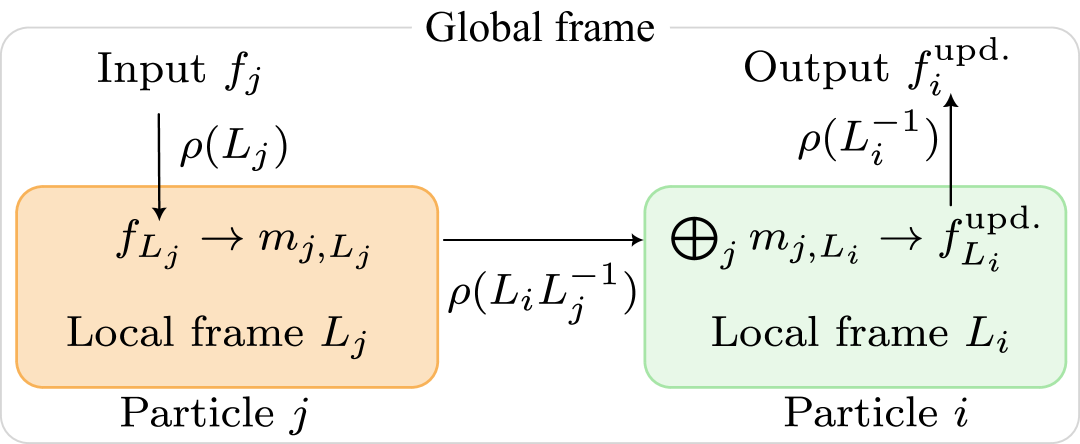
- 将全局四矢量变换到局部帧 x_L = L x,得到局部特征并可由任意骨干网络处理(如 Transformer、GNN)。
- 使用 rho(L_i L_j^{-1}) 在局部帧之间进行张量信息传递,传播洛伦兹协变信息(包括超越标量的张量表示)。
- 实现张量化的点积注意力,使用闵科夫斯基积来得到洛伦兹不变的注意力权重,兼容标准注意力后端,高效计算。
- 通过来自等变预测向量的极分解算法构建局部帧,确保在洛伦兹变换下 L -> L Λ^{-1} 且数值稳定。
- 通过展示非等变与数据增强基线作为 LLoCa 框架的特例,提供数据增强等价性。

实验结果
研究问题
- RQ1是否可以通过局部规范化将任务无关的骨干网络变为完全洛伦兹等变?
- RQ2局部规范化是否在 HEP 任务上实现与专用洛伦兹架构相当或更优的性能?
- RQ3与非等变基线和最先进的洛伦兹等变模型相比,LLoCa 的计算权衡(FLOPs、训练时间)如何?
- RQ4在不同的训练数据规模下,LLoCa 相对数据增强在数据效率和准确性方面有何差异?
- RQ5在 LLoCa 中张量消息表示对性能提升的贡献程度如何?
主要发现
- LLoCa 在多个模型上持续改进非等变骨干网络的喷注标记性能,有时可匹配甚至超过领域特定架构。
- 在 QFT 振幅回归任务中,LLoCa-Transformer 实现了接近最先进的性能,优于更昂贵的 SOTA 模型在 Z+ng 多重性上的表现。
- 张量化消息传递(如多向量/张量)在 LLoCa 中显著优于仅标量的消息。
- LLoCa 的额外开销适中(FLOPs 增长 10–30%;训练时间 +30–110%),但相比其他 SOTA 洛伦兹等变网络(如 L-GATr)训练更快、FLOPs 更少。
- 数据增强在数据极少时可能优于精确等变性,但在大规模数据情况下,LLoCa 的数据效率更高,体现其归纳偏差优势。
阅读本论文
在 Nubint 阅读器中打开原文,边读边就任意段落提问。
在 Nubint 中阅读本论文本解读由 AI 根据论文原文生成,引用前请核对原文。