
[论文解读] Low-noise quantum frequency conversion in a monolithic cavity with bulk periodically poled potassium titanyl phosphate
本论文提出一种单片式周期极化钾钛氧磷酸盐(ppKTP)谐振腔,用于实现低噪声量子频率转换,当将金刚石中氮空位中心发出的637 nm光子上转换至电信通信波段时,实现了72.3%的内部转换效率,噪声仅为110 kHz/nm。该方法利用无源、对准稳定的谐振腔实现泵浦激光的共振增强,仅使用市售标准激光器,显著降低了寄生噪声,相比现有最先进转换器性能更优。
Interfacing the different building blocks of a future large scale quantum network will demand efficient and noiseless frequency conversion of quantum light. Nitrogen-vacancy (NV) centers in diamond are a leading candidate to form the nodes of such a network. However, the performance of a suitable converter remains a bottleneck, with existing demonstrations severely limited by parasitic noise arising at the target telecom wavelength. Here, we demonstrate a new platform for efficient low-noise quantum frequency conversion based on a monolithic bulk ppKTP cavity and show its suitability for the conversion of 637 nm single photons from NV centers in diamond to telecommunication wavelengths. By resonantly enhancing the power of an off-the-shelf pump laser, we achieve an internal conversion efficiency of $(72.3\pm 0.4)\%$ while generating only $(110\pm 4) \mbox{ kHz/nm}$ noise at the target wavelength without the need for any active stabilization. This constitutes a 5-fold improvement in noise over existing state-of-the-art single-step converters at this wavelengths. We verify the almost ideal preservation of non-classical correlations by converting photons from a spontaneous parametric down-conversion source and moreover show the preservation of time-energy entanglement via Franson interferometry.
研究动机与目标
- 解决大规模量子网络中量子节点互联时量子频率转换器中寄生噪声这一关键瓶颈问题。
- 开发一种稳定、可扩展的平台,实现金刚石中氮空位中心发出的637 nm光子向电信波段的高效频率转换。
- 降低自发参量下转换和拉曼散射带来的噪声,这些噪声限制了现有单步转换器的性能。
- 通过实验验证转换过程中非经典关联的保持,证明该平台适用于量子网络。
- 通过单片式谐振腔设计消除对主动稳定系统的需求,实现系统的实际部署。
提出的方法
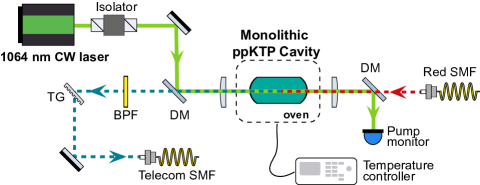
- 制备单片式块状周期极化钾钛氧磷酸盐(ppKTP)谐振腔,用于在1064 nm波长处共振增强泵浦激光功率。
- 谐振腔设计为被动稳定,无需主动反馈或稳定系统。
- 采用低成本市售3 W连续波1064 nm激光器作为泵浦源,通过谐振腔增强实现功率提升。
- 系统采用和频生成(SFG)技术,将637 nm输入光子转换至电信波段(1550 nm),利用ppKTP晶体中的相位匹配条件。
- 理论转换效率基于标准SFG公式建模,涉及泵浦功率、非线性系数、晶体长度及光束聚焦参数。
- 实验验证包括互相关测量和Franson干涉实验,以验证时间-能量纠缠及非经典关联的保持。
实验结果
研究问题
- RQ1单片式块状ppKTP谐振腔是否可在无需主动稳定的情况下实现高效率、低噪声的量子频率转换?
- RQ2在电信波段,基于块状ppKTP的转换器可实现多低的噪声水平(特别是寄生SPDC和拉曼散射)?
- RQ3在频率转换过程中,非经典关联(如时间-能量纠缠)的保持程度如何?
- RQ4市售标准激光器是否可在谐振腔结构中有效使用,以实现高内部转换效率?
- RQ5缺乏主动稳定是否会影响性能,系统是否仍能在量子干涉实验中保持高可见度?
主要发现
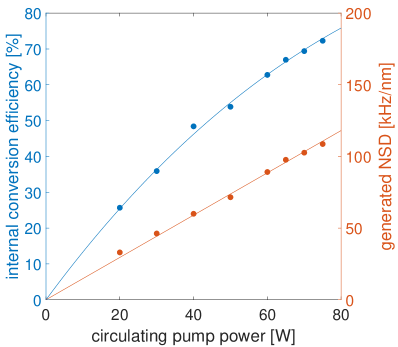
- 系统实现了(72.3 ± 0.4)%的内部转换效率,表明在单步频率转换过程中具有优异性能。
- 在目标电信波段测得的噪声水平为(110 ± 4)kHz/nm,相比现有最先进单步转换器实现5倍降低。
- Franson干涉实验测得修正条纹可见度高达(98.8 ± 0.2)%,证实转换后时间-能量纠缠得以保持。
- 链式贝尔不等式测试在N=4设置时显示15σ的违背,在N=5设置时显示16σ的违背,证实了真正的量子非定域性及纠缠的保持。
- 系统无需主动稳定,依靠单片式谐振腔设计在多次测量中保持相位稳定性。
- 测得的G(2)互相关函数在零延迟处呈现峰值,半高全宽(FWHM)为1.2 ns,表明光子对生成具有高保真度,且量子统计特性得以保持。
阅读本论文
在 Nubint 阅读器中打开原文,边读边就任意段落提问。
在 Nubint 中阅读本论文本解读由 AI 根据论文原文生成,引用前请核对原文。