
[论文解读] LZR: Identifying Unexpected Internet Services
论文揭示互联网服务在非标准端口广泛部署,许多对标准L7握手无响应,并引入LZR以高效识别和指纹化意外服务,实现快速、广泛的覆盖。
Internet-wide scanning is a commonly used research technique that has helped uncover real-world attacks, find cryptographic weaknesses, and understand both operator and miscreant behavior. Studies that employ scanning have largely assumed that services are hosted on their IANA-assigned ports, overlooking the study of services on unusual ports. In this work, we investigate where Internet services are deployed in practice and evaluate the security posture of services on unexpected ports. We show protocol deployment is more diffuse than previously believed and that protocols run on many additional ports beyond their primary IANA-assigned port. For example, only 3% of HTTP and 6% of TLS services run on ports 80 and 443, respectively. Services on non-standard ports are more likely to be insecure, which results in studies dramatically underestimating the security posture of Internet hosts. Building on our observations, we introduce LZR ("Laser"), a system that identifies 99% of identifiable unexpected services in five handshakes and dramatically reduces the time needed to perform application-layer scans on ports with few responsive expected services (e.g., 5500% speedup on 27017/MongoDB). We conclude with recommendations for future studies.
研究动机与目标
- 评估互联网服务在超出IANA分配的非预期端口上的部署情况。
- 评估部署在非标准端口上的服务的安全状况。
- 开发一种快速、可扩展的方法,在互联网范围扫描中识别并指纹化意外服务。
- 为未来的测量研究和开源工具提供建议。
提出的方法
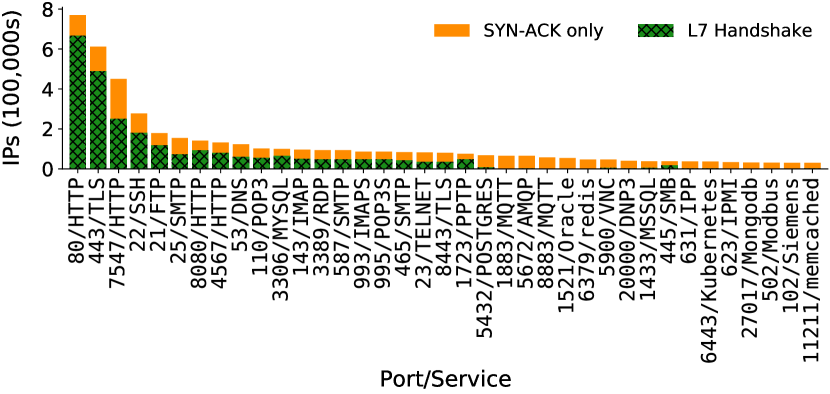
- 执行大规模互联网范围扫描,在37个常用端口和其他端口上比较L4 TCP响应性与应用层(L7)握手。
- 开发基于握手行为推断服务器状态(包括接收数据和确认数据)的TCP状态推断方法。
- 描述影响扫描结果的中间盒和防火墙保护(零窗口、连接回避、动态阻塞等)。
- 引入LZR(Laser)以过滤不响应的主机并以高效率识别意外服务(单个数据包指纹识别率88%;五次握手指纹识别率99%)。
- 分析未分配端口和已分配端口上意外服务的分布与安全性,包括物联网设备的参与。
实验结果
研究问题
- RQ1与IANA分配端口相比,非标准端口上的协议部署有多广泛?
- RQ2在意外端口上运行的服务相对于预期端口的安全状况如何?
- RQ3是否可以用一个快速、可扩展的系统以高准确性和低开销识别并指纹化意外的互联网服务?
- RQ4哪些保护措施(中间盒/防火墙)会影响TCP存活性和L7握手成功率,以及它们如何影响扫描?
主要发现
- 只有3.0%的HTTP和6.4%的TLS服务分别运行在80和443端口,揭示了高度分散的协议部署。
- 在37个常用端口上,最多高达96%的服务(按端口计)未完成预期的L7握手。
- 在常用端口上,平均16%的服务以及在不常用端口上40%的服务在SYN-ACK后未能确认数据,这归因于中间盒或保护措施。
- LZR可以用单个数据包指纹识别88%的可识别服务,用五次握手指纹识别99%的可识别的意外服务。
- 在27017/MongoDB端口上,LZR将扫描时间缩短55倍,同时识别出99.6%的MongoDB服务,并发现额外的23K个具有意外协议的主机。
- 非标准端口上的意外服务往往安全状况较弱,且常与物联网相关(例如,非标准端口上的TLS常与物联网设备相关)。
阅读本论文
在 Nubint 阅读器中打开原文,边读边就任意段落提问。
在 Nubint 中阅读本论文本解读由 AI 根据论文原文生成,引用前请核对原文。