
[论文解读] Machine learning-based network intrusion detection for big and imbalanced data using oversampling, stacking feature embedding and feature extraction
本文提出了一种基于机器学习的网络入侵检测系统,结合随机过采样、基于聚类的堆叠特征嵌入以及基于主成分分析(PCA)的降维技术,以解决大规模网络数据集中数据不平衡和高维特征的问题。该模型在CIC-IDS-2017数据集上实现了高达99.99%的准确率,在UNSW-NB15数据集上达到99.95%,相较于先前方法在基准数据集上显著提升了1.52%至22.19%。
Cybersecurity has emerged as a critical global concern. Intrusion Detection Systems (IDS) play a critical role in protecting interconnected networks by detecting malicious actors and activities. Machine Learning (ML)-based behavior analysis within the IDS has considerable potential for detecting dynamic cyber threats, identifying abnormalities, and identifying malicious conduct within the network. However, as the number of data grows, dimension reduction becomes an increasingly difficult task when training ML models. Addressing this, our paper introduces a novel ML-based network intrusion detection model that uses Random Oversampling (RO) to address data imbalance and Stacking Feature Embedding based on clustering results, as well as Principal Component Analysis (PCA) for dimension reduction and is specifically designed for large and imbalanced datasets. This model's performance is carefully evaluated using three cutting-edge benchmark datasets: UNSW-NB15, CIC-IDS-2017, and CIC-IDS-2018. On the UNSW-NB15 dataset, our trials show that the RF and ET models achieve accuracy rates of 99.59% and 99.95%, respectively. Furthermore, using the CIC-IDS2017 dataset, DT, RF, and ET models reach 99.99% accuracy, while DT and RF models obtain 99.94% accuracy on CIC-IDS2018. These performance results continuously outperform the state-of-art, indicating significant progress in the field of network intrusion detection. This achievement demonstrates the efficacy of the suggested methodology, which can be used practically to accurately monitor and identify network traffic intrusions, thereby blocking possible threats.
研究动机与目标
- 解决网络入侵检测中数据不平衡的挑战,即恶意流量相较于正常流量显著稀少。
- 在保留判别性特征的前提下,降低高容量网络流量数据的维度,以提升模型效率与性能。
- 通过整合基于聚类结果的堆叠特征嵌入与传统机器学习模型,提升检测准确率。
- 在现代、大规模且不平衡的基准数据集(如UNSW-NB15、CIC-IDS-2017和CIC-IDS-2018)上评估所提出的模型。
- 为现实世界中的入侵检测系统提供一种鲁棒、可扩展且高准确率的解决方案,同时减少误报。
提出的方法
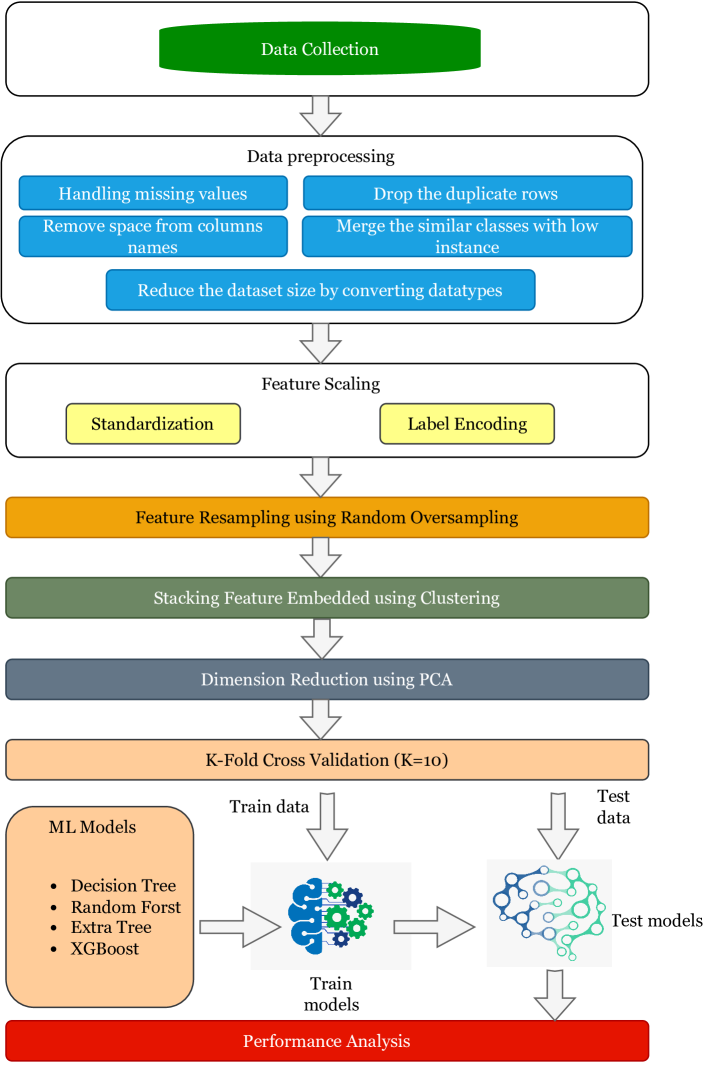
- 应用随机过采样(RO)以平衡少数类(入侵流量),减轻模型训练中的偏差。
- 采用基于聚类的特征嵌入技术,生成输入特征的高层表示,捕捉数据中的复杂模式与关系。
- 通过组合多个基于聚类的表示,构建堆叠特征嵌入,以丰富特征空间并提升模型泛化能力。
- 在嵌入后应用主成分分析(PCA),以降低维度并消除冗余或噪声特征。
- 在预处理后的数据上训练集成分类器——决策树(DT)、随机森林(RF)、极端梯度提升树(ET)和XGBoost(XGB),用于二分类与多标签分类任务。
- 在三个真实世界基准数据集(UNSW-NB15、CIC-IDS-2017和CIC-IDS-2018)上端到端评估该处理流程。
实验结果
研究问题
- RQ1随机过采样是否能有效缓解网络入侵检测中因类别不平衡导致的性能下降?
- RQ2与标准特征表示相比,基于聚类的堆叠特征嵌入在多大程度上提升了检测准确率?
- RQ3PCA在降低维度的同时,多大程度上保留了入侵检测的关键判别性信息?
- RQ4过采样、特征嵌入与降维技术的集成是否显著优于现有最先进模型?
- RQ5所提出的模型是否能在多样化、大规模且不平衡的网络流量数据集上实现良好泛化?
主要发现
- 在UNSW-NB15数据集上,随机森林(RF)和极端梯度提升树(ET)模型的准确率分别达到99.59%和99.95%,显著优于先前方法。
- 在CIC-IDS-2017数据集上,DT、RF和ET模型的准确率均达到99.99%,表现出近乎完美的检测性能。
- 在CIC-IDS-2018数据集上,DT和RF模型的准确率达到99.94%,相较于先前方法提升1.99%至8.44%。
- 与现有最先进方法相比,所提模型在UNSW-NB15数据集上准确率提升1.52%至22.19%,在CIC-IDS-2017数据集上提升0.12%至2.99%,在CIC-IDS-2018数据集上提升1.99%至8.44%。
- 特征嵌入与PCA的集成降低了计算复杂度,同时增强了模型在不同数据分布下的可解释性与鲁棒性。
- 该模型表现出较低的误报率,减轻了安全团队的负担,使其能集中关注高置信度威胁。
阅读本论文
在 Nubint 阅读器中打开原文,边读边就任意段落提问。
在 Nubint 中阅读本论文本解读由 AI 根据论文原文生成,引用前请核对原文。