
[论文解读] Machine Learning for Predicting Chaotic Systems
本文使用新的基准数据库 DeebLorenz 和 Dysts 数据集,评估了轻量级与重量级机器学习模型在预测混沌系统方面的表现,并引入了一种新型累积最大误差(CME)度量。研究发现,经过良好调优的简单模型和未经调优的基线模型通常优于复杂的深度学习架构,凸显了方法与数据匹配以及计算效率在混沌系统预测中的重要性。
Predicting chaotic dynamical systems is critical in many scientific fields, such as weather forecasting, but challenging due to the characteristic sensitive dependence on initial conditions. Traditional modeling approaches require extensive domain knowledge, often leading to a shift towards data-driven methods using machine learning. However, existing research provides inconclusive results on which machine learning methods are best suited for predicting chaotic systems. In this paper, we compare different lightweight and heavyweight machine learning architectures using extensive existing benchmark databases, as well as a newly introduced database that allows for uncertainty quantification in the benchmark results. In addition to state-of-the-art methods from the literature, we also present new advantageous variants of established methods. Hyperparameter tuning is adjusted based on computational cost, with more tuning allocated to less costly methods. Furthermore, we introduce the cumulative maximum error, a novel metric that combines desirable properties of traditional metrics and is tailored for chaotic systems. Our results show that well-tuned simple methods, as well as untuned baseline methods, often outperform state-of-the-art deep learning models, but their performance can vary significantly with different experimental setups. These findings highlight the importance of aligning prediction methods with data characteristics and caution against the indiscriminate use of overly complex models.
研究动机与目标
- 为解决文献中关于预测混沌系统最佳机器学习方法的共识缺失问题。
- 在多样化混沌系统上,对广泛范围的轻量级与重量级模型进行严格、可复现的基准测试。
- 提出一个新的数据集 DeebLorenz,每个系统包含 100 次重复实验,以支持不确定性量化和稳健的性能评估。
- 开发并应用一种新型误差度量——累积最大误差(CME),专为混沌动力学设计。
- 研究超参数调优、噪声、时间步长方案和模型架构对预测性能的影响。
提出的方法
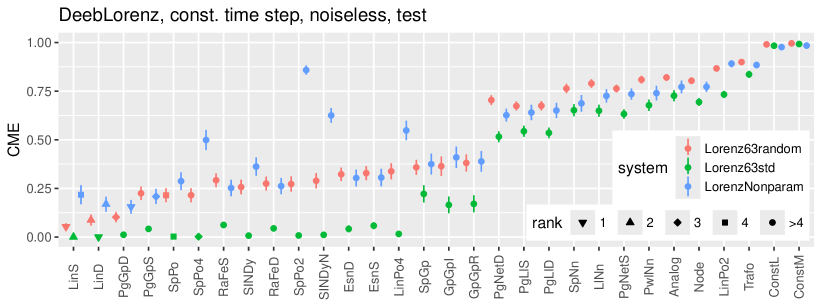
- 提出一个新的基准数据集 DeebLorenz,包含洛伦兹63系统的三种变体,每种系统有 100 次重复模拟,以增强鲁棒性和不确定性量化能力。
- 引入累积最大误差(CME)度量,结合传统度量的优点,并针对混沌发散的敏感性进行了优化。
- 基于计算成本指导超参数调优,为轻量级模型分配更多资源,为重量级模型分配更少资源。
- 在多种数据配置下,应用包含多项式拟合、高斯过程、回声网络计算和深度学习架构在内的 21 种多样化模型。
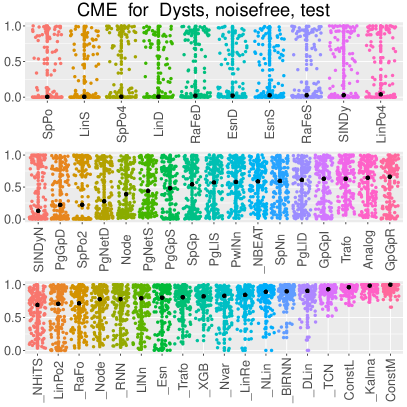
- 同时使用 Dysts 数据库和 DeebLorenz 数据集进行跨数据集比较,评估在不同噪声、时间步长和初始条件方案下的性能表现。
- 应用统计检验和排序分析,评估不同方法在各种实验条件下的差异性和稳健性。
实验结果
研究问题
- RQ1在多样化数据集和配置下,哪些机器学习模型在预测混沌系统方面始终优于其他模型?
- RQ2超参数调优对轻量级与重量级模型在混沌系统预测中的性能影响如何?
- RQ3噪声、固定与随机时间步长、观测方案在多大程度上影响模型泛化能力和误差度量?
- RQ4与传统度量相比,所提出的累积最大误差(CME)度量在捕捉混沌系统预测发散方面有多有效?
- RQ5在混沌动力学中,简单的未经调优模型(如多项式拟合或线性回归)能否优于复杂的深度学习模型?
主要发现
- 经过良好调优的轻量级模型(如多项式拟合和线性回归)在预测混沌系统方面通常优于最先进的深度学习模型。
- 未经调优的基线模型经常与复杂架构的性能相当甚至更优,尤其是在计算资源有限的情况下。
- 累积最大误差(CME)度量能有效捕捉混沌系统的发散特性,并在稳健性方面优于传统度量(如 sMAPE 或 RMSE)。
- 性能在不同实验设置间存在显著差异,噪声、时间步长方案和初始条件选择强烈影响模型排名。
- 超参数调优可提升部分模型的性能(尤其是具有大量可调参数的模型),但对更简单、更稳定的模型带来的收益递减。
- DeebLorenz 数据集支持可靠的不确定性量化,并揭示模型性能对数据特征和实验设计高度敏感。
阅读本论文
在 Nubint 阅读器中打开原文,边读边就任意段落提问。
在 Nubint 中阅读本论文本解读由 AI 根据论文原文生成,引用前请核对原文。