
[论文解读] Machine learning potentials for redox chemistry in solution
本工作表明,四代 HDNNP 机器学习势能够在水溶液中正确描述氧化还原化学过程,包括氧化态区分以及水中 Fe2+ 与 Fe3+ 之间的电子转移,与传统的二代势不同。
Machine learning potentials (MLPs) represent atomic interactions with quantum mechanical accuracy offering an efficient tool for atomistic simulations in many fields of science. However, most MLPs rely on local atomic energies without information about the global composition of the system. To date, this has prevented the application of MLPs to redox reactions in solution, which involve chemical species in different oxidation states and electron transfer between them. Here, we show that fourth-generation MLPs overcome this limitation and can provide a physically correct description of redox chemical reactions. For the example of ferrous (Fe$^{2+}$) and ferric (Fe$^{3+}$) ions in water we show that the correct oxidation states are obtained matching the number of chloride counter ions irrespective of their positions in the system. Moreover, we demonstrate that our method can describe electron-transfer processes between ferrous and ferric ions, paving the way to simulations of general redox chemistry in solution.
研究动机与目标
- 激发在溶液中用 ML 势模拟氧化还原反应的挑战。
- 评估4G-HDNNP 是否能够编码系统范围的 oxidation-state 信息,这是2G-HDNNP所缺乏的。
- 在多种盒子尺寸下对 FeCl2/FeCl3 在水中的2G与4G势进行基准测试。
- 展示在 Fe2Cl5 系统中电子转移建模的能力,并讨论转移性与局限性。
提出的方法
- 在水中 FeCl2 和 FeCl3 的 DFT 参考数据上训练并测试 2G-HDNNP 与 4G-HDNNP。
- 使用 Hirshfeld 电荷来识别氧化态并生成 4G-HDNNP 的训练目标。
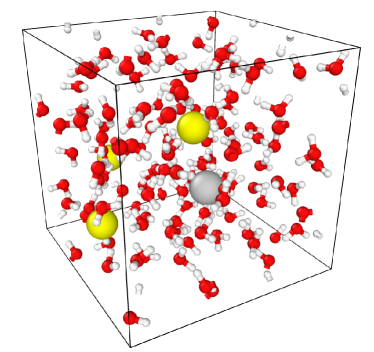
- 在小/中/大盒中进行分子动力学模拟,以探测溶剂化结构并验证氧化态。
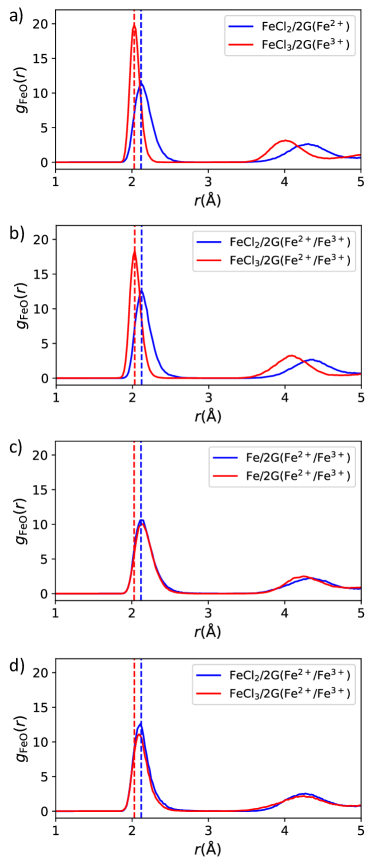
- 通过 Fe–O 径向分布函数和轨迹上的 Fe/Cl 电荷预测来评估溶剂化壳。
- 用两个 Fe 离子和五个 Cl 离子(Fe2Cl5)的体系来观察潜在的电子转移事件。
- 讨论4G与2G方法的计算成本及外推极限。
实验结果
研究问题
- RQ14G-HDNNP 能否在液态水中正确区分 Fe2+ 与 Fe3+ 的溶剂化结构?
- RQ2在混合氧化态数据上训练的 2G-HDNNP 是否无法再现特定氧化态的相互作用?
- RQ34G-HDNNP 是否能描述溶液中 Fe2+ 与 Fe3+ 之间的电子转移(Fe2Cl5)并维持系统总电荷?
- RQ4在探索更大化学空间时,4G-HDNNP 的局限性和外推边界是什么?
主要发现
- 当存在对离子时,2G-HDNNP 无法区分溶液中的氧化态,从而导致错误的溶剂化结构。
- 4G-HDNNP 能正确分配氧化态,并在不同盒子尺寸下再现 Fe2+ 与 Fe3+ 的正确 Fe–O 溶剂化壳。
- 在合并 FeCl2/FeCl3 数据上训练的4G-HDNNP 即使在 2G 失败的较大盒子中也能保持正确的溶剂化结构。
- 来自 4G-HDNNP 的 Hirshfeld 电荷与预期的 Fe2+/Fe3+ 电荷相符,证实了正确的电荷平衡。
- 在 Fe2Cl5 的模拟中,4G-HDNNP 显示出 Fe2+ 与 Fe3+ 之间的电子转移事件,与定性预期一致,尽管要完全定量外推需要扩展训练数据。
- 仅仅 RMSEs 不能保证物理正确性;2G 与 4G 可能具有相近的 RMSE,但在氧化还原行为上存在定性差异。
阅读本论文
在 Nubint 阅读器中打开原文,边读边就任意段落提问。
在 Nubint 中阅读本论文本解读由 AI 根据论文原文生成,引用前请核对原文。