
[论文解读] Magic123: One Image to High-Quality 3D Object Generation Using Both 2D and 3D Diffusion Priors
Magic123 将 2D 与 3D 扩散先验结合在一个两阶段自粗到细的流程中,以从单张图像生成高质量带纹理的三维网格,并在几何探索与开发之间提供可调的权衡。
We present Magic123, a two-stage coarse-to-fine approach for high-quality, textured 3D meshes generation from a single unposed image in the wild using both2D and 3D priors. In the first stage, we optimize a neural radiance field to produce a coarse geometry. In the second stage, we adopt a memory-efficient differentiable mesh representation to yield a high-resolution mesh with a visually appealing texture. In both stages, the 3D content is learned through reference view supervision and novel views guided by a combination of 2D and 3D diffusion priors. We introduce a single trade-off parameter between the 2D and 3D priors to control exploration (more imaginative) and exploitation (more precise) of the generated geometry. Additionally, we employ textual inversion and monocular depth regularization to encourage consistent appearances across views and to prevent degenerate solutions, respectively. Magic123 demonstrates a significant improvement over previous image-to-3D techniques, as validated through extensive experiments on synthetic benchmarks and diverse real-world images. Our code, models, and generated 3D assets are available at https://github.com/guochengqian/Magic123.
研究动机与目标
- 通过在野外场景中利用 2D 和 3D 扩散先验来推动单图像三维重建。
- 提出一个两阶段的粗到细管线,以生成高分辨率的几何和纹理。
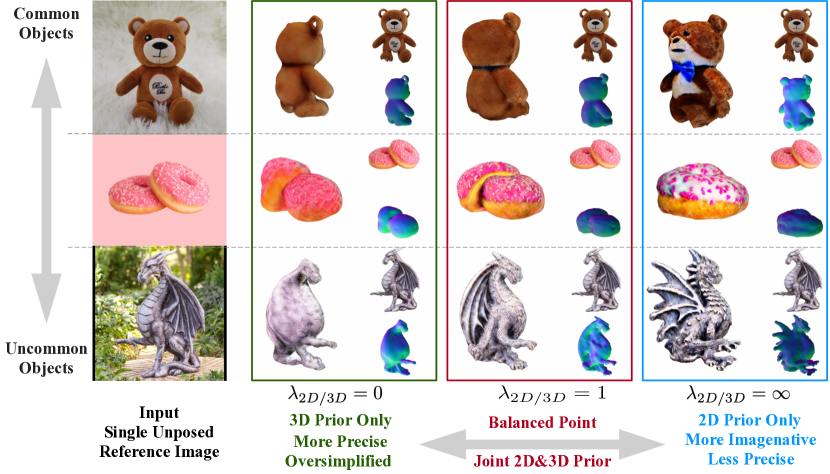
- 引入一个简单的权衡参数,在几何探索与开发之间取得平衡。
- 通过纹理反演和深度正则化实现纹理保留且视图一致的三维内容。
提出的方法
- 两阶段管道:粗略 NeRF 优化,随后进行内存高效的 DMTet 网格细化。
- 联合 2D 与 3D 扩散先验通过一个综合损失 L_g 指导新视图,该损失融合了 2D SDS 指引和一个 3D 视图条件先验。
- 单眼深度正则化和纹理反演以在各视图之间稳定几何和纹理。
- 在第二阶段使用纹理分解网格表示(DMTet)以实现高分辨率网格和纹理。
- 以前景分割和深度先验进行参考视图监督,以防止几何退化。
- 粗略阶段使用参考视图重建损失 L_rec 和新视图引导 L_g,配合深度 L_d 和法线平滑度 L_n;细阶段用 DMTet 替代 NeRF,但保持相同的引导框架。
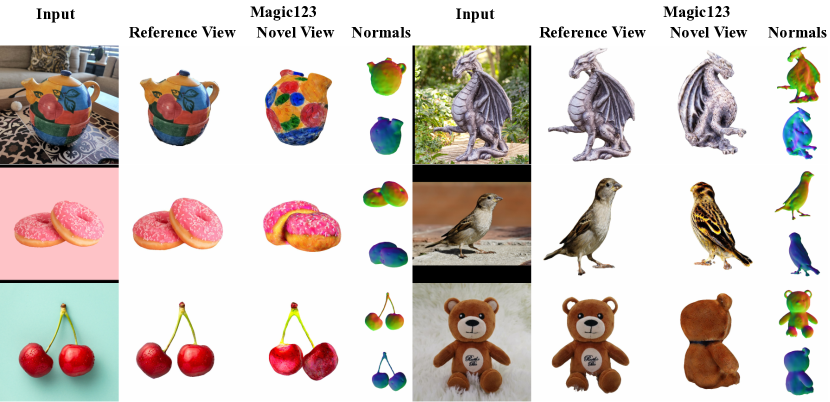
实验结果
研究问题
- RQ1是否可以使用单张非姿态图像来生成高保真、带纹理的三维网格,并在各视图之间保持一致的外观?
- RQ2与单独使用任一先验相比,结合 2D 和 3D 扩散先验是否能提升三维保真度和纹理质量?
- RQ3可调权衡先验之间的关系对多样化对象的几何探索与开发有何影响?
主要发现
- Magic123 在 NeRF4 和 RealFusion15 数据集上,在 CLIP-Similarity、PSNR 和 LPIPS 指标上达到最先进的结果。
- 在平衡权衡下同时使用 2D 和 3D 先验可获得高保真的几何和视觉上吸引人的纹理。
- 以 NeRF 开始、再使用 DMTet 的粗到细方法能够从单张图像实现更高分辨率、具纹理感的 3D 重建。
- 固定参数设定(lambda_2D/3D = 1.0, lambda_3D = 40)再加上阶段特定的调整,能在不进行逐对象调参的情况下提供强性能。
- 消融研究表明仅依赖 2D 先验会导致 Janus 式几何;仅依赖 3D 先验会限制细节;联合先验并采用平衡权重可实现鲁棒结果。
阅读本论文
在 Nubint 阅读器中打开原文,边读边就任意段落提问。
在 Nubint 中阅读本论文本解读由 AI 根据论文原文生成,引用前请核对原文。