
[论文解读] MaGS: Reconstructing and Simulating Dynamic 3D Objects with Mesh-adsorbed Gaussian Splatting
MaGS 将三维重建与动态对象仿真统一起来:通过在变形网格上放置3D高斯分布并学习相对变形场,在变形过程中使高斯悬浮在网格之上,从而实现高质量渲染和逼真的运动。
3D reconstruction and simulation, although interrelated, have distinct objectives: reconstruction requires a flexible 3D representation that can adapt to diverse scenes, while simulation needs a structured representation to model motion principles effectively. This paper introduces the Mesh-adsorbed Gaussian Splatting (MaGS) method to address this challenge. MaGS constrains 3D Gaussians to roam near the mesh, creating a mutually adsorbed mesh-Gaussian 3D representation. Such representation harnesses both the rendering flexibility of 3D Gaussians and the structured property of meshes. To achieve this, we introduce RMD-Net, a network that learns motion priors from video data to refine mesh deformations, alongside RGD-Net, which models the relative displacement between the mesh and Gaussians to enhance rendering fidelity under mesh constraints. To generalize to novel, user-defined deformations beyond input video without reliance on temporal data, we propose MPE-Net, which leverages inherent mesh information to bootstrap RMD-Net and RGD-Net. Due to the universality of meshes, MaGS is compatible with various deformation priors such as ARAP, SMPL, and soft physics simulation. Extensive experiments on the D-NeRF, DG-Mesh, and PeopleSnapshot datasets demonstrate that MaGS achieves state-of-the-art performance in both reconstruction and simulation.
研究动机与目标
- 提出一个用于动态3D重建与仿真统一方法,既不牺牲渲染质量,也不妥协变形真实感。
- 提出一种网格吸附高斯表示,将高斯散布的灵活性与网格一致性相结合。
- 引入可学习的相对变形场(RDF)来建模网格与高斯之间的相对运动。
- 结合基于 ARAP 的网格变形与 RDF,以实现真实且可控的动态效果。
- 联合优化网格、高斯分布和 RDF,以提升重建精度和变形真实感。
提出的方法
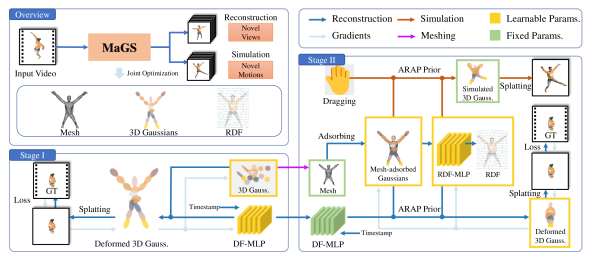
- 提出 Mesh-adsorbed Gaussian Splatting(MaGS),将高斯约束为悬浮在网格表面以实现混合表示。
- 阶段 I 使用变形场 MLP(DF-MLP)估计粗糙的变形场,以渲染帧并通过基于深度的高斯渲染与 Marching Cubes 获得粗糙网格。
- 阶段 II 将高斯吸附到网格上,并使用 RDF-MLP 计算相对变形场,使高斯可以悬浮并随网格变形。
- 扩展 ARAP 先验以捕捉变形过程中的非刚性、每个高斯的运动。
- 使用泊松圆盘采样来放置变形控制点并应用 ARAP 以确保局部刚性,同时允许 RDF 捕捉更细的非刚性运动。
- 通过 3D 高斯散布实现可微渲染,以端到端优化高斯、网格和 RDF。
- 通过拖动网格并通过基于 RDF 的调整改进高斯位置,提供用户交互式仿真。
实验结果
研究问题
- RQ1混合网格吸附高斯表示是否能够同时支持基于单目视频的高精度三维重建与真实的动态变形?
- RQ2可学习的相对变形场(RDF)是否在单个高斯的运动建模上超越基于 ARAP 的网格变形?
- RQ3网格、高斯分布和 RDF 的联合优化与固定网格–高斯锚定在渲染质量与变形可信度方面的比较?
- RQ4该框架是否能够在保持纹理和结构的前提下,支持由用户交互驱动的变形?
- RQ5在动态场景基准(D-NeRF、NeRF-DS)上,使用 MaGS 相较于现有方法的定量提升是多少?
主要发现
- MaGS 在渲染精度和变形真实感方面高于以往的网格-高斯方法,在 D-NeRF 和 NeRF-DS 上有所证明。
- 网格、高斯和 RDF 的联合优化可减少伪影,提升 PSNR/SSIM 指标,同时在评估序列上降低 LPIPS。
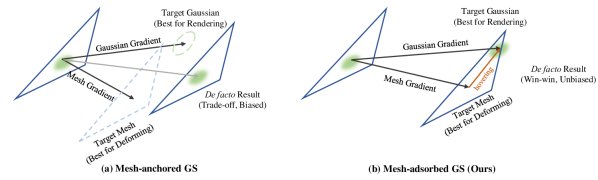
- 允许高斯在网格上悬浮并学习每个高斯的相对变形,相比固定网格锚定的表示获得更好的渲染保真度。
- 消融研究表明去除 RDF 或取消悬浮都会降低性能,其中 RDF 对渲染质量的影响更大。
阅读本论文
在 Nubint 阅读器中打开原文,边读边就任意段落提问。
在 Nubint 中阅读本论文本解读由 AI 根据论文原文生成,引用前请核对原文。