
[论文解读] Make-It-3D: High-Fidelity 3D Creation from A Single Image with Diffusion Prior
Make-It-3D 通过将二维扩散模型作为三维感知先验,在两阶段的 NeRF 到纹理点云管线中利用单图像生成高保真三维内容,在新视角下实现忠实几何和逼真纹理。
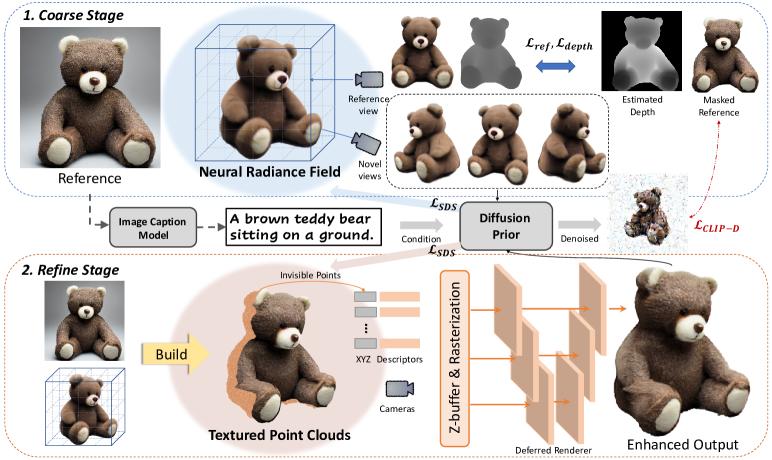
In this work, we investigate the problem of creating high-fidelity 3D content from only a single image. This is inherently challenging: it essentially involves estimating the underlying 3D geometry while simultaneously hallucinating unseen textures. To address this challenge, we leverage prior knowledge from a well-trained 2D diffusion model to act as 3D-aware supervision for 3D creation. Our approach, Make-It-3D, employs a two-stage optimization pipeline: the first stage optimizes a neural radiance field by incorporating constraints from the reference image at the frontal view and diffusion prior at novel views; the second stage transforms the coarse model into textured point clouds and further elevates the realism with diffusion prior while leveraging the high-quality textures from the reference image. Extensive experiments demonstrate that our method outperforms prior works by a large margin, resulting in faithful reconstructions and impressive visual quality. Our method presents the first attempt to achieve high-quality 3D creation from a single image for general objects and enables various applications such as text-to-3D creation and texture editing.
研究动机与目标
- 使从单图像对任意对象进行高质量三维重建成为可能,促进三维内容创作的普及与可及性。
提出的方法
- 使用扩散先验的两阶段框架用于三维感知监督。
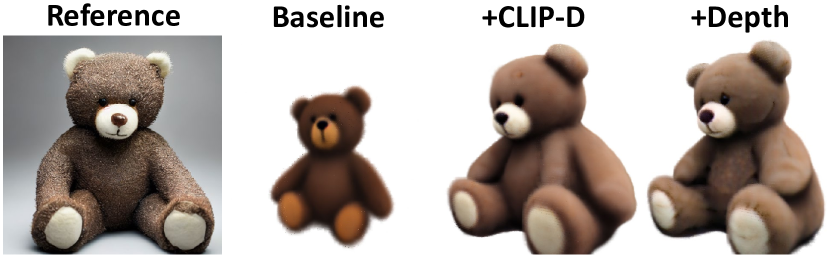
- 阶段1:在参考视图监督、SDS 损失、CLIP-D 损失和深度先验下进行粗糙的 NeRF 优化。
- 阶段2:转换为纹理点云,投影参考纹理,并通过可学习的延迟渲染器结合扩散先验对不可见纹理进行 refined。
实验结果
研究问题
- RQ1是否能够仅从单图像为任意对象利用扩散先验创建高保真三维内容?
- RQ2如何将扩散先验整合以强制执行参考视图保真度与新视角的可 plausibility?
- RQ3两阶段的 NeRF 到纹理点云管线是否在几何和纹理质量上超过先前的单阶段方法?
主要发现
- 在几何和纹理质量方面超越先前工作,覆盖 DTU 数据集和一个新的包含 400 张图像的基准数据集。
- 使用扩散先验的粗糙 NeRF 能得到合理的几何与忠实的参考视图渲染。
- 通过纹理点云和扩散先验进行纹理细化显著提升了不可见区域的纹理保真度。
- 该方法能够从单图像实现 360° 重建,并支持文本到三维创建与纹理编辑等应用。
- 在所测试的数据集上,该方法在 LPIPS、情境距离和基于 CLIP 的相似度等指标上达到或接近最先进水平。
阅读本论文
在 Nubint 阅读器中打开原文,边读边就任意段落提问。
在 Nubint 中阅读本论文本解读由 AI 根据论文原文生成,引用前请核对原文。