
[论文解读] ManyDG: Many-domain Generalization for Healthcare Applications
该论文提出了一种名为 ManyDG 的新型领域泛化方法,将每位患者视为独立的领域,以解决医疗人工智能中的患者特异性协变量问题。通过使用相互重建和正交投影,将患者特异性特征与标签不变表示分离,ManyDG 在多种设置下实现了最先进性能,包括在 MIMIC 药物推荐任务中实现 3.7% 的 Jaccard 分数提升,即使在低数据量和持续学习设置下也表现优异。
The vast amount of health data has been continuously collected for each patient, providing opportunities to support diverse healthcare predictive tasks such as seizure detection and hospitalization prediction. Existing models are mostly trained on other patients data and evaluated on new patients. Many of them might suffer from poor generalizability. One key reason can be overfitting due to the unique information related to patient identities and their data collection environments, referred to as patient covariates in the paper. These patient covariates usually do not contribute to predicting the targets but are often difficult to remove. As a result, they can bias the model training process and impede generalization. In healthcare applications, most existing domain generalization methods assume a small number of domains. In this paper, considering the diversity of patient covariates, we propose a new setting by treating each patient as a separate domain (leading to many domains). We develop a new domain generalization method ManyDG, that can scale to such many-domain problems. Our method identifies the patient domain covariates by mutual reconstruction and removes them via an orthogonal projection step. Extensive experiments show that ManyDG can boost the generalization performance on multiple real-world healthcare tasks (e.g., 3.7% Jaccard improvements on MIMIC drug recommendation) and support realistic but challenging settings such as insufficient data and continuous learning.
研究动机与目标
- 为解决由数据采集环境和身份等患者特异性协变量导致的医疗 AI 模型泛化能力差的问题。
- 提出一种新的多领域泛化设置,将每位患者视为独立领域,实现可扩展且真实的泛化。
- 开发一种方法,显式去除患者特异性特征,同时保留标签不变表示,以提升泛化能力。
- 在真实临床场景下评估该方法,包括有限标注数据和持续学习场景。
提出的方法
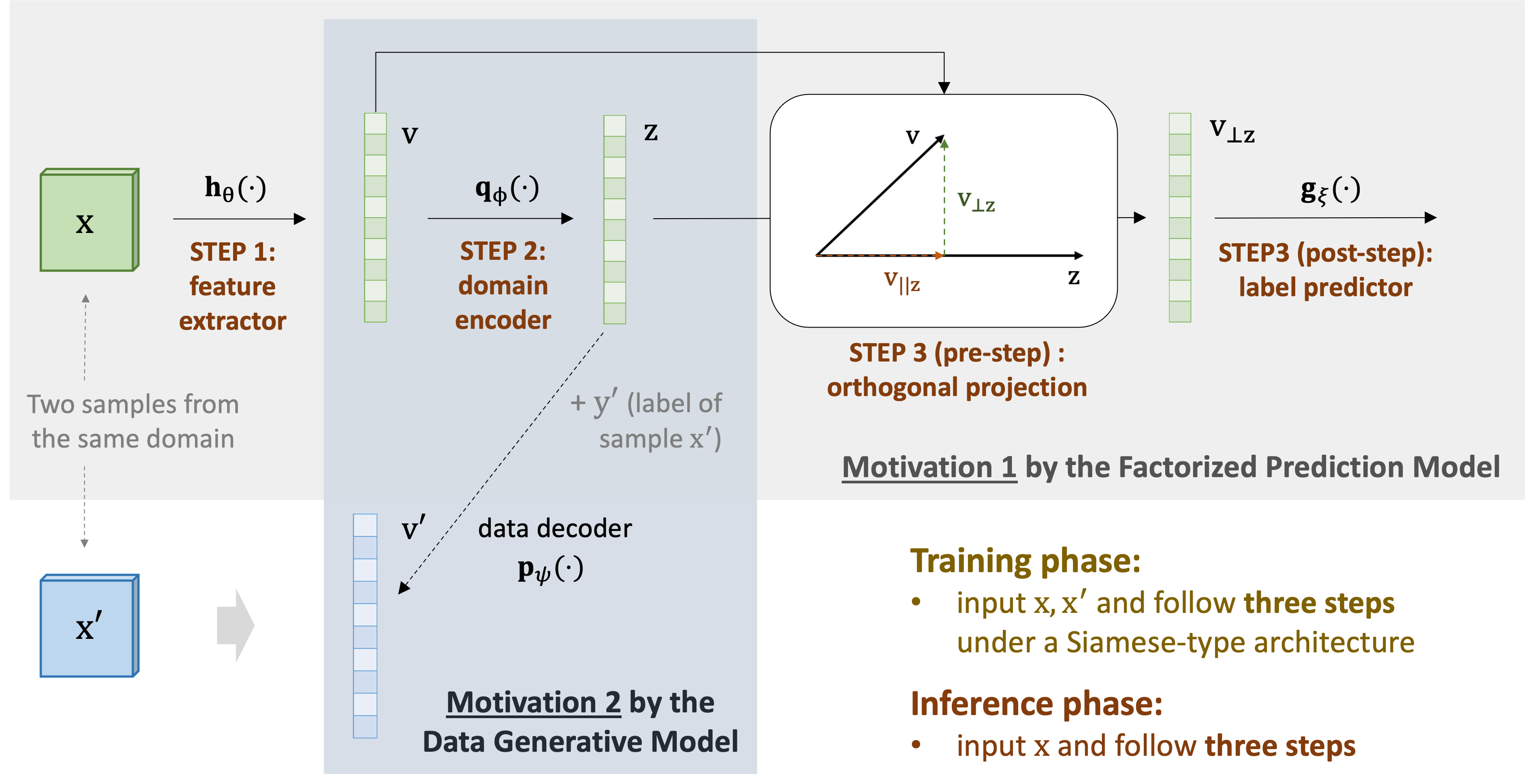
- 该方法采用类孪生网络架构,在同一患者的成对样本上进行训练,实现在患者特异性数据上的联合优化。
- 采用相互重建方法,从独立的领域(z)和标签(u)表示中重建输入特征向量,确保不同视图之间的一致性。
- 应用正交投影以强制领域(z)和标签(u)表示之间的正交性,促进特征解耦。
- 模型通过四种损失组件进行训练:标签预测的监督损失、重建损失、领域相似性损失(最大化同一患者内部 z 的相似性)以及正交性损失。
- 通过因子化解耦预测模型实现该方法,为领域和标签信息分别设置独立编码器,支持端到端训练。
- 该方法在四个真实世界医疗数据集上进行了评估,涵盖多种任务,包括癫痫检测、睡眠分期、药物推荐和再入院预测。
实验结果
研究问题
- RQ1将每位患者视为独立领域是否能提升医疗应用中的模型泛化能力?
- RQ2相互重建和正交投影在从标签不变表示中解耦患者特异性协变量方面有多有效?
- RQ3在临床环境中常见的低数据量和持续学习场景下,该方法是否具备良好的泛化能力?
- RQ4与现有领域泛化基线相比,该方法在性能和鲁棒性方面表现如何?
主要发现
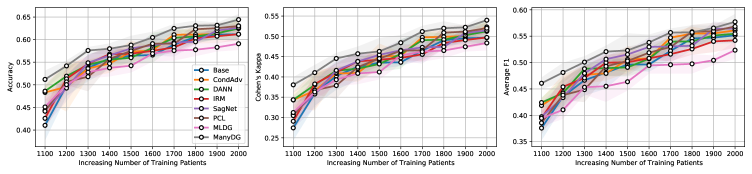
- 在 MIMIC 药物推荐基准上,ManyDG 相较于最佳基线实现了 3.7% 的 Jaccard 分数提升。
- 在癫痫检测任务中,ManyDG 达到 0.6754 的准确率(±0.0079),优于 SimD1(0.5954)和 SimD2(0.6499)。
- 在睡眠分期任务中,ManyDG 达到 0.9055 的准确率(±0.0054),超过 SimD1(0.8862)和 SimD2(0.9017)。
- 在开放 EHR 药物推荐任务中,ManyDG 实现了 0.5175 的 Jaccard 分数(±0.0130),显著高于 SimD1(0.4894)和 SimD2(0.4901)。
- 该方法在所有评估任务中均表现出一致的性能提升,包括再入院预测和睡眠分期任务,无论在标准设置还是挑战性设置下均表现优异。
- 消融研究显示,由于损失目标更合理地缩放,使用余弦相似度进行重建和领域相似性计算的 SimD2 表现优于使用 MSE 的 SimD1。
阅读本论文
在 Nubint 阅读器中打开原文,边读边就任意段落提问。
在 Nubint 中阅读本论文本解读由 AI 根据论文原文生成,引用前请核对原文。