
[论文解读] Mapping the Design Space of Interactions in Human-AI Text Co-creation Tasks
本文通过将交互模式与任务复杂性结合,映射人机文本共创任务的光谱,主张重点关注迭代性、相互依赖的创造性任务。
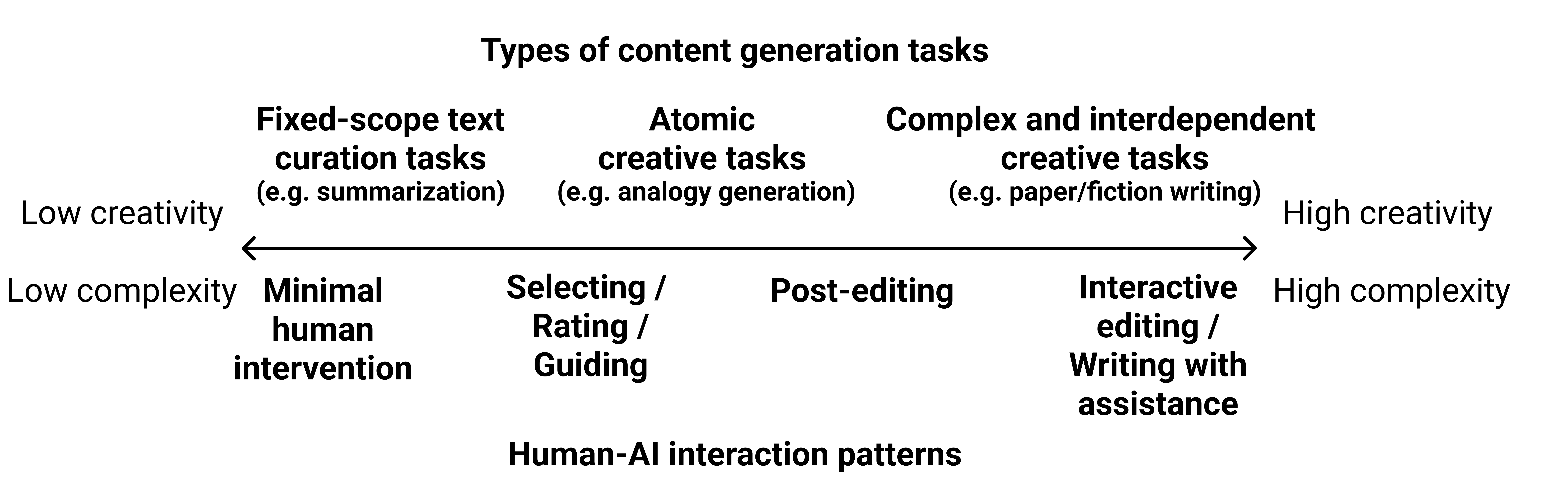
Large Language Models (LLMs) have demonstrated impressive text generation capabilities, prompting us to reconsider the future of human-AI co-creation and how humans interact with LLMs. In this paper, we present a spectrum of content generation tasks and their corresponding human-AI interaction patterns. These tasks include: 1) fixed-scope content curation tasks with minimal human-AI interactions, 2) independent creative tasks with precise human-AI interactions, and 3) complex and interdependent creative tasks with iterative human-AI interactions. We encourage the generative AI and HCI research communities to focus on the more complex and interdependent tasks, which require greater levels of human involvement.
研究动机与目标
- 综合以往工作,将人机交互模式映射到文本型共创任务的谱系。
- 从最小到迭代的创造性复杂性,描述三种任务类别。
- 推动将研究重点放在需要更深入人类参与的复杂、相互依赖的任务。
提出的方法
- 采用 Cheng 等人(2022)的五种交互类型:引导模型输出、选择或评定模型输出、后编辑、交互编辑,以及在模型帮助下写作。
- 定义一组任务谱:固定范围的内容策划、原子级创造任务,以及复杂的相互依赖创造任务。
- 将交互分类映射到任务谱,并讨论谱上每个点的需求与挑战。
- 回顾关于大语言模型能力、创造力和人机循环评估的相关文献,以支撑设计空间。
- 概述未来方向,包括评估挑战和领域知识的整合。
实验结果
研究问题
- RQ1如何用复杂性和创造性来刻画人机文本共创任务的光谱?
- RQ2对每个任务复杂性水平,哪些交互模式最为有效?
- RQ3在使LLM具备迭代性、相互依赖的创造性任务的设计方向有哪些?
- RQ4在原子级与复杂创造性任务的质量评估方面,仍存在哪些挑战?
主要发现
- LLMs 能处理固定范围的内容策划任务,几乎无需人类干预,即可实现高质量的语言输出。
- 原子级创造任务需要精确的人机交互,包括提示、示例指导、选择和后编辑,以确保质量与安全。
- 复杂且相互依赖的创造任务受益于迭代的人机交互,以及在各轮之间对指导、选择和后编辑的仔细排序。
- 所提出的映射建议将未来工作聚焦于更复杂的任务,并开发超越单一参考基准的评估方法。
- 当前的工具设计常常只提供单一的交互范式(引导输出),需要在交互选择/编辑方面发挥更主动的作用。
- 评估存在挑战,需要任务特定的指令、领域专长,甚至可能需要社区化的方法。
阅读本论文
在 Nubint 阅读器中打开原文,边读边就任意段落提问。
在 Nubint 中阅读本论文本解读由 AI 根据论文原文生成,引用前请核对原文。