
[论文解读] Markerless Motion Capture and Biomechanical Analysis Pipeline
本文提出了一种无需标记的运动捕捉与生物力学分析流程,采用基于深度学习的人体姿态估计技术,结合密集且具有生物力学基础的关键点集,利用隐式神经表示实现平滑轨迹重建,并通过双层优化实现逆向运动学。该方法在无需站立校准试验的情况下,实现了关节运动学估计的高精度——与金标准步态测量结果的误差在10 mm以内,从而可在临床康复环境中实现快速、可靠的生物力学评估。
Markerless motion capture using computer vision and human pose estimation (HPE) has the potential to expand access to precise movement analysis. This could greatly benefit rehabilitation by enabling more accurate tracking of outcomes and providing more sensitive tools for research. There are numerous steps between obtaining videos to extracting accurate biomechanical results and limited research to guide many critical design decisions in these pipelines. In this work, we analyze several of these steps including the algorithm used to detect keypoints and the keypoint set, the approach to reconstructing trajectories for biomechanical inverse kinematics and optimizing the IK process. Several features we find important are: 1) using a recent algorithm trained on many datasets that produces a dense set of biomechanically-motivated keypoints, 2) using an implicit representation to reconstruct smooth, anatomically constrained marker trajectories for IK, 3) iteratively optimizing the biomechanical model to match the dense markers, 4) appropriate regularization of the IK process. Our pipeline makes it easy to obtain accurate biomechanical estimates of movement in a rehabilitation hospital.
研究动机与目标
- 开发一种稳健、可临床部署的无标记运动捕捉与生物力学分析流程,适用于康复场景。
- 通过利用从多数据集训练中获得的密集且生物力学一致的关键点集,提升关节运动学估计的精度。
- 通过将双层优化整合到逆向运动学过程中,消除对站立校准试验的需求。
- 通过使用隐式神经表示进行3D关键点重建,提升轨迹的平滑性与解剖学合理性。
- 实现在每名受试者会话时间少于10分钟的快速、可重复的步态分析,适用于多样化的患者群体。
提出的方法
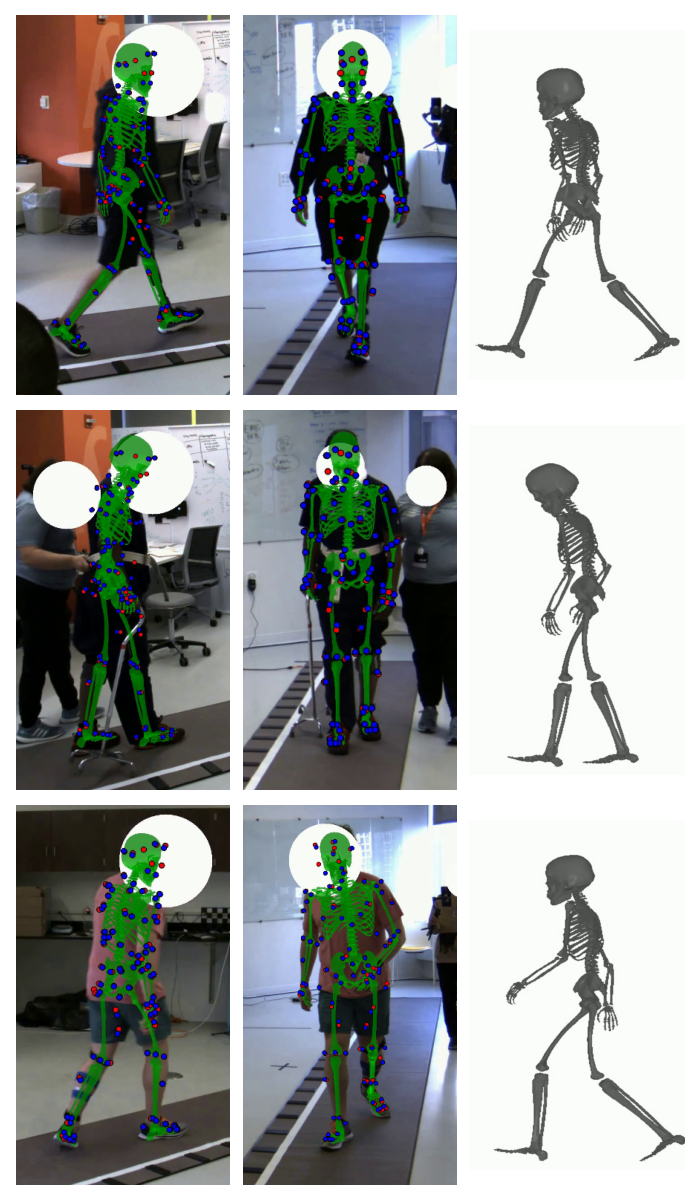
- 利用MeTraBs-ACAE(一种多数据集神经网络),从单张图像中生成具有生物力学一致空间关系的2D与3D关键点估计。
- 采用隐式神经表示(将时间映射到3D位置的神经网络)从噪声较大的HPE输出中重建平滑且受解剖学约束的3D轨迹。
- 应用双层优化,同时调整生物力学模型的缩放参数并求解逆向运动学,无需单独的站立校准试验。
- 通过迭代优化提升IK过程的超参数与正则化项,以增强模型拟合度与稳定性。
- 利用HPE模型输出的置信度估计,加权关键点在轨迹重建与IK拟合中的贡献。
- 整合来自多个校准且同步的摄像机的数据,以实现鲁棒的3D重建并减少遮挡引起的误差。
实验结果
研究问题
- RQ1与传统三角测量方法相比,使用隐式神经表示进行3D轨迹重建是否能提升无标记运动捕捉的精度与平滑度?
- RQ2使用从多数据集训练中获得的密集、生物力学基础关键点集,是否在逆向运动学精度上优于标准的25关键点HPE模型?
- RQ3双层优化是否能够消除对站立校准试验的需求,同时保持生物力学模型缩放的高精度?
- RQ4该流程在包含步态障碍患者及辅助装置使用者的多样化患者群体中,临床环境下的表现如何?
- RQ5与金标准系统相比,该方法在多大程度上能保持步态参数(如步长与步宽)的准确性?
主要发现
- 该流程在步态参数估计方面与GaitRite测量结果的误差在10 mm以内,表现出高空间保真度。
- 使用MeTraBs-ACAE生成的密集关键点集显著提升了逆向运动学估计的精度,优于标准25关键点HPE模型。
- 双层优化使生物力学模型缩放达到高精度,且无需单独的站立校准试验,从而简化了临床工作流程。
- 隐式轨迹重建生成了平滑且解剖学上合理的3D标记轨迹,降低了噪声并提升了IK收敛性。
- 该方法可在每名受试者会话时间少于10分钟内完成可靠步态分析,即使在存在步态障碍或使用助行工具的患者中亦然。
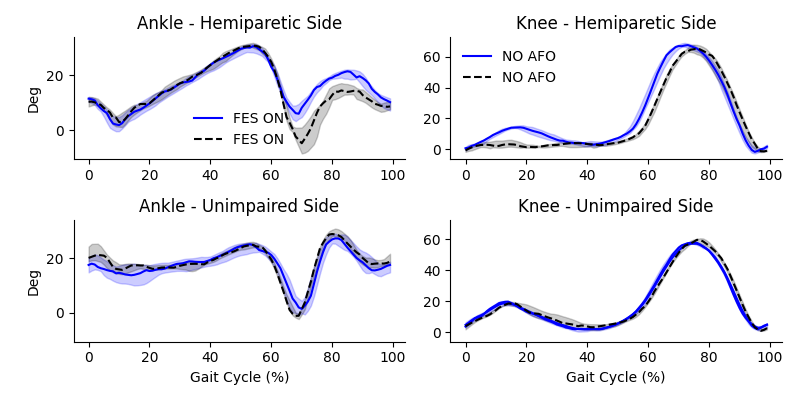
- 该方法能够检测到临床上相关的改变,如支具使用或功能性电刺激的影响,表明对运动变化具有高度敏感性。
阅读本论文
在 Nubint 阅读器中打开原文,边读边就任意段落提问。
在 Nubint 中阅读本论文本解读由 AI 根据论文原文生成,引用前请核对原文。