
[论文解读] Markerless Multi-view 3D Human Pose Estimation: a survey
本综述对无标记多视角3D人体姿态估计进行了全面分析,回顾了方法论、遮挡和数据稀缺等挑战,以及多模态学习和时序一致性等策略。研究指出,目前尚无任何方法能完全解决所有挑战,凸显了在低监督、主动学习和高效推理技术方面进一步研究的必要性。
3D human pose estimation involves reconstructing the human skeleton by detecting the body joints. Accurate and efficient solutions are required for several real-world applications including animation, human-robot interaction, surveillance, and sports. However, challenges such as occlusions, 2D pose mismatches, random camera perspectives, and limited 3D labelled data have been hampering the models' performance and limiting their deployment in real-world scenarios. The higher availability of cameras has led researchers to explore multi-view solutions to take advantage of the different perspectives to reconstruct the pose. Most existing reviews have mainly focused on monocular 3D human pose estimation, so a comprehensive survey on multi-view approaches has been missing since 2012. According to the reviewed articles, the majority of the existing methods are fully-supervised approaches based on geometric constraints, which are often limited by 2D pose mismatches. To mitigate this, researchers have proposed incorporating temporal consistency or depth information. Alternatively, working directly with 3D features has been shown to completely overcome this issue, albeit at the cost of increased computational complexity. Additionally, models with lower levels of supervision have been identified to help address challenges such as annotated data scarcity and generalisation to new setups. Therefore, no method currently addresses all challenges associated with 3D pose reconstruction, and a trade-off between complexity and performance exists. Further research is needed to develop approaches capable of quickly inferring a highly accurate 3D pose with bearable computation cost. Techniques such as active learning, low-supervision methods, temporal consistency, view selection, depth information estimation, and multi-modal approaches are strategies to consider when developing a new method for this task.
研究动机与目标
- 提供无标记多视角3D人体姿态估计领域最先进方法的系统性概述。
- 分析用于解决遮挡、视角关联和3D标注数据有限等关键挑战的策略。
- 评估不同应用场景下模型复杂度、性能与计算成本之间的权衡。
- 识别开放的研究空白,并提出有前景的未来研究方向,包括自监督学习和多模态融合。
- 在基准数据集上比较性能,并指出在罕见姿态或拥挤场景下泛化能力和鲁棒性的局限性。
提出的方法
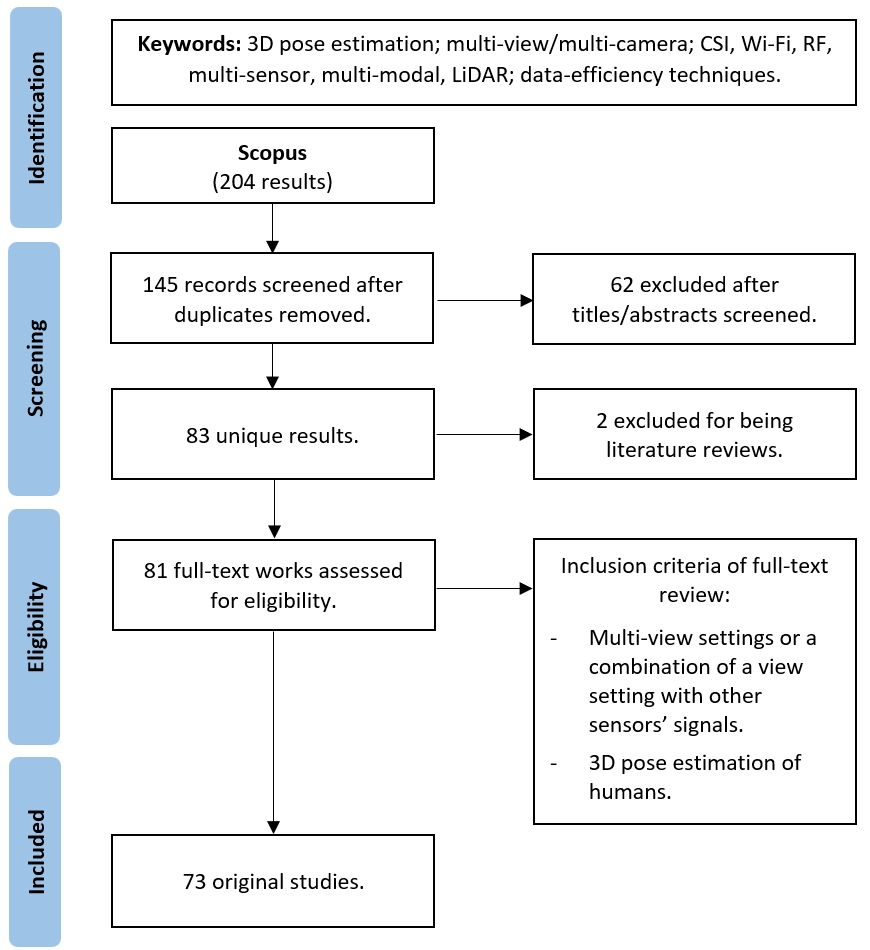
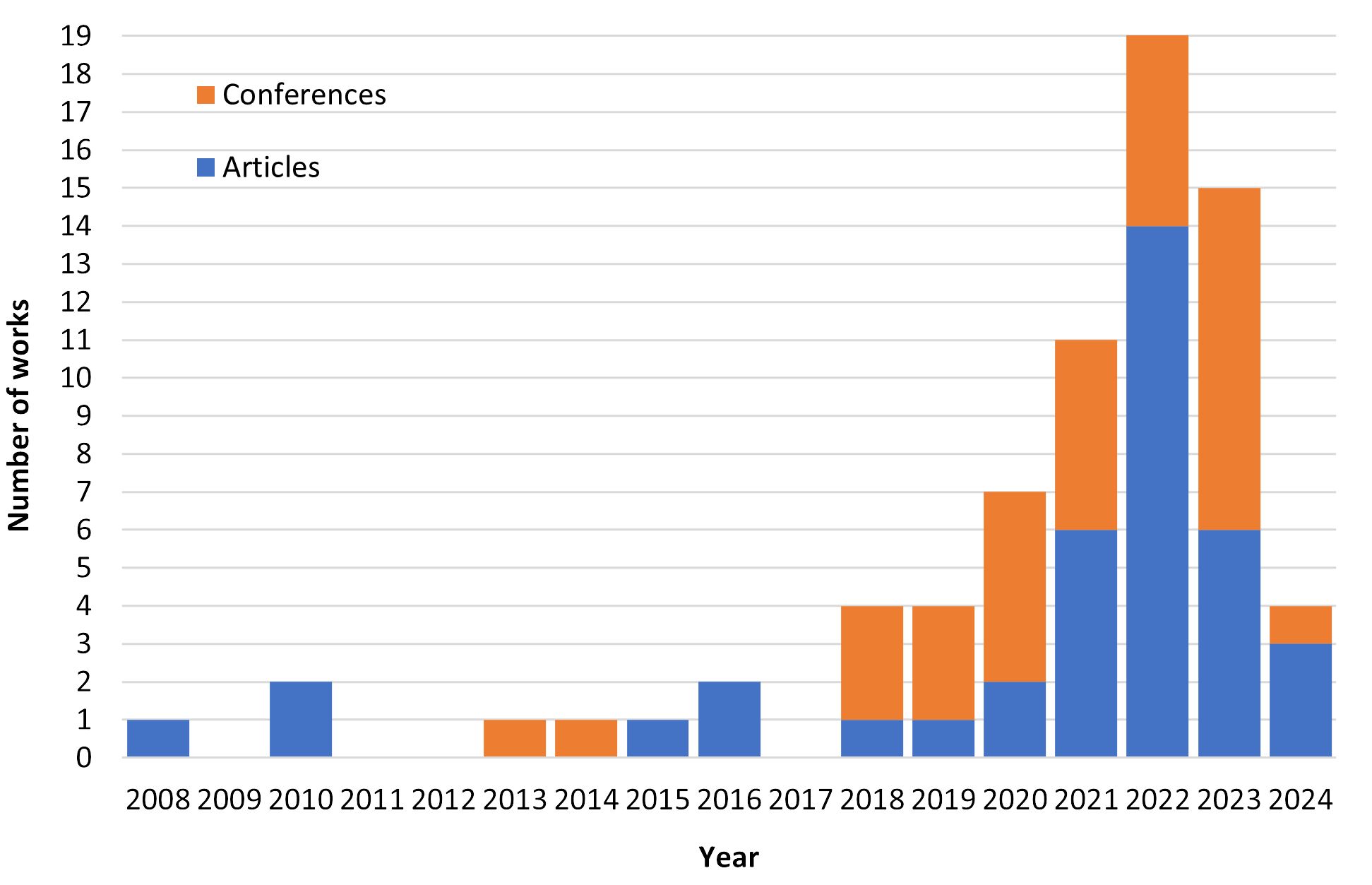
- 对2010年至2024年间的100余篇论文进行系统性文献综述,聚焦于使用单目RGB相机的多视角3D姿态估计。
- 根据监督程度(完全监督、弱监督、自监督)、时序建模和视角选择策略对方法进行分类。
- 分析基于几何和深度学习的方法,包括多视角三角测量、3D关键点回归以及图神经网络。
- 使用CMU Panoptic、UMPm和Human3.6M等标准基准评估性能,指标包括MPJPE(mm)和PCKh(%)
- 引入时序一致性建模以提升视频序列中的鲁棒性。
- 整合深度估计和多模态数据(如IMU、音频)作为新兴策略,以提升准确性和降低监督需求。
实验结果
研究问题
- RQ1多视角3D人体姿态估计中占主导地位的方法论和架构是什么?它们在监督程度和设计上如何不同?
- RQ2现有方法在真实多视角设置中如何应对遮挡、视角模糊性和相机校准不佳等问题?
- RQ3当前方法中的关键性能瓶颈是什么,特别是在数据稀缺和向非受限环境泛化方面?
- RQ4时序建模和多模态融合在多大程度上提升了估计精度和鲁棒性?
- RQ5在实际应用中,实现实时、高精度且低监督的3D姿态估计的最有前景的未来研究方向是什么?
主要发现
- 目前尚无任何方法能完全解决无标记多视角3D人体姿态估计中的所有挑战,尤其是在遮挡、复杂交互和3D监督有限的情况下。
- 使用5个及以上视角的方法在CMU Panoptic数据集上达到最低的MPJPE(如Reddy等人[64]的7.30 mm)和最高的mAP(Zhu等人[103]的92.35%),表明视角数量增加可带来性能提升。
- 自监督和弱监督方法在减少对昂贵3D标注的依赖方面展现出潜力,但性能仍落后于完全监督模型。
- 时序一致性建模显著提升了性能,例如Lin和Lee[50]的方法在CMU Panoptic数据集上于25mm阈值下达到92.12%的AP。
- 多模态方法(如融合RGB与IMU或深度数据)在复杂场景中表现出更强的鲁棒性,但其整合仍处于探索阶段。
- 在UMPm数据集上表现最佳的方法平均PCKh超过96%,其中Ershadi-Nasab等人[26]在p3-chair-11上达到96.65%,表明在受控序列中性能优异。
阅读本论文
在 Nubint 阅读器中打开原文,边读边就任意段落提问。
在 Nubint 中阅读本论文本解读由 AI 根据论文原文生成,引用前请核对原文。