
[论文解读] Masked Particle Modeling on Sets: Towards Self-Supervised High Energy Physics Foundation Models
本文提出掩码粒子建模(Masked Particle Modeling, MPM),一种自监督学习方法,用于从高能物理(HEP)中无序粒子集合中学习排列不变表示。通过掩码粒子特征并利用VQ-VAE学习的码书预测其离散标记身份,MPM 实现了在未标注喷射流数据上的有效预训练,在下游分类任务中实现了强大的零样本和少样本迁移性能,包括在未见类别和新数据领域上的表现。
We propose masked particle modeling (MPM) as a self-supervised method for learning generic, transferable, and reusable representations on unordered sets of inputs for use in high energy physics (HEP) scientific data. This work provides a novel scheme to perform masked modeling based pre-training to learn permutation invariant functions on sets. More generally, this work provides a step towards building large foundation models for HEP that can be generically pre-trained with self-supervised learning and later fine-tuned for a variety of down-stream tasks. In MPM, particles in a set are masked and the training objective is to recover their identity, as defined by a discretized token representation of a pre-trained vector quantized variational autoencoder. We study the efficacy of the method in samples of high energy jets at collider physics experiments, including studies on the impact of discretization, permutation invariance, and ordering. We also study the fine-tuning capability of the model, showing that it can be adapted to tasks such as supervised and weakly supervised jet classification, and that the model can transfer efficiently with small fine-tuning data sets to new classes and new data domains.
研究动机与目标
- 通过开发针对 HEP 数据定制的自监督学习(SSL)策略,解决高能物理(HEP)中基础模型缺乏的问题。
- 通过适配自然语言处理(NLP)和计算机视觉(CV)技术,克服在对撞机物理中常见的无序、连续粒子集合上应用掩码建模的挑战。
- 实现在最小标注数据下的迁移学习,包括少样本和零样本泛化能力。
- 探索直接在真实实验数据上进行预训练的可行性,以减少模拟与真实数据分布之间的领域偏移问题。
- 在弱监督设置下展示 MPM 的有效性,利用噪声标签实现数据驱动的异常检测和信号搜索。
提出的方法
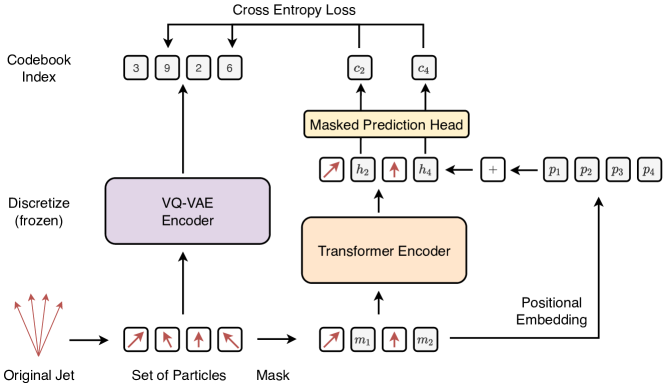
- 将每个喷射流表示为一组无序粒子,每个粒子具有连续特征(如动量、能量),并应用预训练的向量量化变分自编码器(VQ-VAE)将粒子特征离散化为离散标记。
- 在输入集合中掩码一部分粒子,并使用基于 Transformer 的编码器预测被掩码粒子的离散标记身份。
- 通过交叉熵损失计算预测离散码与 VQ-VAE 生成的真实离散码之间的差异,利用模型架构和掩码方案强制实现排列不变性。
- 将预训练的 MPM 主干网络作为特征提取器,仅微调一个线性分类头用于下游分类任务。
- 通过在未见喷射流类型(如顶夸克喷射流与 QCD 喷射流)上进行微调,并跨不同数据分布评估泛化能力。
- 通过在包含噪声标签的数据集(如混合信号与背景样本)上进行训练,并在纯净测试集上评估显著性提升,评估弱监督设置下的性能。
实验结果
研究问题
- RQ1掩码建模能否有效适配高能物理中无序、连续的粒子集合,类似于自然语言处理中的掩码语言建模?
- RQ2通过 VQ-VAE 实现的离散化方式及掩码策略的选择,如何影响粒子物理数据中学习表示的质量?
- RQ3预训练的 MPM 模型在仅需极少微调数据的情况下,对下游任务的泛化能力有多强,包括对未见喷射流类型或新数据领域的适应?
- RQ4基于 MPM 的模型能否在弱监督信号(如混合数据样本中的噪声标签)下有效微调?
- RQ5在真实实验数据上直接进行 MPM 模型预训练是否可行,以缓解模拟与真实数据之间的领域偏移问题?
主要发现
- 即使仅使用少量标注数据进行微调,MPM 模型在喷射流分类任务中也实现了显著的性能提升,展现出强大的少样本迁移能力。
- 在微调过程中,模型对未见喷射流类型表现出有效的泛化能力,显示出稳健的零样本和少样本适应能力。
- 当在包含混合 QCD 与顶夸克喷射流样本的弱监督设置下进行微调时,MPM 主干网络的显著性提升超过两倍,即使在训练过程中未使用真实标签。
- 当迁移到新数据领域时,模型仍保持强劲性能,表明其学习到了通用且可迁移的表示。
- 在真实实验数据上进行预训练(仅在微调阶段使用模拟数据)显示出减少领域偏移问题的潜力,提示了一条通往更稳健实际部署的可行路径。
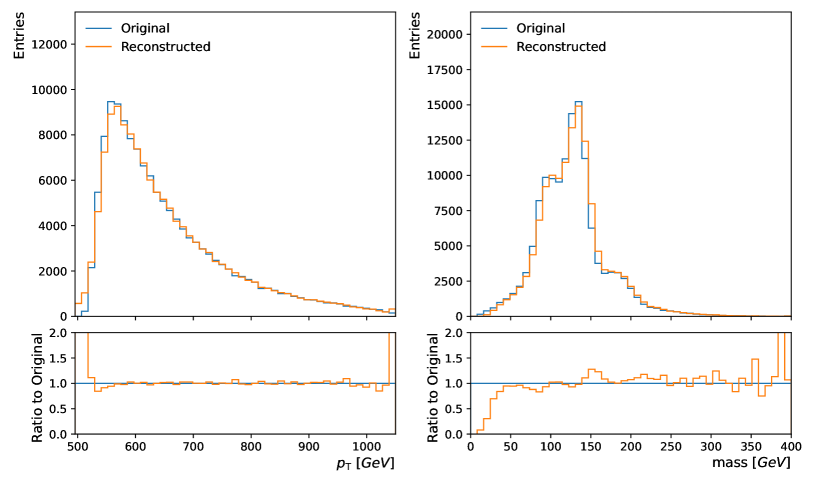
- 基于 VQ-VAE 的离散标记化方法有效实现了对连续粒子特征的掩码与预测,弥合了 NLP 风格掩码建模与 HEP 数据之间的鸿沟。
阅读本论文
在 Nubint 阅读器中打开原文,边读边就任意段落提问。
在 Nubint 中阅读本论文本解读由 AI 根据论文原文生成,引用前请核对原文。