
[论文解读] Massively Multi-Cultural Knowledge Acquisition & LM Benchmarking
本文介绍了CultureAtlas,这是一个大规模基准,用于评估语言模型在1,000多个次国家级区域和2,000多个民族语言群体中的文化推理能力。该研究利用精心整理的维基百科页面及链接遍历,提取高质量、自包含的文化规范陈述,实现了超过90%的人工验证数据质量,并支持对语言模型中文化偏见和推理能力的稳健评估。
Pretrained large language models have revolutionized many applications but still face challenges related to cultural bias and a lack of cultural commonsense knowledge crucial for guiding cross-culture communication and interactions. Recognizing the shortcomings of existing methods in capturing the diverse and rich cultures across the world, this paper introduces a novel approach for massively multicultural knowledge acquisition. Specifically, our method strategically navigates from densely informative Wikipedia documents on cultural topics to an extensive network of linked pages. Leveraging this valuable source of data collection, we construct the CultureAtlas dataset, which covers a wide range of sub-country level geographical regions and ethnolinguistic groups, with data cleaning and preprocessing to ensure textual assertion sentence self-containment, as well as fine-grained cultural profile information extraction. Our dataset not only facilitates the evaluation of language model performance in culturally diverse contexts but also serves as a foundational tool for the development of culturally sensitive and aware language models. Our work marks an important step towards deeper understanding and bridging the gaps of cultural disparities in AI, to promote a more inclusive and balanced representation of global cultures in the digital domain.
研究动机与目标
- 为解决预训练大语言模型(LLMs)中存在的文化偏见以及在非西方和次区域语境下缺乏细粒度文化常识的问题。
- 开发一种可扩展的高质量数据收集流程,以捕捉多样化地理和民族语言群体中的细微文化规范。
- 构建一个基准数据集,以实现对语言模型文化推理能力的严格评估,超越粗粒度文化类别的限制。
- 通过事实性(正面)和非事实性(负面)文化知识样本,识别并探测当前最先进语言模型在文化推理方面的弱点。
- 通过提供去偏和提升语言模型文化意识的基础,促进自然语言处理中的公平性、包容性和文化一致性。
提出的方法
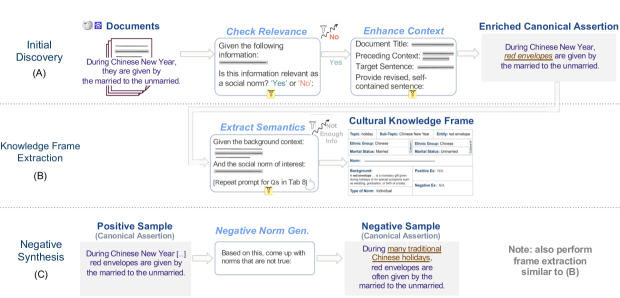
- 从核心文化主题(如节日、婚姻、教育)的精选维基百科文章出发,通过超链接页面扩展,构建文化相关内容网络。
- 利用预训练语言模型将句子分类为可推广的社会规范,而非特定实例事实或历史事件,以提取文化知识陈述。
- 通过网络搜索生成并交叉验证非事实性(非真实)文化知识样本,以测试模型在识别文化错误方面的鲁棒性。
- 从知识陈述中提取细粒度文化档案字段(如次国家级区域、民族语言身份和人口统计信息),用于上下文分析。
- 通过人工评估进行数据质量检查,确认通过率超过90%,确保正样本和负样本的高可靠性。
- 该数据集专为评估语言模型在文化细微推理方面的能力而设计,重点关注规范违反和文化错位的检测。
实验结果
研究问题
- RQ1我们如何系统性地在数千个次国家级区域和民族语言群体中收集高质量、细粒度的文化知识?
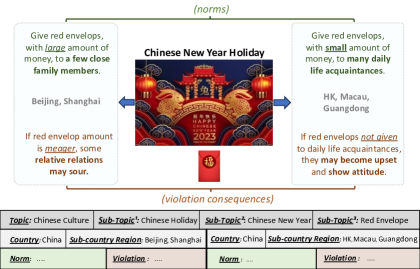
- RQ2当推理关于特定区域规范(如中国农历新年红包习俗的地区差异)时,当前大语言模型在多大程度上表现出文化偏见?
- RQ3一个同时包含事实性和非事实性文化陈述的基准,能否有效揭示语言模型在文化推理和规范违反检测方面的弱点?
- RQ4在训练和评估数据中纳入次区域和民族语言多样性,如何影响模型的公平性和文化敏感性?
- RQ5在大规模自动化文化知识标注中存在哪些局限性?如何通过人机协同验证提高可靠性?
主要发现
- CultureAtlas数据集覆盖了超过1,000个次国家级区域和2,000个民族语言群体,显著扩展了现有跨文化自然语言处理基准的范围。
- 该数据集在人工评估中实现了超过90%的通过率,证实了正样本(事实性)和负样本(非事实性)文化知识样本的高质量。
- 最先进语言模型在推理文化细微规范方面表现出可测量的性能差距,尤其是在非西方和次区域语境中。
- 负样本的引入使模型鲁棒性得以有效探测,揭示了其在识别文化错误陈述方面的脆弱性。
- 该基准揭示,当前语言模型往往无法区分地区特有的文化实践,例如中国各地区红包习俗的差异。
- 本研究证明,结合自上而下的主题引导与自下而上的网络遍历,可实现一种可扩展且高质量的文化知识获取方法。
阅读本论文
在 Nubint 阅读器中打开原文,边读边就任意段落提问。
在 Nubint 中阅读本论文本解读由 AI 根据论文原文生成,引用前请核对原文。