
[论文解读] MathVista: Evaluating Mathematical Reasoning of Foundation Models in Visual Contexts
MathVista 在视觉情境中对数学推理进行基准测试,覆盖来自28个现有多模态数据集和3个新数据集的6,141个示例,评估12个基础模型,并揭示与人类表现之间的显著差距。
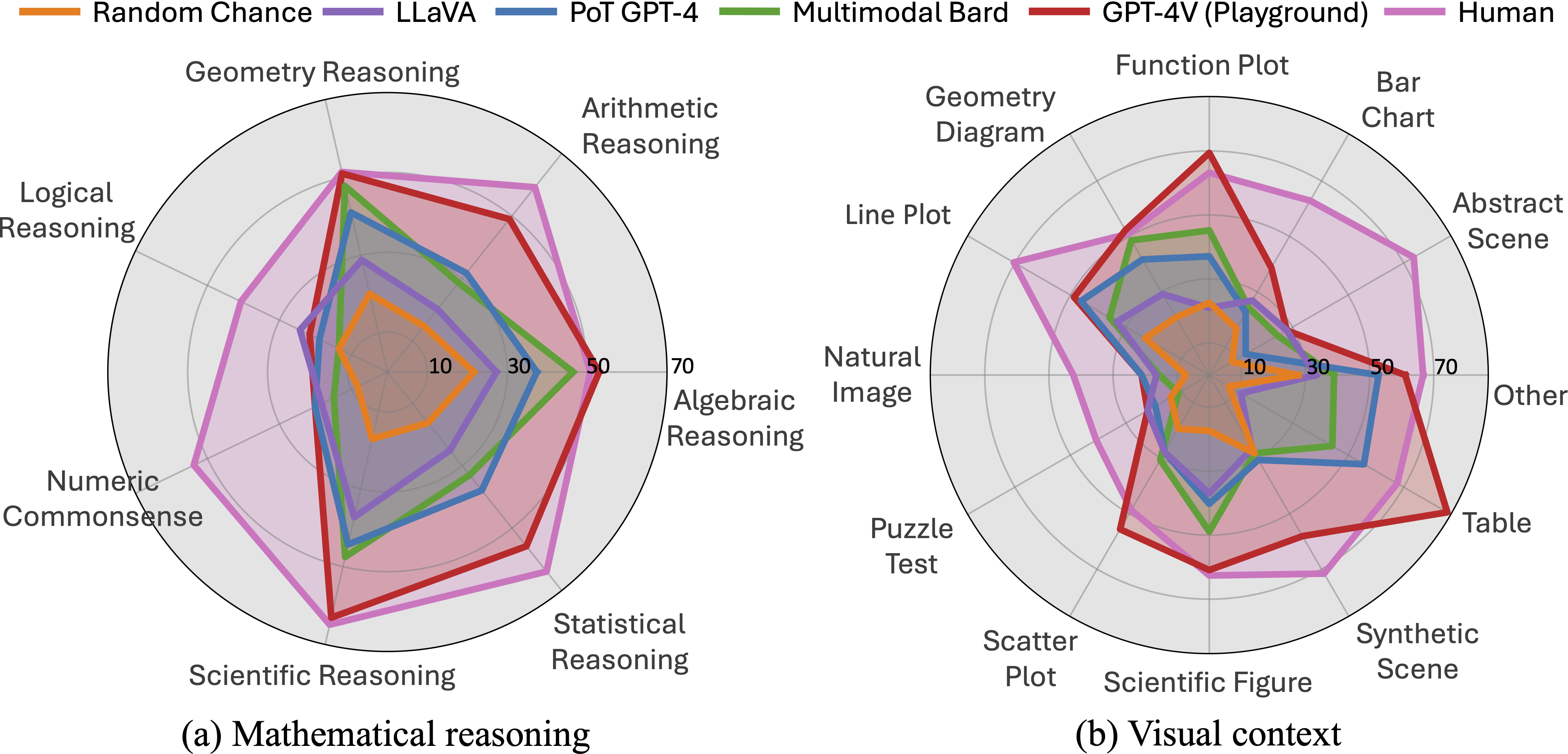
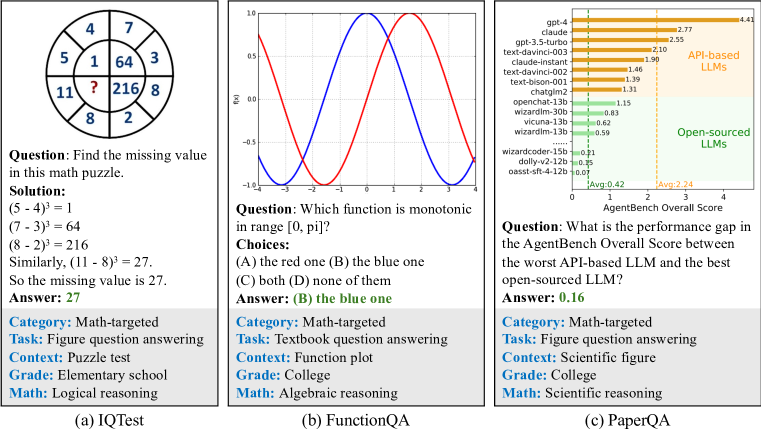
Large Language Models (LLMs) and Large Multimodal Models (LMMs) exhibit impressive problem-solving skills in many tasks and domains, but their ability in mathematical reasoning in visual contexts has not been systematically studied. To bridge this gap, we present MathVista, a benchmark designed to combine challenges from diverse mathematical and visual tasks. It consists of 6,141 examples, derived from 28 existing multimodal datasets involving mathematics and 3 newly created datasets (i.e., IQTest, FunctionQA, and PaperQA). Completing these tasks requires fine-grained, deep visual understanding and compositional reasoning, which all state-of-the-art foundation models find challenging. With MathVista, we have conducted a comprehensive, quantitative evaluation of 12 prominent foundation models. The best-performing GPT-4V model achieves an overall accuracy of 49.9%, substantially outperforming Bard, the second-best performer, by 15.1%. Our in-depth analysis reveals that the superiority of GPT-4V is mainly attributed to its enhanced visual perception and mathematical reasoning. However, GPT-4V still falls short of human performance by 10.4%, as it often struggles to understand complex figures and perform rigorous reasoning. This significant gap underscores the critical role that MathVista will play in the development of general-purpose AI agents capable of tackling mathematically intensive and visually rich real-world tasks. We further explore the new ability of self-verification, the application of self-consistency, and the interactive chatbot capabilities of GPT-4V, highlighting its promising potential for future research. The project is available at https://mathvista.github.io/.
研究动机与目标
- 定义一个面向视觉丰富情境的综合性数学推理基准。
- 在多样的数学与视觉任务上评估12个知名的基础模型。
- 创建新的数据集(IQTest、FunctionQA、PaperQA),以弥合推理类型上的空白。
- 提供细粒度的元数据和分析,以诊断模型的优点与不足。
提出的方法
- 将 MathVista 由来自28个现有的多模态数据集加上3个新数据集组成,总样本量为6,141个示例。
- 用元数据标注示例,包括问题类型、答案类型、任务、年级、视觉上下文和推理技能。
- 使用三阶段管线评估模型:生成回答、提取答案和分数计算。
- 对于多项选择题和自由回答题,使用精确答案准确性进行确定性评估。
- 在零样本、少样本和提示变体(CoT、PoT)下,比较文本型LLM、带视觉线索的增强LLM,以及开源/专有的LMM。
实验结果
研究问题
- RQ1当问题以视觉情境呈现时,当前的LLM和LMM在数学推理方面有多大能力?
- RQ2文本型与多模态模型在MathVista任务上的相对优势与失败模式是什么?
- RQ3外部视觉辅助(字幕、OCR)在多模态模型的数学推理中在多大程度上提升性能?
- RQ4新的数据集(IQTest、FunctionQA、PaperQA)是否能揭示现有数学或VQA基准未覆盖的空白?
- RQ5相对于本基准,人类表现的上限是多少?
主要发现
- GPT-4V 在整体精确度上最高,为 49.9%,但仍落后人类表现 10.4%。
- 带字幕和OCR的增强型LLM达到33.9%(GPT-4 with PoT),显示相较文本基线的增益有限。
- Multimodal Bard 达到34.8% 的准确率,远低于GPT-4V和人类,突出显示了重大幻觉与计算错误。
- 开源LMM的表现不如封闭模型,表明在数学推理、OCR和图表理解方面存在差距。
- GPT-4V 展现出强烈的视觉感知与推理能力,具备新兴的自我验证与自洽能力,能够进行多轮对话。
- MathVista上的人类表现为60.3% 整体,指示当前模型在大学和科学层面的视觉数学任务上存在相当大的差距。
阅读本论文
在 Nubint 阅读器中打开原文,边读边就任意段落提问。
在 Nubint 中阅读本论文本解读由 AI 根据论文原文生成,引用前请核对原文。