
[论文解读] MD-VQA: Multi-Dimensional Quality Assessment for UGC Live Videos
本论文提出MD-VQA,一种用于用户生成内容(UGC)直播视频的无参考视频质量评估模型,通过预训练2D-CNN提取语义特征、手工设计描述符提取失真特征、以及3D-CNN提取运动特征,实现对视频质量的多维感知。该模型在新构建的TaoLive数据库及现有压缩UGC VQA基准测试中均达到最先进性能,展现出在多样化视频条件下的强大泛化能力与可解释性。
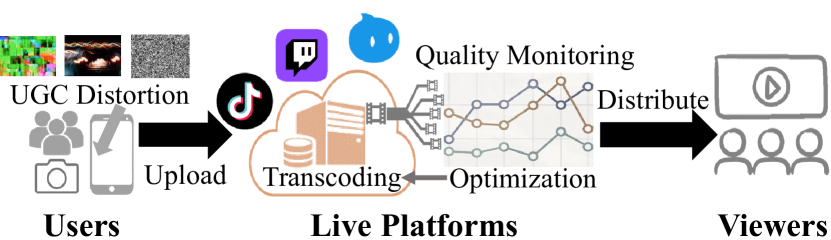
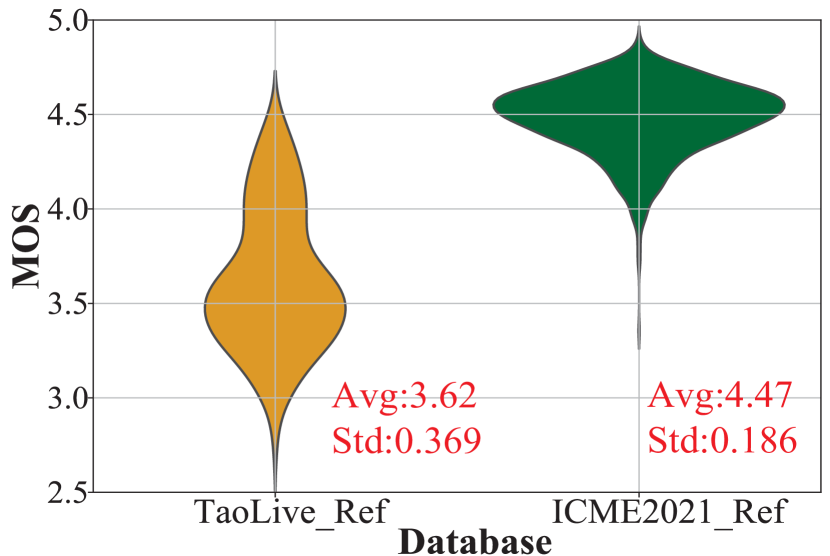
User-generated content (UGC) live videos are often bothered by various distortions during capture procedures and thus exhibit diverse visual qualities. Such source videos are further compressed and transcoded by media server providers before being distributed to end-users. Because of the flourishing of UGC live videos, effective video quality assessment (VQA) tools are needed to monitor and perceptually optimize live streaming videos in the distributing process. In this paper, we address extbf{UGC Live VQA} problems by constructing a first-of-a-kind subjective UGC Live VQA database and developing an effective evaluation tool. Concretely, 418 source UGC videos are collected in real live streaming scenarios and 3,762 compressed ones at different bit rates are generated for the subsequent subjective VQA experiments. Based on the built database, we develop a \underline{M}ulti-\underline{D}imensional \underline{VQA} ( extbf{MD-VQA}) evaluator to measure the visual quality of UGC live videos from semantic, distortion, and motion aspects respectively. Extensive experimental results show that MD-VQA achieves state-of-the-art performance on both our UGC Live VQA database and existing compressed UGC VQA databases.
研究动机与目标
- 为解决缺乏针对压缩伪影的、大规模且真实世界场景下的UGC直播视频质量评估数据库的问题。
- 开发一种无参考VQA模型,能够捕捉与感知相关的质量维度——语义、失真与运动,专用于直播流式UGC视频。
- 在不同视频内容类型与压缩标准(如H.265和VP9)下验证模型性能,确保其鲁棒性与泛化能力。
提出的方法
- MD-VQA模型利用预训练2D-CNN(如ResNet)在视频帧上提取语义特征,以捕捉内容级别的质量线索。
- 通过手工设计的描述符(包括模糊、噪声、方块效应、曝光与色彩丰富度)提取失真特征,量化视觉损伤程度。
- 利用预训练3D-CNN(如I3D)在视频片段上提取运动特征,以建模时间动态与与运动相关的退化。
- 通过可学习的融合模块在时空维度上融合三类特征,生成统一的视频级质量评分。
- 模型通过44名参与者的受控实验室实验获取的主观MOS评分进行端到端训练。
- 消融实验验证了绝对误差损失与特征融合模块(FFM)在提升性能方面的有效性。
实验结果
研究问题
- RQ1是否能够通过联合分析语义、失真与运动特征的多维VQA模型,在压缩UGC直播视频上超越现有方法?
- RQ2所提出的MD-VQA模型在不同视频内容类型与压缩标准(如H.265与VP9)下是否具备良好的泛化能力?
- RQ3在真实世界UGC直播视频场景中,手工设计的失真特征与3D-CNN运动特征对质量预测的贡献程度如何?
- RQ4尽管在压缩UGC直播视频数据集上进行训练,该模型是否仍能在真实世界UGC VQA数据库上保持优异性能?
- RQ5在直播流媒体场景中,各质量维度(语义、失真、运动)对最终质量预测的相对贡献如何?
主要发现
- 在KoNViD-1k数据集上,MD-VQA的斯皮尔曼等级相关系数(SRCC)达到0.851,皮尔逊线性相关系数(PLCC)达到0.853,优于所有对比方法。
- 在LIVE-VQC数据集上,MD-VQA的SRCC为0.814,PLCC为0.839,在所有测试方法中排名第二。
- 在跨数据库评估中,MD-VQA在LIVE-WC上的SRCC为0.742,PLCC为0.728;在YT-UGC+上的SRCC为0.440,PLCC为0.448,尽管存在分布偏移,仍展现出强大的泛化能力。
- 消融实验表明,绝对误差损失与特征融合模块(FFM)均显著提升模型性能,其中FFM对最终得分的贡献更大。
- 在YT-UGC+数据集中,失真特征(SRCC 0.277)与运动特征(SRCC 0.537)表现较差,原因在于游戏视频中存在非典型的失真与运动特征。
- 该模型在真实世界数据库上保持了具有竞争力的性能,表明其在压缩特定场景之外的通用UGC VQA任务中具有作为强基线的潜力。
阅读本论文
在 Nubint 阅读器中打开原文,边读边就任意段落提问。
在 Nubint 中阅读本论文本解读由 AI 根据论文原文生成,引用前请核对原文。