
[论文解读] Measurement-induced entanglement transitions in quantum circuits of non-interacting fermions: Born-rule versus forced measurements
论文表明 Born-rule 与在受监控的高斯电路中对非相互作用费米子(Majorana chain)的强制测量属于不同的普适类,具有 entanglement 转变的不同临界指数。它通过在 SO(n)×SO(n) 的二维 principal chiral 非线性 sigma 模型中的场论理解,采用不同的 replica 极限。
We address entanglement transitions in monitored random quantum circuits of non-interacting fermions, in particular, the question of whether Born-rule and forced measurements yield the same universality class. For a generic circuit with no symmetry other than fermion parity, acting on a one-dimensional Majorana chain, we numerically obtain several critical exponents, providing clear evidence that the two transitions with Born-rule and forced measurements are in different universality classes. We provide a theoretical understanding for our numerical results by identifying the underlying statistical mechanics model which follows from the general correspondence, established in Jian et al., Phys. Rev. B 106, 134206, between non-unitary circuits of non-interacting fermions and the ten-fold Altland-Zirnbauer (AZ) symmetry classes. The AZ class is the same for Born-rule and forced measurements of the circuits. For the circuit under consideration (in AZ class DIII), the statistical mechanics model describing the transition is the principal chiral non-linear sigma model whose field variable is an ${ m SO}(n)$ matrix in the replica limits $n o 0$ and $n o 1$ for forced and Born-rule measurements, respectively. The former is in an Anderson localization universality class while we show that the latter is in a novel universality class beyond Anderson localization. Both entanglement transitions are driven by proliferation of $\mathbb{Z}_2$ topological defects. The different replica limits account for the difference in the universality classes. Furthermore, we provide numerical and symmetry-based arguments that the entanglement transition in the previously-studied monitored circuit of Majorana fermions based on the loop model with crossings, a highly fine-tuned circuit, belongs to a universality class different from both transitions in the generic circuits discussed in this paper.
研究动机与目标
- 在对称性极小的费米子分区上,研究受监控的 1D Majorana chain 的纠缠转变。
- 确定 Born-rule 与强制测量是否落入相同的普适类。
- 在 AZ 对称性分类下,识别描述每个转变的底层统计力学模型。
提出的方法
- 使用最近邻两站门及带参数化为单位向量在 S^2 上的 Kraus 操作的一般化测量,来建模受监控的高斯电路。
- 区分 Born-rule 与强制测量的统计性质并将其与其 replica 极限相关联(强制为 n→0,Born-rule 为 n→1)。
- 通过费米表示将电路动力学映射到 Altland-Zirnbauer DIII 类的静态 Hamiltonian 问题。
- 用具有 SO(n)×SO(n) 对称性的二维 principal chiral 非线性 sigma 模型来描述纠缠转变。
- 分析相关函数及其多重尺度以下的多重分形行为,以提取临界指数并区分普适类。
实验结果
研究问题
- RQ1 Born-rule 与强制测量在受监控的非相互作用费米子高斯电路中的纠缠转变是否属于同一普适类?
- RQ2在 AZ 类 DIII 中,描述这些转变的有效场论是什么?
- RQ3复制极限(n→0 与 n→1)如何影响转变处的临界指数和多重分形性质?
- RQ4转变是否由 Z2 拓扑缺陷的增殖驱动?与 Anderson 局域化有何比较?
- RQ5Born-rule 与强制测量转变与相关电路中的带交叉的环模型有何对比?
主要发现
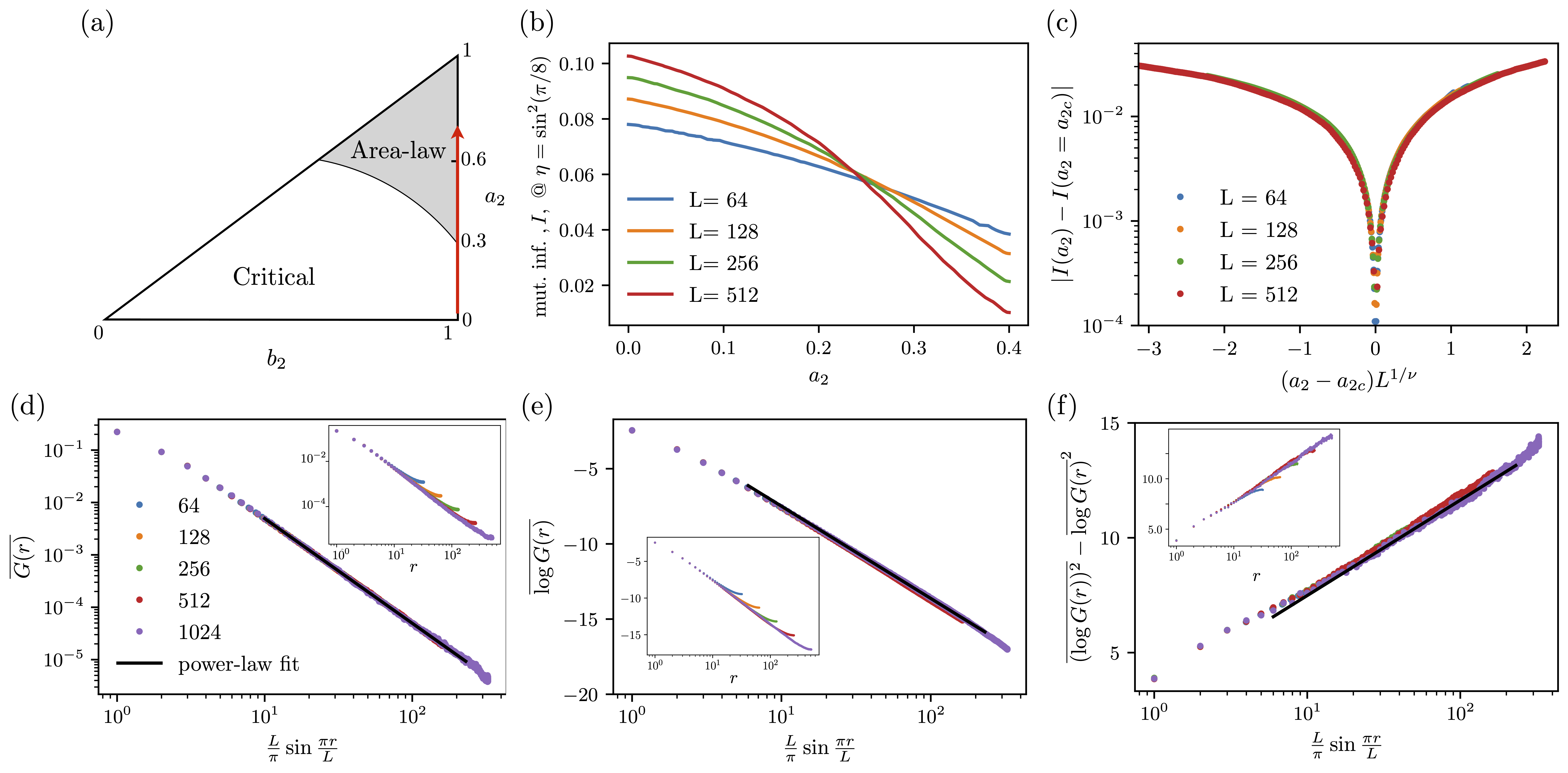
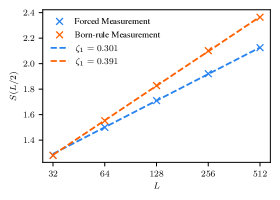
- Born-rule 与强制测量在 Majorana chain 电路中的纠缠转变属于不同的普适类。
- 两种转变都由具有 SO(n)×SO(n) 对称性的二维 principal chiral 非线性 sigma 模型描述,复制极限分别为 n→0(强制)和 n→1(Born-rule)。
- 强制测量映射到同一 AZ 类中的 Anderson 局域化普适类,而 Born-rule 测量则产生超越 Anderson 局域化的新普适类。
- 两种转变均由 Z2 拓扑缺陷的增殖驱动,但不同的复制极限导致不同的临界行为。
- 数值证据显示两种转变在相关函数的衰减幂律和多重分形尺度上存在差异。
阅读本论文
在 Nubint 阅读器中打开原文,边读边就任意段落提问。
在 Nubint 中阅读本论文本解读由 AI 根据论文原文生成,引用前请核对原文。