
[论文解读] MedAgents: Large Language Models as Collaborators for Zero-shot Medical Reasoning
本论文提出一个训练无关的多学科协作框架,在该框架中基于 LLM 的专家进行多轮讨论,在零-shot 设置下解决医学问题,超越零-shot 基线并在九个数据集上达到强大 few-shot 方法的水平。
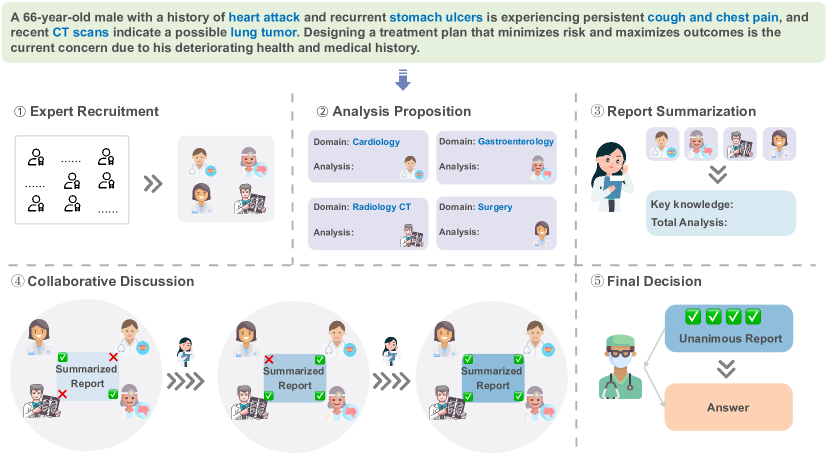
Large language models (LLMs), despite their remarkable progress across various general domains, encounter significant barriers in medicine and healthcare. This field faces unique challenges such as domain-specific terminologies and reasoning over specialized knowledge. To address these issues, we propose MedAgents, a novel multi-disciplinary collaboration framework for the medical domain. MedAgents leverages LLM-based agents in a role-playing setting that participate in a collaborative multi-round discussion, thereby enhancing LLM proficiency and reasoning capabilities. This training-free framework encompasses five critical steps: gathering domain experts, proposing individual analyses, summarising these analyses into a report, iterating over discussions until a consensus is reached, and ultimately making a decision. Our work focuses on the zero-shot setting, which is applicable in real-world scenarios. Experimental results on nine datasets (MedQA, MedMCQA, PubMedQA, and six subtasks from MMLU) establish that our proposed MedAgents framework excels at mining and harnessing the medical expertise within LLMs, as well as extending its reasoning abilities. Our code can be found at https://github.com/gersteinlab/MedAgents.
研究动机与目标
- 解决医学领域推理中的空白,即领域知识有限且提示本身不足够有效。
- 提出一个训练无关、可解释的 MC 框架,通过角色扮演的基于 LLM 的代理来显现领域专业知识。
- 在零-shot 设置下,在九个数据集上展示有效性(MedQA、MedMCQA、PubMedQA,以及六个 MMLU 医学子任务)。
- 通过人工评估来特征化错误,并进行消融实验以理解影响性能的因素。
提出的方法
- 五阶段的多学科协作框架:专家汇聚、分析提议、报告摘要、协同咨询和决策制定。
- 角色分配提示引导 LLM 充当问题和选项分析的领域专家。
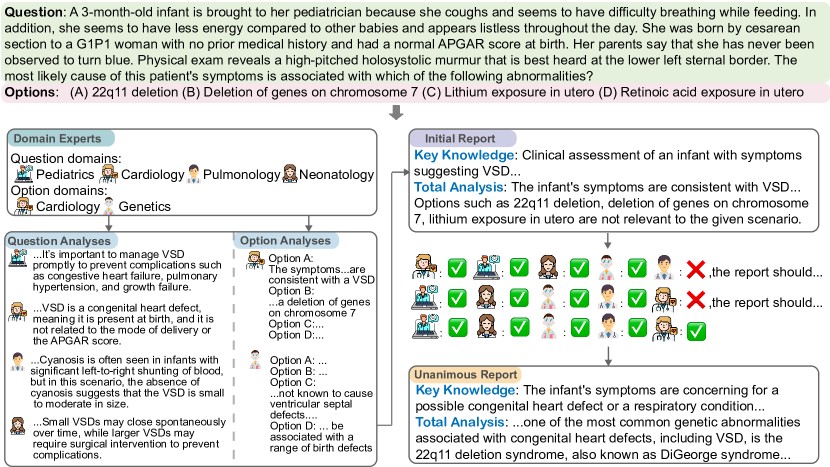
- 问题分析(qa_i)和选项分析(oa_i)由充当专门领域专家的 LLM 生成。
- 从分析中产生综合报告(Repo),随后进行迭代的协同咨询,直到所有专家达成一致。
- 最终决策(ans)由基于一致报告的 LLM 医学决策者给出。
实验结果
研究问题
- RQ1多学科协作(MC)框架是否在多样的医学数据集上改善零-shot 医学推理?
- RQ2MC 与零-shot 和 few-shot 提示基线的比较,包括 chain-of-thought 与 self-consistency 方法?
- RQ3协作的问题-领域代理数量对性能的影响是什么?
- RQ4MC 框架中的常见错误类型有哪些,以及如何缓解?
主要发现
- MC 框架在九个数据集上显著优于所有零-shot 基线。
- 在零-shot 条件下,MC 与强的 few-shot coT+self-consistency 基线相当或超越它们。
- 最佳问题-领域代理数量因数据集而异(例如:MedQA/MedMCQA 为 5,PubMedQA 为 4)。
- 人工评估识别出四类错误:缺乏领域知识、检索错误、一致性错误和 CoT 错误。
- 消融研究揭示了该框架的有效性,并指明了缓解已识别错误类型的方向。
阅读本论文
在 Nubint 阅读器中打开原文,边读边就任意段落提问。
在 Nubint 中阅读本论文本解读由 AI 根据论文原文生成,引用前请核对原文。