
[论文解读] MedAlign: A Clinician-Generated Dataset for Instruction Following with Electronic Medical Records
MedAlign 是一个由临床医生生成的基准,包含 983 份基于电子病历(EHR)的指令,用于评估 6 个大型语言模型并研究上下文长度效应与自动评估指标。
The ability of large language models (LLMs) to follow natural language instructions with human-level fluency suggests many opportunities in healthcare to reduce administrative burden and improve quality of care. However, evaluating LLMs on realistic text generation tasks for healthcare remains challenging. Existing question answering datasets for electronic health record (EHR) data fail to capture the complexity of information needs and documentation burdens experienced by clinicians. To address these challenges, we introduce MedAlign, a benchmark dataset of 983 natural language instructions for EHR data. MedAlign is curated by 15 clinicians (7 specialities), includes clinician-written reference responses for 303 instructions, and provides 276 longitudinal EHRs for grounding instruction-response pairs. We used MedAlign to evaluate 6 general domain LLMs, having clinicians rank the accuracy and quality of each LLM response. We found high error rates, ranging from 35% (GPT-4) to 68% (MPT-7B-Instruct), and an 8.3% drop in accuracy moving from 32k to 2k context lengths for GPT-4. Finally, we report correlations between clinician rankings and automated natural language generation metrics as a way to rank LLMs without human review. We make MedAlign available under a research data use agreement to enable LLM evaluations on tasks aligned with clinician needs and preferences.
研究动机与目标
- 促使人们认识到需要现实的 EHR 指令执行基准,以代表临床医生的任务和负担。
- 创建 MedAlign:一个多专科、由临床医生生成的多样化 EHR 基于指令集合。
- 提供配对的 EHR 与临床医生撰写的金标准回应,以便在真实任务中评估大语言模型。
- 研究将自动化指标作为临床医生判断的代理,以实现可扩展的评估。
提出的方法
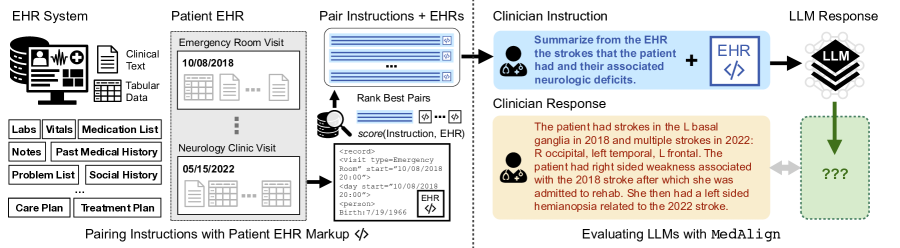
- 从 7 个专科的 15 位临床医生处收集指令,形成 983 条指令。
- 通过基于检索的 BM25 匹配方法将指令与 EHR 配对,以获得相关的指令–EHR 对。
- 让临床医生基于 EHR 为 303 条指令撰写金标准回应,并评估 6 个 LLM。
- 使用临床医生的正确性与质量判断评估 LLM 输出,对模型身份保持盲评。
- 分析自动化 NLG 指标(如 COMET、BERTScore)与人类排序之间的相关性。
实验结果
研究问题
- RQ1由临床医生生成的 EHR 指令是否能够与纵向 EHR 数据有效配对,从而形成一个真实的指令遵循基准?
- RQ2在长期、以 EHR 为基础的指令上,最先进的 LLM 相对于临床判断的表现如何?
- RQ3在 EHR 指令遵循场景中,自动化 NLG 指标是否与临床医生的排序相关?
主要发现
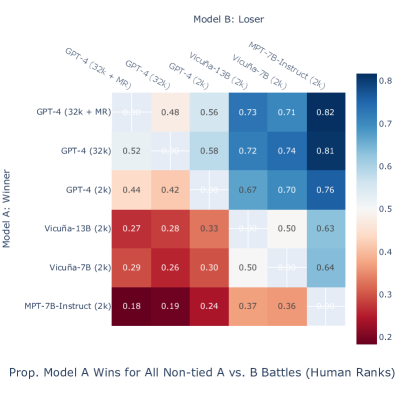
- GPT-4 变体在正确性方面高于开放模型,例如 65.0%(GPT-4 32k + MR)和 60.1%(GPT-4 32k)对比 35.0%(Vicuña-13B)、33.3%(Vicuña-7B)和 31.7%(MPT-7B-Instruct)。
- 具有 32k 上下文和多步细化的 GPT-4 在与其他模型的对比中取得最高的胜率(0.676)。
- 上下文长度显著影响正确性,将 GPT-4 上下文从 2k 增加到 32k 时,正确响应增加 8.3%。
- 自动化指标 COMET 与临床医生排序的相关性最强(0.37,接近评审者之间一致性 0.44)。
- 评估模型输出的临床医生之间的平均一致性为 0.44(肯登塔 Tau)。
- 自动化指标如 BERTScore(0.34)和 METEOR(0.32)与人工排名呈中等相关性;许多指标呈较弱的相关性。
阅读本论文
在 Nubint 阅读器中打开原文,边读边就任意段落提问。
在 Nubint 中阅读本论文本解读由 AI 根据论文原文生成,引用前请核对原文。