
[论文解读] Medical Vision Language Pretraining: A survey
这是关于医学视觉-语言预训练(VLP)的综合性综述,详细介绍了在医学领域的目标、结构、数据集、下游任务、挑战与未来方向。
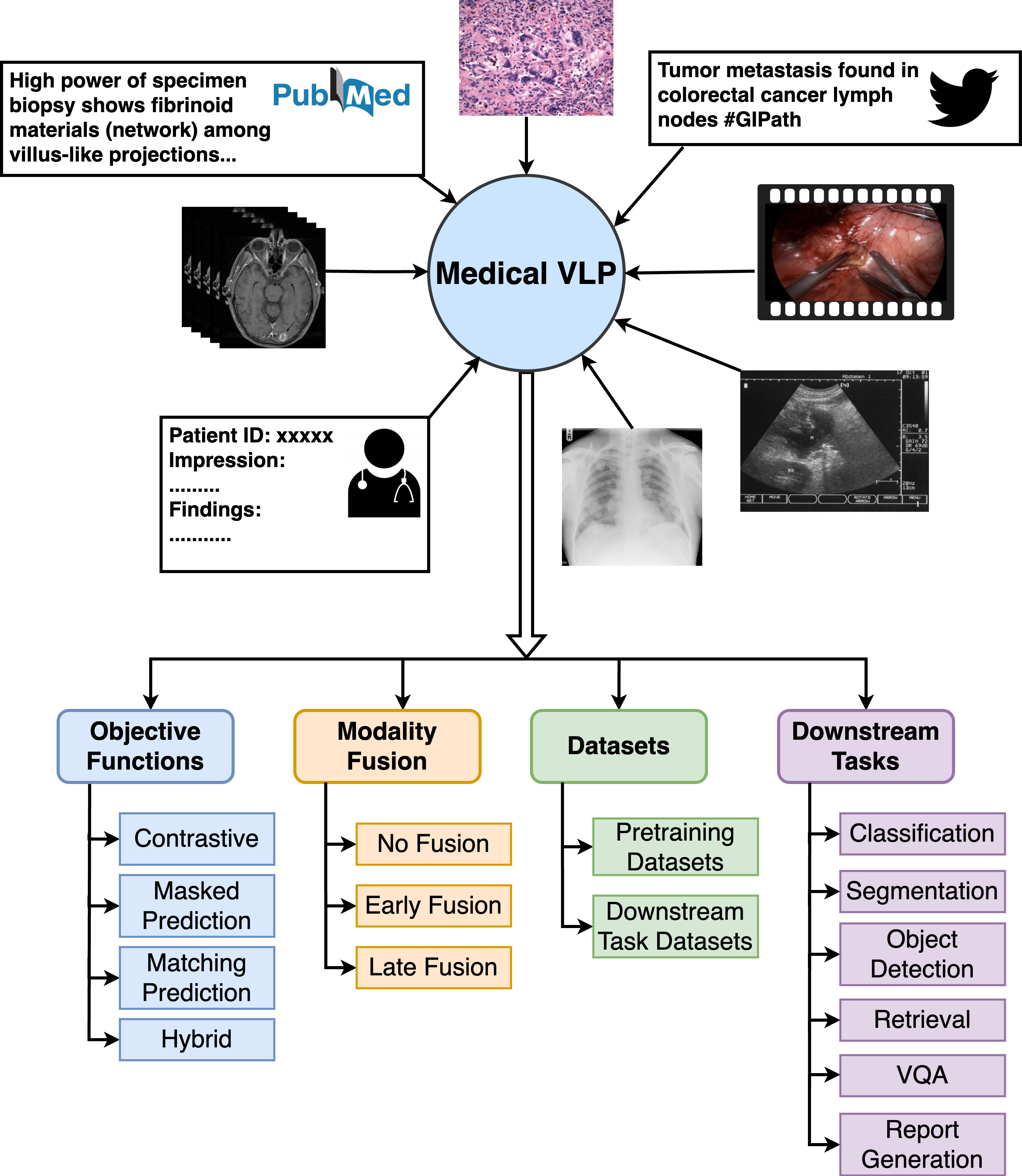
Medical Vision Language Pretraining (VLP) has recently emerged as a promising solution to the scarcity of labeled data in the medical domain. By leveraging paired/unpaired vision and text datasets through self-supervised learning, models can be trained to acquire vast knowledge and learn robust feature representations. Such pretrained models have the potential to enhance multiple downstream medical tasks simultaneously, reducing the dependency on labeled data. However, despite recent progress and its potential, there is no such comprehensive survey paper that has explored the various aspects and advancements in medical VLP. In this paper, we specifically review existing works through the lens of different pretraining objectives, architectures, downstream evaluation tasks, and datasets utilized for pretraining and downstream tasks. Subsequently, we delve into current challenges in medical VLP, discussing existing and potential solutions, and conclude by highlighting future directions. To the best of our knowledge, this is the first survey focused on medical VLP.
研究动机与目标
- 由于标注丰富的医学数据稀缺,动机多模态VLP的必要性。
- 回顾医学VLP中的学习目标、模型架构、医学数据集和下游任务。
- 分析医学VLP中的挑战,如假阴性、非成对数据和时序性因素。
- 概述未来方向及潜在解决方案,以推动医学视觉语言预训练的发展。
提出的方法
- 将预训练目标分为掩码预测、对比学习、匹配预测和混合方法。
- 讨论模型架构和融合策略,包括全局与局部对齐。
- 综述用于VLP及下游任务的医学数据集和评估任务,包括非成对数据的使用。
- 综合当前方法的局限性并提出提升医学VLP的方向。
实验结果
研究问题
- RQ1为医学视觉语言预训练提出了哪些学习目标和架构?
- RQ2医学VLP方法在各种下游任务和数据集上的表现如何?
- RQ3医学VLP中的主要挑战(例如假阴性、非成对数据、时序信息)有哪些,如何解决?
- RQ4哪些未来方向可以提升医学VLP的有效性和适用性?
主要发现
- 该综述覆盖自2018年起至2023年10月发表的74篇医学VLP论文。
- 全局跨模态对比方法(如ConVIRT、PubMedCLIP)与局部对齐方法(如GLORIA、LRCLR、LIMITR)在医学VLP中具有突出地位。
- 结合掩码、对比和匹配目标的混合目标策略在缓解各自局限性方面很常见。
- 非成对数据的使用与临床报告中的时序信息被识别为预训练中的重要考虑因素。
- 综述强调了对比学习中的假阴性等局限,以及需要更好地局部区域对齐以适应局部化的医疗任务。
阅读本论文
在 Nubint 阅读器中打开原文,边读边就任意段落提问。
在 Nubint 中阅读本论文本解读由 AI 根据论文原文生成,引用前请核对原文。