
[论文解读] Membership Inference Attacks on DNNs using Adversarial Perturbations
本文提出了 AMIA 和 E-AMIA 两种高效的深度神经网络成员推理攻击方法,通过利用对抗性扰动和成员感知损失优化,在 MNIST 和 Fashion-MNIST 等简单数据集上实现了较高的真正例率(TPR),而此前的攻击方法(如 LiRA、EMIA)在这些数据集上表现不佳。在 1% 的假正例率(FPR)下,AMIA 在两个数据集上均实现了 6% 的 TPR,而 E-AMIA 在 Fashion-MNIST 上达到 8%,在 MNIST 上达到 4%,显著优于现有方法在低假正例率区域的表现。
Several membership inference (MI) attacks have been proposed to audit a target DNN. Given a set of subjects, MI attacks tell which subjects the target DNN has seen during training. This work focuses on the post-training MI attacks emphasizing high confidence membership detection -- True Positive Rates (TPR) at low False Positive Rates (FPR). Current works in this category -- likelihood ratio attack (LiRA) and enhanced MI attack (EMIA) -- only perform well on complex datasets (e.g., CIFAR-10 and Imagenet) where the target DNN overfits its train set, but perform poorly on simpler datasets (0% TPR by both attacks on Fashion-MNIST, 2% and 0% TPR respectively by LiRA and EMIA on MNIST at 1% FPR). To address this, firstly, we unify current MI attacks by presenting a framework divided into three stages -- preparation, indication and decision. Secondly, we utilize the framework to propose two novel attacks: (1) Adversarial Membership Inference Attack (AMIA) efficiently utilizes the membership and the non-membership information of the subjects while adversarially minimizing a novel loss function, achieving 6% TPR on both Fashion-MNIST and MNIST datasets; and (2) Enhanced AMIA (E-AMIA) combines EMIA and AMIA to achieve 8% and 4% TPRs on Fashion-MNIST and MNIST datasets respectively, at 1% FPR. Thirdly, we introduce two novel augmented indicators that positively leverage the loss information in the Gaussian neighborhood of a subject. This improves TPR of all four attacks on average by 2.5% and 0.25% respectively on Fashion-MNIST and MNIST datasets at 1% FPR. Finally, we propose simple, yet novel, evaluation metric, the running TPR average (RTA) at a given FPR, that better distinguishes different MI attacks in the low FPR region. We also show that AMIA and E-AMIA are more transferable to the unknown DNNs (other than the target DNN) and are more robust to DP-SGD training as compared to LiRA and EMIA.
研究动机与目标
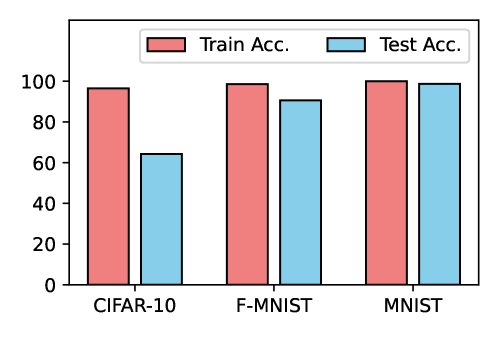
- 解决现有成员推理攻击方法(如 LiRA、EMIA)在 MNIST 和 Fashion-MNIST 等简单数据集上的表现不佳问题,这些模型并未出现过拟合现象。
- 开发计算高效的攻击方法,有效利用训练样本的成员与非成员信息。
- 在低假正例率(FPR)区域提升检测准确率,这对实现高置信度的成员推理至关重要。
- 增强攻击方法在面对差分隐私训练方法(如 DP-SGD)时的可迁移性与鲁棒性。
- 提出一个统一框架,通过准备、指示和决策三个阶段,分析并改进成员推理攻击。
提出的方法
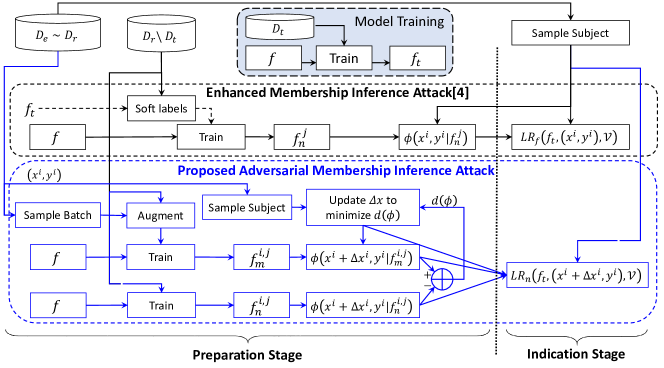
- 提出一个统一的三阶段成员推理攻击框架:准备阶段(影子模型训练)、指示阶段(基于损失的特征提取)和决策阶段(成员分类)。
- 提出对抗性成员推理攻击(AMIA),通过在样本批次上训练影子 DNN,并最小化一种新型对抗性损失函数,以利用样本附近的局部损失曲面特性。
- 在 AMIA 中设计一种新型损失函数,联合最小化成员样本的损失并最大化非成员样本的损失,从而增强成员身份的判别能力。
- 通过结合 EMIA 的软标签利用机制与 AMIA 的对抗性损失优化,开发增强版 AMIA(E-AMIA),以进一步提升攻击性能。
- 引入两种增强型指示器,整合高斯邻域损失信息,使在 1% FPR 下的 TPR 分别提升 2.5%(Fashion-MNIST)和 0.25%(MNIST)。
- 提出一种新的评估指标——运行真正例率平均值(RTA),以更准确评估低 FPR 区域的攻击性能,尤其适用于高置信度推理场景。
实验结果
研究问题
- RQ1为何现有成员推理攻击方法(如 LiRA 和 EMIA)在 MNIST 和 Fashion-MNIST 等简单数据集上表现不佳,尽管其在 CIFAR-10 和 ImageNet 等复杂数据集上表现良好?
- RQ2能否通过同时利用成员与非成员信息,提升在训练良好且未过拟合的 DNN 上的成员推理攻击效果?
- RQ3在低 FPR 区域,引入对抗性扰动和局部损失曲面信息如何提升成员推理性能?
- RQ4AMIA 和 E-AMIA 相较于 LiRA 和 EMIA,在未知 DNN 上的可迁移性如何?
- RQ5与标准 L2 正则化模型相比,AMIA 和 E-AMIA 在经过 DP-SGD 训练的 DNN 上的表现如何,是否展现出更强的抗差分隐私防御能力?
主要发现
- 在 1% FPR 下,AMIA 在 Fashion-MNIST 和 MNIST 上均实现 6% 的 TPR,显著优于 LiRA(0% TPR)和 EMIA(分别为 0% 和 2% TPR)。
- 在 1% FPR 下,E-AMIA 在 Fashion-MNIST 上实现 8% TPR,在 MNIST 上实现 4% TPR,表明其在低 FPR 区域的性能优于 LiRA 和 EMIA。
- 所提出的增强型指示器在 1% FPR 下使攻击 TPR 分别提升 2.5%(Fashion-MNIST)和 0.25%(MNIST),证明了引入邻域损失信息的有效性。
- AMIA 和 E-AMIA 比 LiRA 和 EMIA 具有更高的可迁移性,其中 AMIA 在不同网络架构间展现出最高的可迁移性。
- AMIA 和 E-AMIA 在面对 DP-SGD 训练的 DNN 时,显著优于 LiRA 和 EMIA,表明其对差分隐私防御具有更强的鲁棒性。
- 所提出的运行真正例率平均值(RTA)指标能更清晰地区分低 FPR 区域的攻击性能,相较于标准的 TPR-FPR 曲线,提供了更细致的评估能力。
阅读本论文
在 Nubint 阅读器中打开原文,边读边就任意段落提问。
在 Nubint 中阅读本论文本解读由 AI 根据论文原文生成,引用前请核对原文。