
[论文解读] Merge, Ensemble, and Cooperate! A Survey on Collaborative Strategies in the Era of Large Language Models
本综述将大语言模型(LLM)的协作分为三种方法——合并、集成和协作——并评述在利用多個LLM时的方法、改编与未来发展方向。
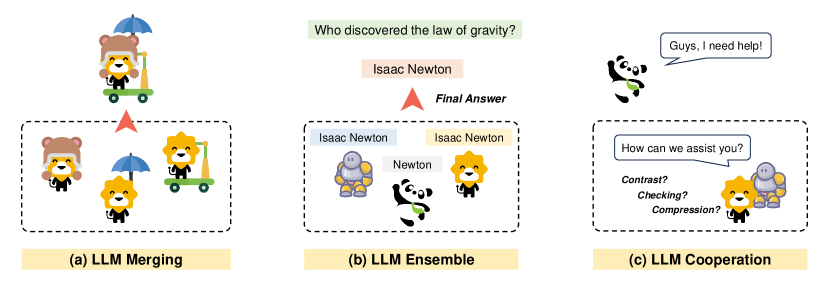
The remarkable success of Large Language Models (LLMs) has ushered natural language processing (NLP) research into a new era. Despite their diverse capabilities, LLMs trained on different corpora exhibit varying strengths and weaknesses, leading to challenges in maximizing their overall efficiency and versatility. To address these challenges, recent studies have explored collaborative strategies for LLMs. This paper provides a comprehensive overview of this emerging research area, highlighting the motivation behind such collaborations. Specifically, we categorize collaborative strategies into three primary approaches: Merging, Ensemble, and Cooperation. Merging involves integrating multiple LLMs in the parameter space. Ensemble combines the outputs of various LLMs. Cooperation} leverages different LLMs to allow full play to their diverse capabilities for specific tasks. We provide in-depth introductions to these methods from different perspectives and discuss their potential applications. Additionally, we outline future research directions, hoping this work will catalyze further studies on LLM collaborations and paving the way for advanced NLP applications.
研究动机与目标
- 考察为何多模型协作能够由于多样的优势和劣势而超过单一模型。
- 将协作策略定义并组织为合并、集成和协作。
- 在LLM时代总结各类别的技术、架构与应用。
- 突出LLM协作中的挑战、局限性及未来研究方向。
提出的方法
- 将LLM协作方法分为三类:合并(参数空间融合)、集成(输出融合)和协作(任务特定协同)。
- 在每个类别中详细描述子方法(例如,M-ROS、M-MTC、任务向量、裁剪、合并的增量训练等)。
- 描述集成范式(推理前、推理中和推理后)并解决异构LLM的词汇表/对齐挑战。
- 讨论利用多样能力提升效率、知识迁移与对齐的协作策略。
- 提供关于工具包支持(MergeKit)和LLM协作的实际注意事项的讨论。
实验结果
研究问题
- RQ1LLM的主要协作策略是什么?它们在需求和结果上有何不同?
- RQ2合并、集成与协作方法如何利用多样化的LLM优势来改善性能和适用性?
- RQ3在每个协作类别(合并、集成、协作)中,关键技术、挑战与未来方向是什么?
- RQ4实际工具与工作流程如何支持可扩展的LLM协作?
主要发现
- 合并策略旨在通过参数融合来创造更强的单一模型,M-ROS与M-MTC为核心目标。
- 集成方法着重于在推理不同阶段组合输出,以提高跨具备兼容词汇表的模型的可靠性和质量。
- 协作方法强调任务特定的协调与对多样能力的高效利用,超越简单的合并或集成。
- 研究指出同一架构的合并最为直接,而集成与协作放宽了兼容性要求,从而实现更广泛的协作。
- 实际进展包括任务向量、自适应加权、裁剪技术(DARE、DPPA)以及工具包(MergeKit)以支持合并和相关工作流程。
- 该综述概述了多种未来方向与挑战,包括对齐成本、幻觉、隐私问题,以及对可扩展评估基准的需求。
阅读本论文
在 Nubint 阅读器中打开原文,边读边就任意段落提问。
在 Nubint 中阅读本论文本解读由 AI 根据论文原文生成,引用前请核对原文。