
[论文解读] MetaAgents: Large Language Model Based Agents for Decision-Making on Teaming
论文介绍了 MetaAgents,这是一个多模块框架,使基于大型语言模型的代理能够在招聘会仿真实验中协作、协调并形成工作流来解决基于团队的任务。
Significant advancements have occurred in the application of Large Language Models (LLMs) for social simulations. Despite this, their abilities to perform teaming in task-oriented social events are underexplored. Such capabilities are crucial if LLMs are to effectively mimic human-like social behaviors and form efficient teams to solve tasks. To bridge this gap, we introduce MetaAgents, a social simulation framework populated with LLM-based agents. MetaAgents facilitates agent engagement in conversations and a series of decision making within social contexts, serving as an appropriate platform for investigating interactions and interpersonal decision-making of agents. In particular, we construct a job fair environment as a case study to scrutinize the team assembly and skill-matching behaviors of LLM-based agents. We take advantage of both quantitative metrics evaluation and qualitative text analysis to assess their teaming abilities at the job fair. Our evaluation demonstrates that LLM-based agents perform competently in making rational decisions to develop efficient teams. However, we also identify limitations that hinder their effectiveness in more complex team assembly tasks. Our work provides valuable insights into the role and evolution of LLMs in task-oriented social simulations.
研究动机与目标
- 在任务导向的社交环境中凸显具备协作能力的基于LLM的代理的需求。
- 提出一个多模块框架(感知、记忆、推理、执行)以实现代理之间的协同寻址行为。
- 评估协作生成代理是否能够在模拟招聘会中组建高效团队、分配角色并设计工作流。
- 检查在协调大量代理及对齐它们的目标方面的局限性和挑战。
提出的方法
- 提出用于协作生成代理的四模块架构:感知、记忆、推理和执行。
- 实现一种记忆机制,在对话中保留关键主题和高亮词汇,以支持鲁棒的记忆检索。
- 使用具有计划生成、反思和目标更新的推理模块来引导协同操作。
- 提供一个执行模块,具备技能函数库,使代理能够根据自身能力执行动作。
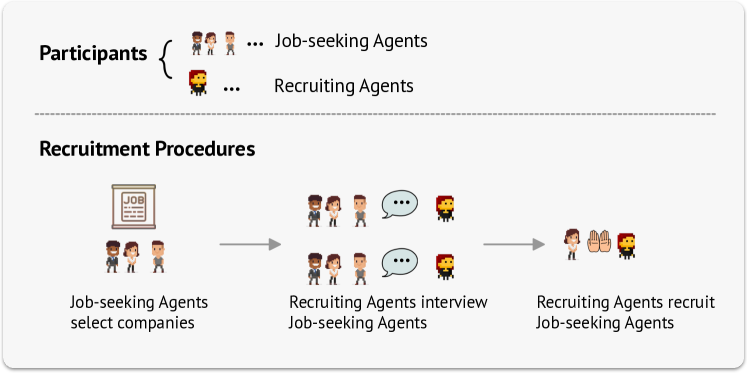
- 部署一个招聘会风格的仿真,包含招募和求职代理,以研究信息处理、招募和工作流设计。

实验结果
研究问题
- RQ1协作生成代理是否能够在招聘会仿真中形成高效团队并完成任务?
- RQ2代理是否能够动态创建利用个人专长来完成团队项目的工作流?
- RQ3参与代理数量增加时,主要的协调挑战是什么?
- RQ4推理模块在面向任务的协调中的性能影响如何?
主要发现
- 代理在理解团队工作流并利用对话生成的信息来识别合作者并分派任务方面表现出熟练度。
- 随着更多代理加入,协调性能下降,原因在于LLM的目标或意图不一致。
- 推理模块在提升面向任务的代理协调中发挥关键作用。
- 该框架显示在招聘会情景中,代理能够形成与标准开发流程(如瀑布模型)一致的团队工作流。
阅读本论文
在 Nubint 阅读器中打开原文,边读边就任意段落提问。
在 Nubint 中阅读本论文本解读由 AI 根据论文原文生成,引用前请核对原文。