
[论文解读] Metastability of the contact process on slowly evolving scale-free networks
本文研究了在缓慢演化尺度无标度网络上接触过程的亚稳态行为,其中顶点连接的更新速率依赖于度数,通过参数 $\eta$ 控制。研究识别出当感染率 $\lambda \to 0$ 时控制感染衰减的亚稳态指数,揭示了由于退化、再生和耗竭效应引起的丰富相变,并提出了一种基于鞅的新证明技术,用于在缓慢演化情形下获得上界。
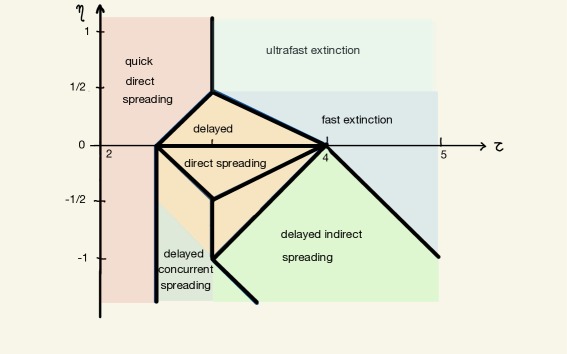
We investigate the contact process on scale-free networks evolving by a stationary dynamics whereby each vertex independently updates its connections with a rate depending on its power. This rate can be slowed down or speeded up by virtue of decreasing or increasing a parameter $η$, with $η\downarrow-\infty$ approaching the static and $η\uparrow\infty$ the mean-field case. We identify the regimes of slow, fast and ultra-fast extinction of the contact process. Slow extinction occurs in the form of metastability, when the contact process maintains a certain density of infected states for a time exponential in the network size. In our main result we identify the metastability exponents, which describe the decay of metastable densities as the infection rate goes to zero, in dependence on $η$ and the power-law exponent $τ$. While the fast evolution cases have been treated in a companion paper, Jacob, Linker, Mörters (2019), the present paper looks at the significantly more difficult cases of slow network evolution. We describe various effects, like degradation, regeneration and depletion, which lead to a rich picture featuring numerous first-order phase transitions for the metastable exponents. To capture these effects in our upper bounds we develop a new martingale based proof technique combining a local and global analysis of the process.
研究动机与目标
- 理解尺度无标度网络的缓慢时间演化如何影响接触过程中亚稳态感染的持续性。
- 识别在演化尺度无标度网络上接触过程的缓慢、快速和超快速灭绝的区域。
- 表征描述当 $\lambda \to 0$ 时亚稳态感染密度衰减的亚稳态指数。
- 分析退化、再生和耗竭效应在局部感染存活与网络层面亚稳态中的竞争作用。
- 开发一种基于鞅的新证明技术,结合局部与全局分析,用于在具有挑战性的缓慢演化区域中获得上界。
提出的方法
- 将网络建模为平稳的自主动力学系统,其中每个顶点以与其度数 $k$ 的 $\eta$ 次方成比例的速率更新连接,$\eta \in \mathbb{R}$ 控制演化速度。
- 分析此类网络上的接触过程,其中感染顶点以速率 $\lambda$ 传播,以速率 1 恢复,允许再次感染。
- 引入评分函数,并将顶点分类为“好”和“坏”顶点,以控制感染过程中的波动。
- 使用递归鞅论证来限制随时间推移每个顶点的感染邻居数量及其感染贡献。
- 应用大偏差界来控制遇到“坏”顶点的概率,确保感染过程在时间 $\tilde{T}$ 内保持稳定。
- 通过结合高阶度顶点的局部存活机制与缓慢更新下的全局网络再生效应,推导出感染传播的上界。
实验结果
研究问题
- RQ1演化速度参数 $\eta$ 如何影响尺度无标度网络上接触过程的亚稳态?
- RQ2控制 $\lambda \to 0$ 时亚稳态感染密度衰减的亚稳态指数是什么?
- RQ3退化、再生与耗竭效应如何相互作用,从而塑造亚稳态感染持续性的相结构?
- RQ4尽管网络演化缓慢,哪些机制使感染能够实现亚稳态持续存在,又在何时失效?
- RQ5新型基于鞅的证明技术是否能有效控制在以往方法失效的缓慢演化区域中的感染动力学?
主要发现
- 本文识别出依赖于演化参数 $\eta$ 和幂律指数 $\tau$ 的灭绝不同区域——缓慢、快速和超快速。
- 当感染在大小为 $N$ 的网络中以与 $N$ 指数成比例的时间维持非零密度时,出现亚稳态,其驱动力来自高阶度顶点的局部存活。
- 亚稳态指数 $\alpha$ 由 $\eta$ 与 $\tau$ 的相互作用决定,随着 $\eta$ 和 $\tau$ 的变化,指数中出现一阶相变。
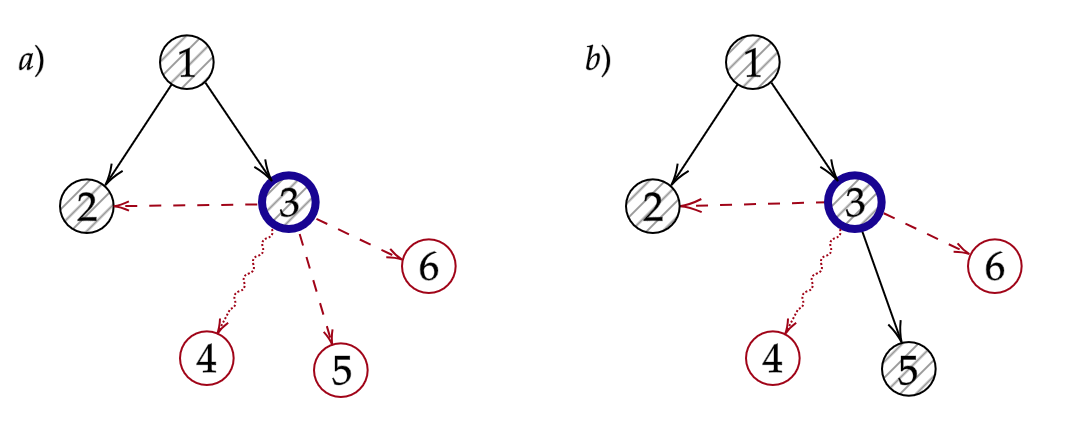
- 退化将局部感染存活时间减少至 $\sim \lambda^2 k^{1-\eta}$,但通过顶点更新实现的再生可恢复有效连通性。
- 新型基于鞅的证明技术成功控制了感染过程中的波动,使在缓慢演化区域中获得精确上界成为可能。
- 感染过程偏离亚稳态行为的失败概率在 $\lambda^{-\alpha}$ 上呈指数级小,因此当 $\lambda \to 0$ 时可忽略不计。
阅读本论文
在 Nubint 阅读器中打开原文,边读边就任意段落提问。
在 Nubint 中阅读本论文本解读由 AI 根据论文原文生成,引用前请核对原文。