
[论文解读] MG-GNN: Multigrid Graph Neural Networks for Learning Multilevel Domain Decomposition Methods
本文提出 MG-GNN,一种新颖的图神经网络架构,旨在针对非结构化网格上的偏微分方程(PDE)求解,学习两层受限加法 Schwarz(RAS)域分解方法的优化参数。通过实现跨尺度信息流动并采用一种新型无监督损失函数,MG-GNN 在收敛性能上优于经典 RAS 方法和现有 GNN 模型,且能有效泛化至远大于训练集规模的问题。
Domain decomposition methods (DDMs) are popular solvers for discretized systems of partial differential equations (PDEs), with one-level and multilevel variants. These solvers rely on several algorithmic and mathematical parameters, prescribing overlap, subdomain boundary conditions, and other properties of the DDM. While some work has been done on optimizing these parameters, it has mostly focused on the one-level setting or special cases such as structured-grid discretizations with regular subdomain construction. In this paper, we propose multigrid graph neural networks (MG-GNN), a novel GNN architecture for learning optimized parameters in two-level DDMs\@. We train MG-GNN using a new unsupervised loss function, enabling effective training on small problems that yields robust performance on unstructured grids that are orders of magnitude larger than those in the training set. We show that MG-GNN outperforms popular hierarchical graph network architectures for this optimization and that our proposed loss function is critical to achieving this improved performance.
研究动机与目标
- 解决在通用非结构化网格上优化两层域分解方法(DDMs)的挑战,其中传统参数调优困难且计算成本高昂。
- 克服现有图神经网络(GNN)在多层 PDE 求解器背景下存在的局限性,如过度平滑和长距离信息流动能力差的问题。
- 开发一种可扩展的无监督学习框架,实现从小型训练问题到大规模非结构化问题的有效泛化。
- 通过学习两层 RAS 方法中的界面条件和插值算子,提升迭代求解器的收敛速度。
提出的方法
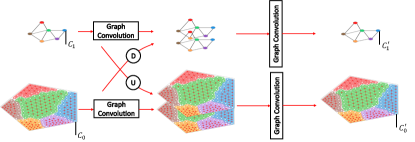
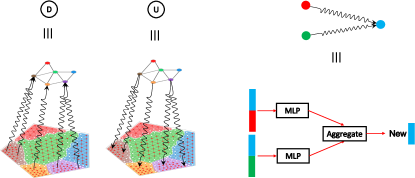
- 提出 MG-GNN,一种具备跨尺度跳跃连接的 GNN 架构,可在每一层实现粗细尺度之间的信息流动,避免对深层 GNN 堆叠的依赖。
- 设计一种新型无监督损失函数,结合残差最小化与基于迹的正则化项,以优化插值算子和界面值。
- 在具有已知 PDE 解的小型合成图上进行模型训练,随后在远大于训练集规模的非结构化网格上进行测试。
- 采用两阶段学习设置:一个模型学习界面值,另一个模型学习插值算子,第三个模型联合优化两者。
- 施加结构约束,如在插值算子中保持行和为 1,以维持物理一致性与稳定性。
- 将 MG-GNN 与图 U-Net 及经典 RAS 方法进行对比,评估其在平稳迭代次数和 FGMRES 前置条件性能方面的表现。
实验结果
研究问题
- RQ1能否设计一种 GNN 架构,有效学习非结构化网格上的多层域分解参数,实现跨尺度信息流动,同时避免因深度增加导致的过度平滑?
- RQ2所提出的无监督损失函数相较于以往损失函数,在提升两层 RAS 求解器收敛性能方面表现如何?
- RQ3在实际应用中,针对小型问题训练的模型在多大程度上能泛化至大规模非结构化 PDE 问题?
- RQ4联合学习界面值与插值算子是否优于分别学习二者?
- RQ5MG-GNN 与现有 GNN 架构(如图 U-Net)相比,在收敛速度与可扩展性方面表现如何?
主要发现
- MG-GNN 在测试问题上将平稳迭代次数最多减少 50%,优于经典两层 RAS 和先前工作中优化的一层 RAS。
- 所提出的无监督损失函数至关重要:不使用该损失函数的变体无法超越基线 RAS,甚至最佳的先前损失函数也表现更差。
- 四层 MG-GNN 达到最佳性能,且在相同层数和参数量下始终优于图 U-Net。
- 学习插值算子比仅学习界面值更具影响力,因为插值算子决定了全局粗网格校正过程。
- 模型泛化能力出色:尽管在小型问题上进行训练,仍能在远大于训练规模的非结构化网格上实现稳健性能。
- 强制施加标准 DDM 稀疏性(一对一的细网格到粗网格连接)会严重降低性能,因为它限制了模型学习有效插值模式的能力。
阅读本论文
在 Nubint 阅读器中打开原文,边读边就任意段落提问。
在 Nubint 中阅读本论文本解读由 AI 根据论文原文生成,引用前请核对原文。