
[论文解读] MiAMix: Enhancing Image Classification through a Multi-stage Augmented Mixed Sample Data Augmentation Method
MiAMix 提出一个多阶段增强混合框架,结合 AGMix 与多重 MSDA 掩码,实现自混合和掩码增强,在 modest training overhead 下提高准确性和鲁棒性。它在 CIFAR-10/100 和 Tiny-ImageNet 上优于其他低成本 MSDA 方法,同时仅增加约 ~11% 的训练开销。
Despite substantial progress in the field of deep learning, overfitting persists as a critical challenge, and data augmentation has emerged as a particularly promising approach due to its capacity to enhance model generalization in various computer vision tasks. While various strategies have been proposed, Mixed Sample Data Augmentation (MSDA) has shown great potential for enhancing model performance and generalization. We introduce a novel mixup method called MiAMix, which stands for Multi-stage Augmented Mixup. MiAMix integrates image augmentation into the mixup framework, utilizes multiple diversified mixing methods concurrently, and improves the mixing method by randomly selecting mixing mask augmentation methods. Recent methods utilize saliency information and the MiAMix is designed for computational efficiency as well, reducing additional overhead and offering easy integration into existing training pipelines. We comprehensively evaluate MiaMix using four image benchmarks and pitting it against current state-of-the-art mixed sample data augmentation techniques to demonstrate that MIAMix improves performance without heavy computational overhead.
研究动机与目标
- 通过增强基于 mixup 的数据增强来解决过拟合和标注数据有限的问题。
- 将图像增强整合到包含多重并行混合掩码的 mixup 框架中。
- 通过增强和旋转来增加混合掩码的多样性,以提升泛化能力。
- 保持计算效率并无缝集成到现有训练流程中。
提出的方法
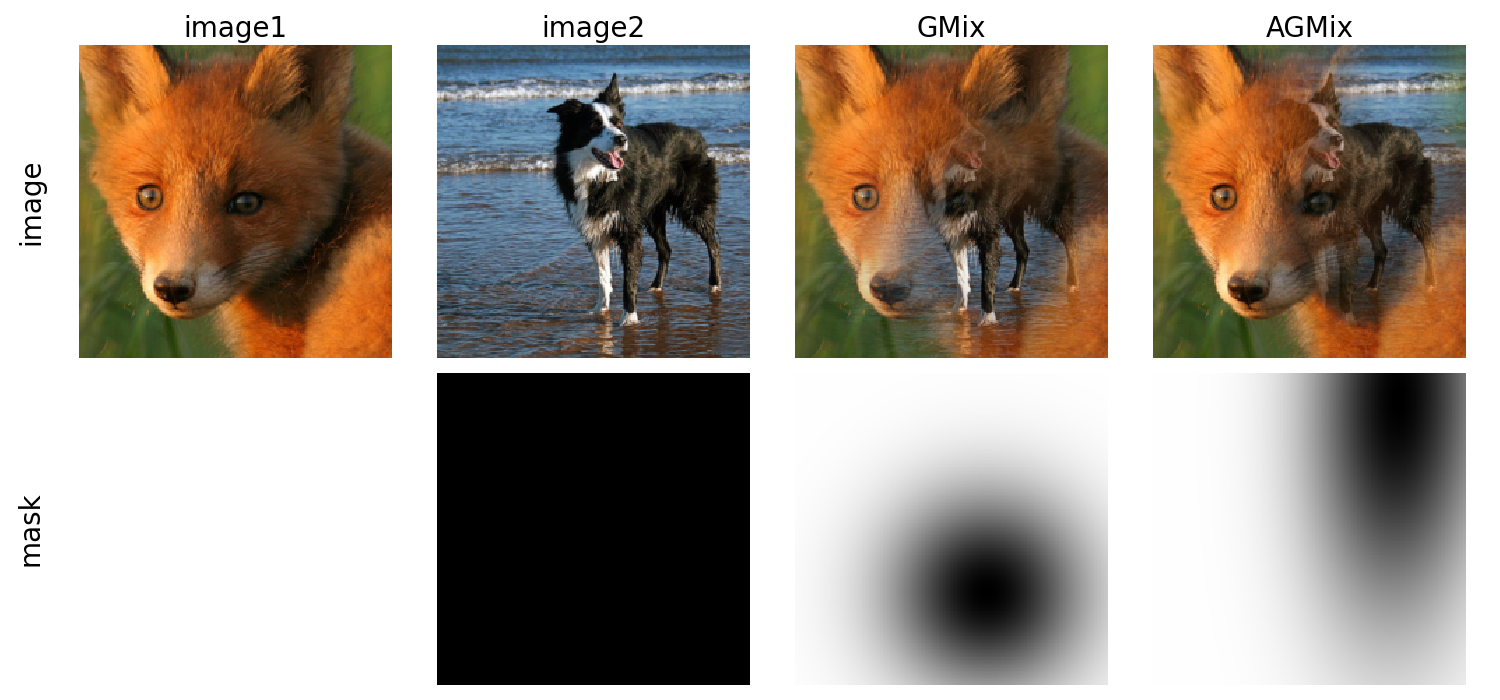
- 将 GMix 扩展为 AGMix,使用随机高斯混合核以得到多样的掩码形状。
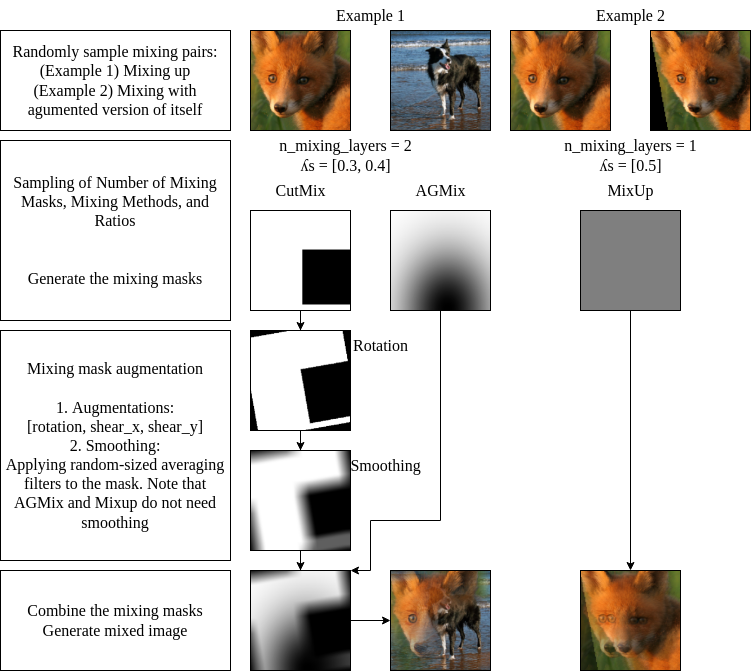
- 引入 MiAMix,包含四个阶段:随机样本配对、混合方法与比率的采样、混合掩码的生成与增强,以及混合输出的生成。
- 在使用多重掩码时,采用 Dirichlet 分布来对每个掩码的混合比率进行采样。
- 在保持混合比的前提下,通过错切、旋转和平滑来增强混合掩码(适用于非 MixUp/AGMix 方法)。
- 通过相乘将多个掩码合并(首选),得到合并后的掩码,并将最终标签混合权重计算为图像上掩码值的平均值,确保标签权重反映实际混合强度。
- 加入自混合(将图像与其增强版本进行概率性混合)以提高鲁棒性。
实验结果
研究问题
- RQ1MiAMix 是否在标准图像分类基准上优于现有的 MSDA 方法?
- RQ2与单掩码 MSDA 方法相比,多阶段掩码对泛化和鲁棒性的影响如何?
- RQ3掩码增强(错切、旋转、平滑)对性能有何影响?
- RQ4自混合对准确性和对损坏/噪声的鲁棒性有何影响?
- RQ5MSDA 集成的组成如何影响总体性能?
主要发现
- MiAMix 在 CIFAR-10、CIFAR-100 和 Tiny-ImageNet 的低成本 MSDA 方法中实现最先进的性能,训练开销适中(约 ~11% 相比 vanilla)。
- MiAMix 在所评估的数据集上超越 AutoMix,同时增加的计算成本远低于 AutoMix。
- AGMix(增强版 GMix)通过提供更丰富的混合输出提升了 GMix 的表现,在各数据集上均有提升。
- 掩码增强和多层混合显著提高 Top-1 准确率,随机化层数带来额外收益。
- 将多种 MSDA 方法(包括 MixUp、CutMix、FMix、GridMix 和 AGMix)进行集成有助于提升性能;移除任一方法都会降低准确率。
- 自混合(约 10%)提高鲁棒性,尤其是在受损数据(CIFAR-100-C)上。
阅读本论文
在 Nubint 阅读器中打开原文,边读边就任意段落提问。
在 Nubint 中阅读本论文本解读由 AI 根据论文原文生成,引用前请核对原文。