
[论文解读] Microscopic Examination of SRF-quality Nb Films through Local Nonlinear Microwave Response
本研究利用近场磁微波显微镜测绘了采用直流磁控溅射(DCMS)和高电离溅射(HiPIMS)技术生长的超导射频(SRF)质量铌薄膜的局部非线性微波响应,重点关注三次谐波功率(P₃f)。研究发现HiPIMS薄膜中存在一个持久的低临界温度(Tc)表面缺陷(6.3–6.8 K),可能源于氧化的晶界。研究还表明,结合P₃f测量与时间依赖的金兹堡-朗道(TDGL)模拟,可定量探测涡旋成核深度与缺陷密度,从而识别出适用于SRF应用的最优薄膜。
The performance of superconducting radio-frequency (SRF) cavities is sometimes limited by local defects. To investigate the RF properties of these local defects, especially those that nucleate RF magnetic vortices, a near-field magnetic microwave microscope is employed. Local third harmonic response (P3f) and its temperature-dependence and RF power-dependence are measured for one Nb/Cu film grown by Direct Current Magnetron Sputtering (DCMS) and six Nb/Cu films grown by High Power Impulse Magnetron Sputtering (HiPIMS) with systematic variation of deposition conditions. Five out of the six HiPIMS Nb/Cu films show a strong third harmonic response that is likely coming from RF vortex nucleation due to a low-Tc surface defect with a transition temperature between 6.3 K and 6.8 K, suggesting that this defect is a generic feature of air-exposed HiPIMS Nb/Cu films. A phenomenological model of surface defect grain boundaries hosting a low-Tc impurity phase is introduced and studied with Time-Dependent Ginzburg-Landau (TDGL) simulations of probe/sample interaction to better understand the measured third harmonic response. The simulation results show that the third harmonic response of RF vortex nucleation caused by surface defects exhibits the same general features as the data, including peaks in third harmonic response with temperature, and their shift and broadening with higher microwave amplitude. We find that the parameters of the phenomenological model (the density of surface defects that nucleate RF vortices and the depth an RF vortex travels through these surface defects) vary systematically with film deposition conditions. From the point of view of these two properties, the Nb/Cu film that is most effective at reducing the nucleation of RF vortices associated with surface defects can be identified.
研究动机与目标
- 研究限制超导射频(SRF)铌薄膜腔体性能的缺陷局部射频特性。
- 识别HiPIMS生长的Nb/Cu薄膜中持久三次谐波微波响应(P₃f)的来源与特征。
- 开发一种结合局部P₃f测量与TDGL模拟的方法,以定量表征缺陷诱导的涡旋成核与表面缺陷密度。
- 基于缺陷相关的非线性微波响应,识别出最适合SRF应用的Nb薄膜。
提出的方法
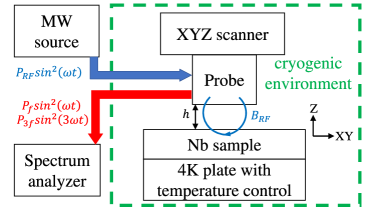
- 采用扫描线圈近场磁微波显微镜测量Nb/Cu薄膜的局部三次谐波微波响应(P₃f)。
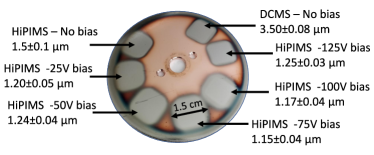
- 系统性地改变HiPIMS生长Nb薄膜的沉积条件,并与DCMS生长的薄膜进行对比。
- 测量P₃f随温度(2–10 K)和射频功率(0.1–10 mW)的变化,以探究缺陷行为。
- 进行时间依赖的金兹堡-朗道(TDGL)模拟,以建模表面缺陷处的涡旋成核。
- 模拟两种缺陷模型:含低Tc杂质的晶界,以及Tc降低的局域表面缺陷。
- 利用模拟的P₃f响应,从实验数据中定性提取涡旋穿透深度与缺陷密度。
实验结果
研究问题
- RQ1为何在大多数HiPIMS生长的Nb薄膜中观察到强烈的、持久的三次谐波微波响应(P₃f)?
- RQ2P₃f的温度与射频功率依赖性如何揭示SRF质量Nb薄膜中局部缺陷的性质?
- RQ3TDGL模拟能否定量解释来自表面缺陷的观测P₃f响应?
- RQ4P₃f测量在多大程度上可用于推断在缺陷处成核的涡旋密度与穿透深度?
- RQ5在七种测试的Nb薄膜中,哪一种表现出最有利于SRF腔体应用的局部射频特性?
主要发现
- 六种HiPIMS生长的Nb/Cu薄膜中有五种表现出强烈的、温度依赖的P₃f响应,其转变温度在6.3 K至6.8 K之间,表明存在一种共同的低Tc表面缺陷。
- P₃f响应归因于Tc降低的表面缺陷,可能源于氧化铌或含有杂质的晶界。
- TDGL模拟表明,此类缺陷处的射频涡旋成核可定量解释P₃f响应随温度与射频场的变化。
- 模拟结果表明,涡旋穿透深度随射频场振幅增加而增大,在5.4 K时,当外场为56.6 mT时穿透深度约为93.5 nm,当外场为67.9 mT时约为110.6 nm。
- P₃f响应可定性地提取出成核涡旋的表面缺陷密度以及涡旋穿透的深度。
- DCMS生长的Nb薄膜未表现出显著的P₃f响应,表明其在局部缺陷抑制方面优于HiPIMS薄膜。
阅读本论文
在 Nubint 阅读器中打开原文,边读边就任意段落提问。
在 Nubint 中阅读本论文本解读由 AI 根据论文原文生成,引用前请核对原文。