
[论文解读] Milky Way and Andromeda analogs from the TNG50 simulation
本论文在 TNG50 模拟中定义并编目银河系及仙女座样星系,提供一个基准选择、数据产品及与真实银河系和仙女座的比较。
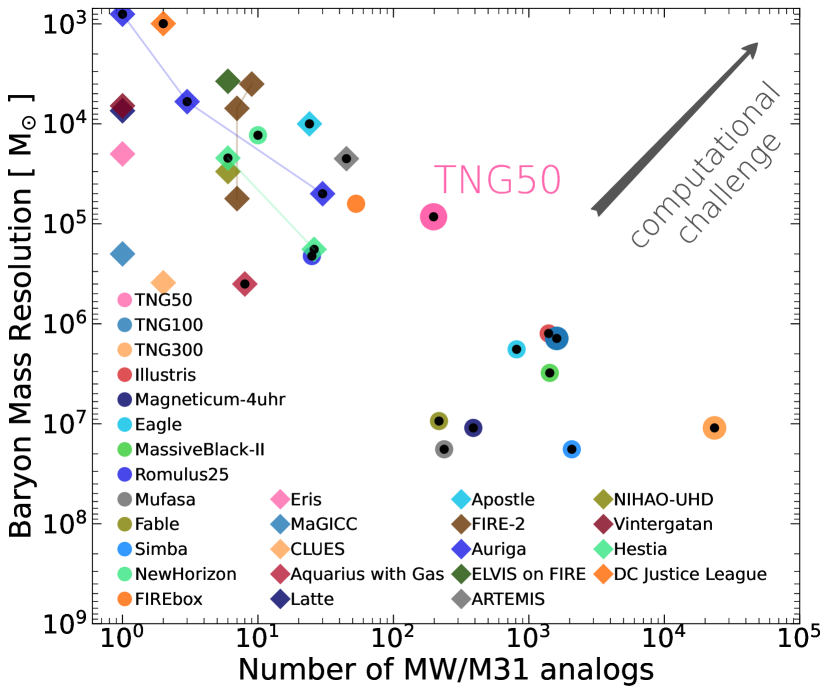
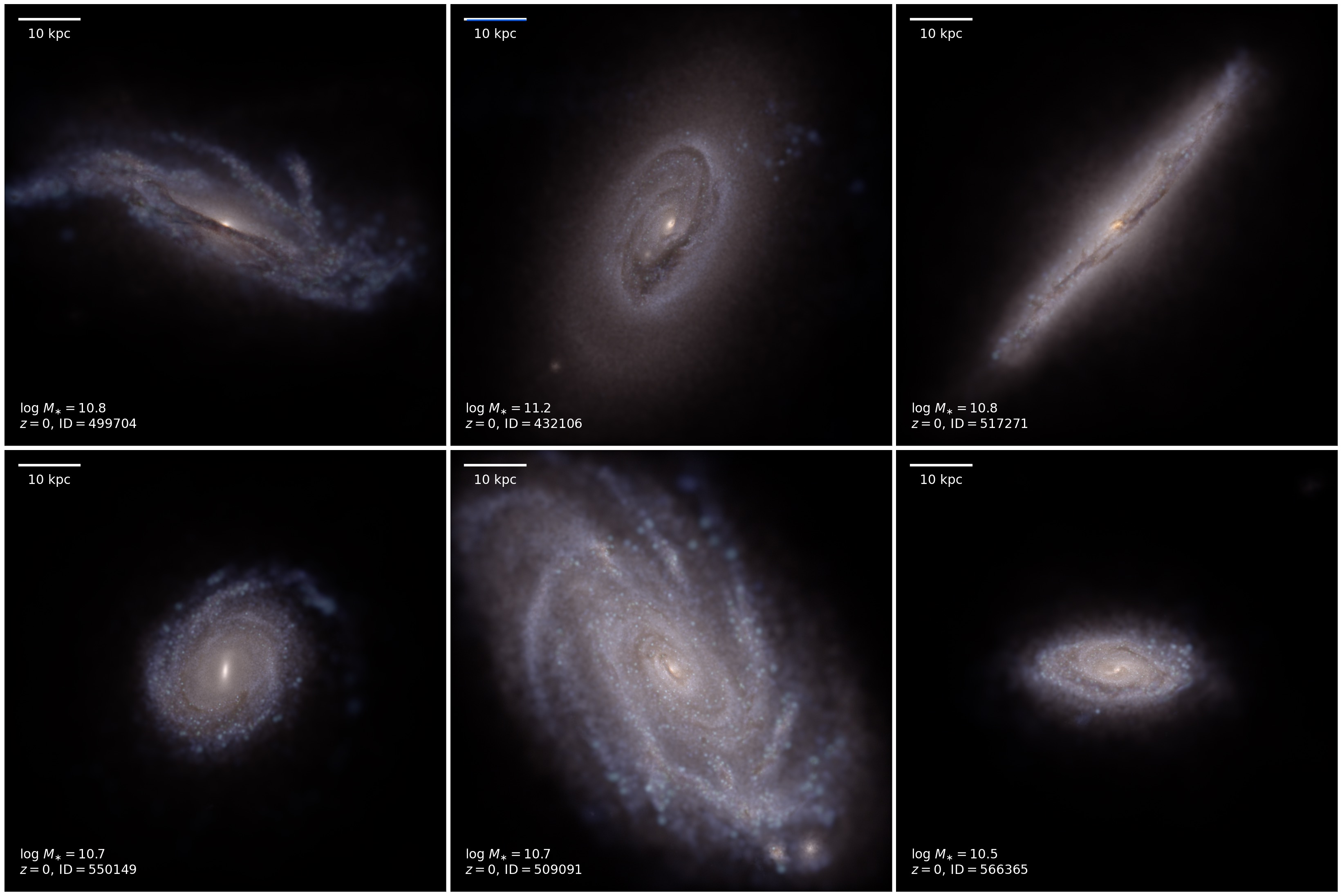
We present the properties of Milky Way- and Andromeda-like (MW/M31-like) galaxies simulated within TNG50, the highest-resolution run of the IllustrisTNG suite of $Λ$CDM magneto-hydrodynamical simulations. We introduce our fiducial selection for MW/M31 analogs, which we propose for direct usage as well as for reference in future analyses. TNG50 contains 198 MW/M31 analogs, i.e. galaxies with stellar disky morphology, with a stellar mass in the range of $M_* = 10^{10.5 - 11.2}$ Msun, and within a MW-like Mpc-scale environment at z=0. These are resolved with baryonic (dark matter) mass resolution of $8.5 imes10^4$ Msun ($4.5 imes10^5$ Msun) and $\sim150$ pc of average spatial resolution in the star-forming regions: we therefore expand by many factors (2 orders of magnitude) the sample size of cosmologically-simulated analogs with similar ($ imes 10$ better) numerical resolution. The majority of TNG50 MW/M31 analogs at $z=0$ exhibit a bar, 60 per cent are star-forming, the sample includes 3 Local Group (LG)-like systems, and a number of galaxies host one or more satellites as massive as e.g. the Magellanic Clouds. Even within such a relatively narrow selection, TNG50 reveals a great diversity in galaxy and halo properties, as well as in past histories. Within the TNG50 sample, it is possible to identify several simulated galaxies whose integral and structural properties are consistent, one or more at a time, with those measured for the Galaxy and Andromeda. With this paper, we document and release a series of broadly applicable data products that build upon the IllustrisTNG public release and aim to facilitate easy access and analysis by public users. These include datacubes across snapshots ($0 \le z \le 7$) for each TNG50 MW/M31-like galaxy, and a series of value-added catalogs that will be continually expanded to provide a convenient and up to date community resource.
研究动机与目标
- 在 TNG50 中定义一个基于可观测属性的基准银河系/仙女座拟像选择标准。
- 量化宇宙体积内银河系/仙女座样星系的多样性及性质。
- 评估 TNG50 中银河系/仙女座拟像与实际银河系和仙女座在各项特征上的符合程度。
- 发布数据产品和目录,以促进公众使用和未来分析。
提出的方法
- 使用 TNG50 宇宙学磁流体动力学模拟,星形成区域分辨率 ~150 pc,包含 SMBH 反馈。
- 在 z=0 通过恒星质量、盘状形态和类似银河环境等标准识别银河系/仙女座样星系。
- 定义一个满足质量、形态和环境约束的拟合银河系/仙女座子集,包含 198 颗星系。
- 在快照 (0≤z≤7) 提供数据立方体并在 IllustrisTNG 发布基础上构建增值目录。
实验结果
研究问题
- RQ1在宇宙学模拟中,哪些可观测属性标准可以稳健地选择银河系/仙女座拟像?
- RQ2在 TNG50 中,银河系/仙女座样星系在环境、结构和历史方面有多大程度的多样性?
- RQ3TNG50 的银河系/仙女座拟像在总体和结构特征上在多大程度上与银河系和仙女座相似?
- RQ4哪些数据产品和目录最能促进公众对这些拟像的分析?
主要发现
- TNG50 包含 198 个以 M*>10^{10.5-11.2} Msun、盘状形态和 MW 样环境在 z=0 时被定义的银河系/仙女座拟像。
- 该样本在环境、整体属性与结构特征上呈现多样性,包括一些 satellites 的质量与大麦哲伦星云相当。
- 大多数拟像在星际形成方面活跃,且许多拥有关节棒,显示在相对窄的恒星质量范围内的多样性。
- 若干模拟星系在不同属性上与银河系和仙女座一致,证明它们在针对性比较中具有有用的拟像意义。
阅读本论文
在 Nubint 阅读器中打开原文,边读边就任意段落提问。
在 Nubint 中阅读本论文本解读由 AI 根据论文原文生成,引用前请核对原文。