
[论文解读] MiniGPT-v2: large language model as a unified interface for vision-language multi-task learning
提出 MiniGPT-v2,这是一种使用任务特定标识符和三阶段训练来处理多任务(如 VQA、描述生成和定位)的统一视觉-语言模型,在各基准上取得接近甚至达到最先行的结果。
Large language models have shown their remarkable capabilities as a general interface for various language-related applications. Motivated by this, we target to build a unified interface for completing many vision-language tasks including image description, visual question answering, and visual grounding, among others. The challenge is to use a single model for performing diverse vision-language tasks effectively with simple multi-modal instructions. Towards this objective, we introduce MiniGPT-v2, a model that can be treated as a unified interface for better handling various vision-language tasks. We propose using unique identifiers for different tasks when training the model. These identifiers enable our model to better distinguish each task instruction effortlessly and also improve the model learning efficiency for each task. After the three-stage training, the experimental results show that MiniGPT-v2 achieves strong performance on many visual question-answering and visual grounding benchmarks compared to other vision-language generalist models. Our model and codes are available at https://minigpt-v2.github.io/
研究动机与目标
- 通过简单指令建立一个能够执行多样化视觉-语言任务的单一模型。
- 引入任务特定标识符以减少跨任务的指令歧义。
- 设计三阶段训练课程以利用弱标注、细粒度和多模态指令数据。
- 在训练投影层和 LoRA 调整的语言模型时保持视觉骨干冻结。
- 在 VQA 和指称表达基准测试上展示与VL-generalist 模型相比的强劲性能。
提出的方法
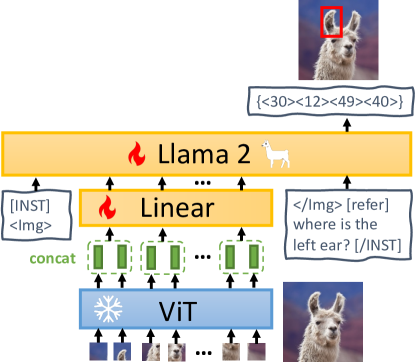
- 使用冻结的基于 ViT 的视觉骨干(EVA)以 448x448 分辨率提取视觉标记。
- 将每四个相邻的视觉标记连接起来以降低序列长度,并通过线性投影映射到 LLaMA-2 空间。
- 采用 LLaMA-2-chat 作为多模态输入的统一语言接口。
- 引入每个任务的标识符标记(如 [vqa]、[caption]、[grounding]、[refer]、[identify]、[detection])以按任务条件化所有数据。
- 分三阶段训练:Stage 1 在弱标注和细粒度数据上构建广泛的 VL 知识;Stage 2 在细粒度数据上聚焦每个任务;Stage 3 在多模态指令微调和对话能力上训练,包括 LLaVA、Flickr30k 和 Unnatural Instruction 数据集。
- 在保持视觉骨干冻结的同时,对语言模型进行 LoRA(秩 64)微调。
实验结果
研究问题
- RQ1一个通过任务特定标识符训练的单一视觉-语言模型是否可以在竞争性准确性下执行多任务 VL?
- RQ2面向任务的指令是否能提升多任务学习在 VQA、描述生成、定位和 REC/REG 的效率和准确性?
- RQ3多阶段训练和指令微调在提升定位和开放式 VL 能力方面有多大程度的改进?
- RQ4MiniGPT-v2 与 VL-generalist 和专门模型在标准 VQA 和 REC 基准上的对比如何?
主要发现
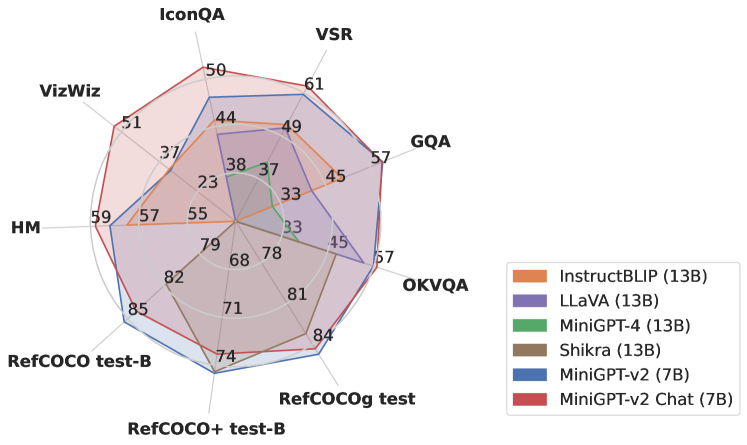
- 与 MiniGPT-4、InstructBLIP、LLaVA 和 Shikra 等视觉-语言通用模型相比,MiniGPT-v2 在多样化的 VL 基准上达到最先进或具竞争力的结果。
- 在 VSR 基准上,MiniGPT-v2 的表现领先 MiniGPT-4 21.3%、InstructBLIP 11.3%、LLaVA 11.7%(摘要中的表格文本)。
- 聊天版本(MiniGPT-v2 chat)通常优于非聊天版本,例如在 OKVQA、VSR、IconVQA、VizWiz 和 HM 上的提升(结果部分列出相对提升)。
- 在 REC 中,MiniGPT-v2 在 RefCOCO/RefCOCO+/RefCOCOg 上的准确率超过 OFA-L 8% 以上,并且与 Shikra(13B)保持竞争力。
- 消融实验显示,与没有任务标识符的版本相比,新增任务标识符在 VQA 基准上平均顶级准确率提升约 1.2%。
- 定性结果证明在对象识别、基于定位的图像描述、VQA 与 REC 等方面的能力,并且在有限指令数据的新任务上具有良好泛化。
阅读本论文
在 Nubint 阅读器中打开原文,边读边就任意段落提问。
在 Nubint 中阅读本论文本解读由 AI 根据论文原文生成,引用前请核对原文。