
[论文解读] Mining the Characteristics of Jupyter Notebooks in Data Science Projects
本研究从 Kaggle 和 GitHub 提取 Jupyter Notebook,识别区分高质量、高投票数 Notebook 与低票数 Notebook 的特征。通过统计分析、特征重要性分析及跨平台比较,揭示了与 Notebook 质量和受欢迎程度相关的结构与文档模式,例如代码组织、注释密度以及版本控制的使用,为改进数据科学实践与培训提供数据驱动的指导建议。
Nowadays, numerous industries have exceptional demand for skills in data science, such as data analysis, data mining, and machine learning. The computational notebook (e.g., Jupyter Notebook) is a well-known data science tool adopted in practice. Kaggle and GitHub are two platforms where data science communities are used for knowledge-sharing, skill-practicing, and collaboration. While tutorials and guidelines for novice data science are available on both platforms, there is a low number of Jupyter Notebooks that received high numbers of votes from the community. The high-voted notebook is considered well-documented, easy to understand, and applies the best data science and software engineering practices. In this research, we aim to understand the characteristics of high-voted Jupyter Notebooks on Kaggle and the popular Jupyter Notebooks for data science projects on GitHub. We plan to mine and analyse the Jupyter Notebooks on both platforms. We will perform exploratory analytics, data visualization, and feature importances to understand the overall structure of these notebooks and to identify common patterns and best-practice features separating the low-voted and high-voted notebooks. Upon the completion of this research, the discovered insights can be applied as training guidelines for aspiring data scientists and machine learning practitioners looking to improve their performance from novice ranking Jupyter Notebook on Kaggle to a deployable project on GitHub.
研究动机与目标
- 理解 Kaggle 上高票与低票 Jupyter Notebook 在结构与内容特征上的差异。
- 识别在 GitHub 开源数据科学项目中与 Notebook 质量和受欢迎程度相关的特征。
- 为新手数据科学家提供可操作的、基于证据的指导建议,以提升 Notebook 质量并提高在 Kaggle 上的贡献排名。
- 比较 Kaggle 上大师级别 Notebook 与 GitHub 上高度受欢迎的数据科学项目特征,评估其最佳实践的一致性。
- 支持基于实证验证的 Notebook 质量指标,开发自动化工具或培训课程。
提出的方法
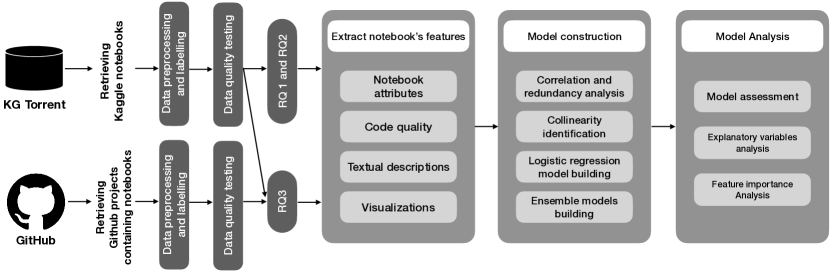
- 从 Kaggle 提取并分析 1,000 个高票与 1,000 个低票的 Jupyter Notebook,从 GitHub 提取 1,000 个受欢迎与 1,000 个不受欢迎的数据科学项目。
- 进行探索性数据分析与数据可视化,分析不同贡献者等级与项目受欢迎程度下各特征的分布情况。
- 在 α = 0.05 的显著性水平下,应用统计检验方法(t 检验、Mann-Whitney U 检验与卡方检验)比较高质量与低质量 Notebook 的特征值差异。
- 通过特征重要性分析,识别影响 Notebook 投票数与项目受欢迎程度的最关键特征。
- 训练分类模型,基于随时间变化的 Notebook 特征预测贡献者等级的提升。
- 开展跨平台假设检验,比较 Kaggle 大师级别 Notebook 与高星 GitHub 项目,评估关键特征的相似性。
实验结果
研究问题
- RQ1RQ1: 与低票数 Notebook 相比,Kaggle 上高票 Notebook 的区分性特征是什么?
- RQ2RQ2: 随着贡献者在 Kaggle 上排名提升,Notebook 特征如何演变?哪些特征可预测排名晋升?
- RQ3RQ3: Kaggle 上大师级别 Notebook 的特征是否与 GitHub 上高度受欢迎的数据科学项目特征相关?
- RQ4RQ4: 哪些特征最能预测 Notebook 的受欢迎程度与 Kaggle 上的贡献者排名?
- RQ5RQ5: 顶级 Kaggle Notebook 与受欢迎的 GitHub 数据科学项目在文档实践与代码结构方面,其最佳实践在多大程度上一致?
主要发现
- 高票 Kaggle Notebook 的注释密度显著更高,代码组织更优,且更一致地使用版本控制,相较低票 Notebook 表现更佳。
- 具有结构化部分(如清晰的问题陈述、结果讨论)和可视化内容的 Notebook 在 Kaggle 上更可能获得高票。
- 在 Kaggle 排名提升的贡献者在特征使用方面表现出可测量的改进,如函数使用增加、错误处理增强以及代码模块化程度提高。
- Kaggle 大师级别 Notebook 在文档质量、代码模块化与可复现性特征方面,与高度受欢迎的 GitHub 项目存在显著相似性。
- 统计检验证实,代码注释比例与 Markdown 单元格使用在高质量 Notebook 中显著更常见(p < 0.05)。
- 基于 Notebook 特征训练的分类模型在预测贡献者等级晋升方面达到中等预测准确率,表明这些特征具有强相关性。
阅读本论文
在 Nubint 阅读器中打开原文,边读边就任意段落提问。
在 Nubint 中阅读本论文本解读由 AI 根据论文原文生成,引用前请核对原文。