
[论文解读] Mitigating Accuracy-Robustness Trade-off via Balanced Multi-Teacher Adversarial Distillation
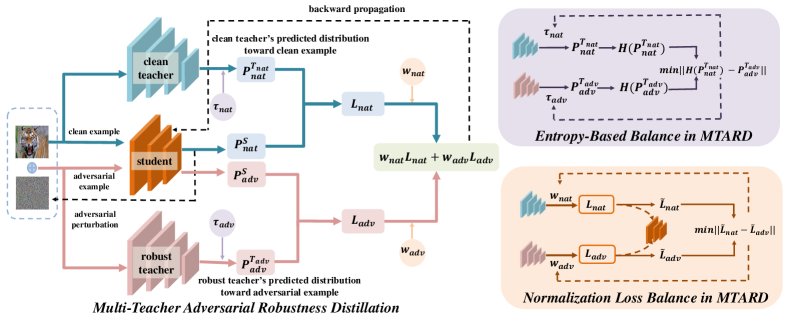
该论文提出了一种新型知识蒸馏框架——多教师对抗鲁棒性蒸馏(MTARD),通过使用一个干净教师模型和一个鲁棒教师模型,同时提升模型的准确率与对抗鲁棒性。通过引入基于熵的温度平衡和归一化损失加权机制,MTARD缓解了准确率与鲁棒性之间的权衡问题,在多种对抗攻击下于CIFAR-10、CIFAR-100和Tiny-ImageNet数据集上取得了最先进性能。
Adversarial Training is a practical approach for improving the robustness of deep neural networks against adversarial attacks. Although bringing reliable robustness, the performance towards clean examples is negatively affected after Adversarial Training, which means a trade-off exists between accuracy and robustness. Recently, some studies have tried to use knowledge distillation methods in Adversarial Training, achieving competitive performance in improving the robustness but the accuracy for clean samples is still limited. In this paper, to mitigate the accuracy-robustness trade-off, we introduce the Balanced Multi-Teacher Adversarial Robustness Distillation (B-MTARD) to guide the model's Adversarial Training process by applying a strong clean teacher and a strong robust teacher to handle the clean examples and adversarial examples, respectively. During the optimization process, to ensure that different teachers show similar knowledge scales, we design the Entropy-Based Balance algorithm to adjust the teacher's temperature and keep the teachers' information entropy consistent. Besides, to ensure that the student has a relatively consistent learning speed from multiple teachers, we propose the Normalization Loss Balance algorithm to adjust the learning weights of different types of knowledge. A series of experiments conducted on three public datasets demonstrate that B-MTARD outperforms the state-of-the-art methods against various adversarial attacks.
研究动机与目标
- 解决对抗训练中持续存在的准确率-鲁棒性权衡问题,即提升鲁棒性常导致干净数据准确率下降。
- 克服单教师知识蒸馏的局限性,后者因模型固有的权衡而无法同时优化干净准确率与鲁棒性。
- 开发一种多教师蒸馏框架,将干净样本与对抗样本的指导解耦,以实现平衡学习。
- 通过解决知识尺度与学习难度的固有差异,确保来自多个教师的知识转移保持平衡。
- 在多种基准数据集上,面对多样化对抗攻击,实现干净准确率与鲁棒性的最先进性能。
提出的方法
- 提出双教师框架:一个在干净数据上具有高准确率的干净教师,以及一个在对抗样本上具有高鲁棒性的鲁棒教师。
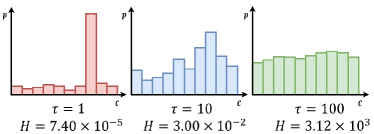
- 提出基于熵的平衡算法(Entropy-Based Balance),动态调整每个教师软标签的温度,确保两教师间信息熵一致,从而平衡知识尺度。
- 设计归一化损失平衡算法(Normalization Loss Balance),动态加权来自每个教师的蒸馏损失,确保学生以均衡速率学习两类知识。
- 结合对抗训练与知识蒸馏,使学生在干净输入上模仿干净教师,在对抗输入上模仿鲁棒教师。
- 使用组合损失函数,结合干净数据上的交叉熵损失、对抗损失以及来自两个教师的蒸馏损失,并采用自适应加权以防止某一教师主导。
- 应用梯度估计与AutoAttack(包括PGD和Square Attack)评估鲁棒性,并确认对“梯度混淆”(obfuscated gradients)不敏感——这是防御评估中常见的假阳性问题。
实验结果
研究问题
- RQ1多教师蒸馏框架能否有效缓解对抗训练中的准确率-鲁棒性权衡问题?
- RQ2如何平衡来自干净教师与鲁棒教师的知识,以防止其中一方主导学生的学习过程?
- RQ3将干净知识与对抗知识的迁移过程解耦,是否能在干净准确率与鲁棒性两方面均优于单教师蒸馏?
- RQ4基于熵的温度缩放能否有效对齐性能特征截然不同的两教师的知识尺度?
- RQ5所提方法在强黑盒与白盒对抗攻击(包括梯度估计攻击)下是否依然保持鲁棒性?
主要发现
- MTARD在ResNet-18上实现了SOTA级别的鲁棒准确率,在CIFAR-10、CIFAR-100和Tiny-ImageNet上面对多种攻击均优于现有对抗训练与蒸馏方法。
- 在MobileNet-v2上,MTARD相较基线方法在CIFAR-10上提升干净准确率5.56%,在CIFAR-100上提升4.78%,在Tiny-ImageNet上提升3.31%。
- 该方法能有效抵抗强对抗攻击:在AutoAttack(PGD与Square Attack)下,CIFAR-10的鲁棒准确率超过60%,CIFAR-100超过30%,展现出强大的泛化能力。
- 对MTARD保护的ResNet-18实施梯度估计攻击(GE)后,CIFAR-10上的鲁棒准确率达到60.34%,证实其不被‘梯度混淆’问题所影响。
- 出人意料的是,较小的教师模型(如ResNet-56和WideResNet-34-10)在指导学生方面优于更大的模型(如WideResNet-70-16),表明模型大小并非蒸馏效果的决定性因素。
- 学生的性能并未严格受限于教师的参数量或原始性能,表明即使使用较小但精心选择的教师,也能实现高效蒸馏。
阅读本论文
在 Nubint 阅读器中打开原文,边读边就任意段落提问。
在 Nubint 中阅读本论文本解读由 AI 根据论文原文生成,引用前请核对原文。