
[论文解读] MixFormer: End-to-End Tracking with Iterative Mixed Attention
MixFormer 是一个端到端的基于变换器的跟踪器,通过混合注意力模块(MAM)统一特征提取和目标信息整合,支持多模板和非对称注意力,实现高效在线跟踪。
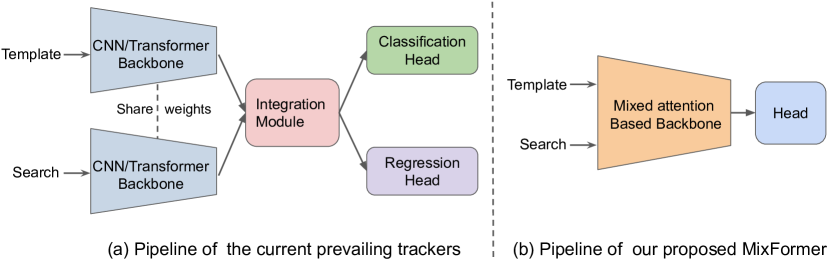
Tracking often uses a multi-stage pipeline of feature extraction, target information integration, and bounding box estimation. To simplify this pipeline and unify the process of feature extraction and target information integration, we present a compact tracking framework, termed as MixFormer, built upon transformers. Our core design is to utilize the flexibility of attention operations, and propose a Mixed Attention Module (MAM) for simultaneous feature extraction and target information integration. This synchronous modeling scheme allows to extract target-specific discriminative features and perform extensive communication between target and search area. Based on MAM, we build our MixFormer tracking framework simply by stacking multiple MAMs with progressive patch embedding and placing a localization head on top. In addition, to handle multiple target templates during online tracking, we devise an asymmetric attention scheme in MAM to reduce computational cost, and propose an effective score prediction module to select high-quality templates. Our MixFormer sets a new state-of-the-art performance on five tracking benchmarks, including LaSOT, TrackingNet, VOT2020, GOT-10k, and UAV123. In particular, our MixFormer-L achieves NP score of 79.9% on LaSOT, 88.9% on TrackingNet and EAO of 0.555 on VOT2020. We also perform in-depth ablation studies to demonstrate the effectiveness of simultaneous feature extraction and information integration. Code and trained models are publicly available at https://github.com/MCG-NJU/MixFormer.
研究动机与目标
- 提出一个紧凑的端到端跟踪器,消除显式分离的特征提取与信息整合阶段。
- 通过单一的变换器骨干网络统一目标模板和搜索区域的处理。
- 通过非对称注意力和基于分数的模板更新机制实现高效的在线模板处理。
- 在多个跟踪基准上展示最先进的性能。
提出的方法
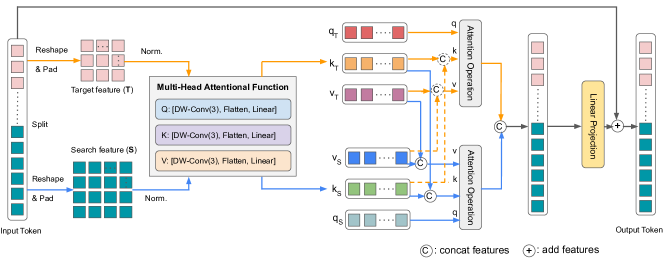
- 引入 Mixed Attention Module (MAM),对目标和搜索令牌执行自注意力,并在两者之间执行交叉注意力,通过连接的令牌序列实现。
- 可选地应用非对称的 MAM,裁剪目标到搜索的交叉注意力以减少计算并支持多模板。
- 通过堆叠 N 个 MAM,结合渐进的 patch 嵌入和一个简单的定位头(基于角点或基于查询)来构建 MixFormer。
- 使用分数预测模块(SPM)来选择高质量的在线模板,从而实现鲁棒的在线更新。
- 采用两阶段训练:在 CVT 模型上预训练 MAM,然后在目标数据集上进行联合微调,使用 L1 和 GIoU 损失进行定位。
- 推理阶段,将一个静态模板与在线模板和搜索区域融合同化,以在无需后处理的情况下生成边界框。
实验结果
研究问题
- RQ1一个具备 Mixed Attention 的统一变换器骨干是否能够在跟踪中同时执行特征提取和目标信息整合?
- RQ2非对称混合注意力是否足以减少计算量,从而支持多模板在线而不牺牲精度?
- RQ3基于分数的模板更新机制在外观变化下维持跟踪鲁棒性方面有多有效?
- RQ4使用不同的定位头(基于角点 vs. 基于查询)对端到端跟踪性能有何影响?
主要发现
- MixFormer 在五个基准测试上达到最先进的性能:LaSOT、TrackingNet、VOT2020、GOT-10k 和 UAV123。
- 混合注意力模块实现了特征提取与目标-搜索信息融合的同时进行,提升目标特异性的判别特征。
- 非对称的 MAM 减少了计算并支持多模板在线,且精度损失极小。
- 分数预测模块有效筛选模板,改善在线更新决策。
- 两种定位头风格(基于角点和基于查询)展示了骨干的泛化能力,角点头在无需后处理的情况下提供了强劲的性能。
阅读本论文
在 Nubint 阅读器中打开原文,边读边就任意段落提问。
在 Nubint 中阅读本论文本解读由 AI 根据论文原文生成,引用前请核对原文。