
[论文解读] MixPro: Data Augmentation with MaskMix and Progressive Attention Labeling for Vision Transformer
MixPro 提出了一种新颖的视觉变换器数据增强方法,通过引入可调节的、以图像块为单位的掩码(MaskMix),在保持全局上下文的同时混合图像;并采用渐进注意力标签重加权(Progressive Attention Labeling, PAL),动态调整基于注意力的标签置信度,以减少早期训练中不可靠注意力图带来的噪声。该方法在使用 DeiT-T 的情况下,ImageNet 上达到 73.8% 的 top-1 准确率,优于 TransMix 在多个基准上的表现,并提升了在语义分割和目标检测等下游任务中的迁移能力。
The recently proposed data augmentation TransMix employs attention labels to help visual transformers (ViT) achieve better robustness and performance. However, TransMix is deficient in two aspects: 1) The image cropping method of TransMix may not be suitable for ViTs. 2) At the early stage of training, the model produces unreliable attention maps. TransMix uses unreliable attention maps to compute mixed attention labels that can affect the model. To address the aforementioned issues, we propose MaskMix and Progressive Attention Labeling (PAL) in image and label space, respectively. In detail, from the perspective of image space, we design MaskMix, which mixes two images based on a patch-like grid mask. In particular, the size of each mask patch is adjustable and is a multiple of the image patch size, which ensures each image patch comes from only one image and contains more global contents. From the perspective of label space, we design PAL, which utilizes a progressive factor to dynamically re-weight the attention weights of the mixed attention label. Finally, we combine MaskMix and Progressive Attention Labeling as our new data augmentation method, named MixPro. The experimental results show that our method can improve various ViT-based models at scales on ImageNet classification (73.8\% top-1 accuracy based on DeiT-T for 300 epochs). After being pre-trained with MixPro on ImageNet, the ViT-based models also demonstrate better transferability to semantic segmentation, object detection, and instance segmentation. Furthermore, compared to TransMix, MixPro also shows stronger robustness on several benchmarks. The code is available at https://github.com/fistyee/MixPro.
研究动机与目标
- 为解决 TransMix 的局限性,其采用区域级裁剪方式会破坏全局上下文,且在早期训练中依赖不可靠的注意力图。
- 通过更有效的数据增强方法,提升视觉变换器(ViT)的泛化能力与鲁棒性。
- 设计一种保留全局图像结构并减少早期训练中混合标签噪声的数据增强策略。
- 提升基于 ViT 的模型在下游任务(如语义分割、目标检测和实例分割)中的迁移学习性能。
提出的方法
- MaskMix 使用类似图像块的网格掩码构建混合图像,其中每个掩码块的大小为输入图像块大小的倍数,确保每个输出块仅来源于单一源图像。
- 掩码大小可调节,旨在通过避免图像间在块级别混合来保持全局图像结构。
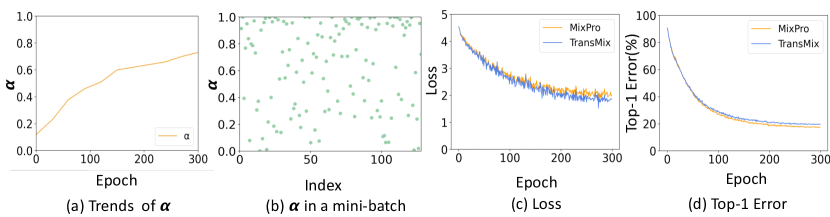
- 渐进注意力标签重加权(PAL)利用渐进因子 α 动态重加权基于注意力的标签置信度,减少对早期训练中不可靠注意力图的依赖。
- 渐进因子 α 在训练过程中逐步增加,使模型在注意力图逐渐变得可靠后,更依赖其输出。
- MixPro 将 MaskMix 与 PAL 整合为统一的数据增强流水线,同时提升图像级与标签级的混合效果。
- 该方法应用于 ImageNet 的预训练阶段,并在分类、检测、分割及鲁棒性基准上进行评估。

实验结果
研究问题
- RQ1与 TransMix 中基于区域的裁剪相比,MaskMix 如何改善视觉变换器的图像混合效果?
- RQ2在注意力图不可靠的早期训练阶段,渐进注意力标签是否能减少混合标签中的噪声?
- RQ3MixPro 是否能提升基于 ViT 的模型在 ImageNet 及下游任务中的泛化能力与鲁棒性?
- RQ4在准确率、遮挡鲁棒性以及分布外检测方面,MixPro 与 TransMix 相比表现如何?
- RQ5为最大化性能,掩码块的最佳尺度与渐进因子策略为何?
主要发现
- 使用 DeiT-T 在 300 个周期内,MixPro 在 ImageNet 上达到 73.8% 的 top-1 准确率,优于 TransMix 和原始 ViT。
- 在 DeiT-S 上,MixPro 在 ImageNet-A 自然对抗样本上将 top-1 准确率提升 1.3%,达到 22.4%,高于 TransMix 的 21.1%。
- MixPro 在 ImageNet-A 上实现 32.4% 的 AURRAC,较 TransMix-DeiT-S 提升 3.6%,表明其不确定性估计更优。
- 在 ImageNet-O 的分布外检测任务中,MixPro-DeiT-S 达到 23.1% 的 AUPRC,较 TransMix-DeiT-S 提高 1.2%,较原始 DeiT-S 提高 2.2%。
- 经过 MixPro 训练的模型展现出更强的迁移能力,在语义分割、目标检测和实例分割等下游任务中均表现更优。
- 消融实验表明,MaskMix 与 PAL 均对性能有显著贡献,最优的掩码块尺度与渐进因子策略可进一步提升鲁棒性与准确率。
阅读本论文
在 Nubint 阅读器中打开原文,边读边就任意段落提问。
在 Nubint 中阅读本论文本解读由 AI 根据论文原文生成,引用前请核对原文。