
[论文解读] Mixture-of-Experts Meets Instruction Tuning:A Winning Combination for Large Language Models
这篇论文显示稀疏MoE模型在指令微调下显著受益,在较低的计算量下达到端到端的最先进结果;值得注意的是,Flan-MoE-32B 在大约 one-third the FLOPs 下超越 Flan-PaLM-62B。
Sparse Mixture-of-Experts (MoE) is a neural architecture design that can be utilized to add learnable parameters to Large Language Models (LLMs) without increasing inference cost. Instruction tuning is a technique for training LLMs to follow instructions. We advocate combining these two approaches, as we find that MoE models benefit more from instruction tuning than dense models. In particular, we conduct empirical studies across three experimental setups: (i) Direct finetuning on individual downstream tasks devoid of instruction tuning; (ii) Instructiontuning followed by in-context few-shot or zero-shot generalization on downstream tasks; and (iii) Instruction tuning supplemented by further finetuning on individual downstream tasks. In the first scenario, MoE models overall underperform dense models of identical computational capacity. This narrative, however, dramatically changes with the introduction of instruction tuning (second and third scenario), used independently or in conjunction with task-specific finetuning. Our most powerful model, FLAN-MOE-32B, surpasses the performance of FLAN-PALM-62B on four benchmark tasks, while using only a third of the FLOPs. The advancements embodied byFLAN-MOE inspire a reevaluation of the design principles of large-scale, high-performance language models in the framework of task-agnostic learning.
研究动机与目标
- 证明指令微调在相似容量的密集模型相比下显著提升MoE模型的性能。
- 量化 MoE 模型在直接微调、上下文内泛化以及后续特定任务微调中的对指令微调的响应程度。
- 分析路由策略、专家数量和辅助损失,以确定 Flan-MoE 的最佳实践。
- 展示 Flan-MoE 的扩展行为,并在精度和计算效率方面将其与密集基线和 PaLM 风格模型进行比较。
- 讨论多语言/泛化挑战等局限性及其对 MoE 设计原则的意义。
提出的方法
- 在 Transformer 架构中采用稀疏 MoE 层,用在交替层中替换前馈网络为 MoE 层。
- 使用 FLAN 数据集混合集上的前缀语言模型目标对 Flan-MoE 进行微调,按指定的超参数更新所有参数。
- 在 MMLU、BBH、推理和问答基准上使用零-shot 与少样本提示进行评估,并附带一个归一化平均指标。
- 在模型规模和 FLOPs 方面将 Flan-MoE 与等效的密集编码-解码(T5)模型进行比较。
- 扩展到 Flan-ST-32B(32B 参数),并与 Flan-PaLM-62B 及其他基线进行比较,突出计算效率。
- 通过消融研究调查路由策略( token-choice 与 expert-choice)以及辅助损失(平衡损失 vs Z-损失)。

实验结果
研究问题
- RQ1指令微调在 MoE 模型上的影响是否大于在密集模型上的影响?
- RQ2路由策略和专家数量如何影响指令微调后的 MoE 在不同基准上的表现?
- RQ3Flan-MoE 是否在较少 FLOPs 的情况下达到或超过最先进的密集模型?
- RQ4辅助损失与参数冻结对 MoE 指令微调有何影响?
- RQ5MoE 在多语言场景中的局限性及其缓解途径是什么?
主要发现
- 指令微调在下游和保留集合任务中显著提升 MoE 相对于密集模型的收益。
- Flan-MoE 模型在第二和第三个实验设置中表现优于可比的密集对手,在 MMLU、BBH、推理和问答基准上取得显著提升。
- 最大的 Flan-ST-32B 模型在少量示例学习上表现强劲,超越 Flan-PaLM-62B,同时每个令牌的 FLOPs 低于 30%。
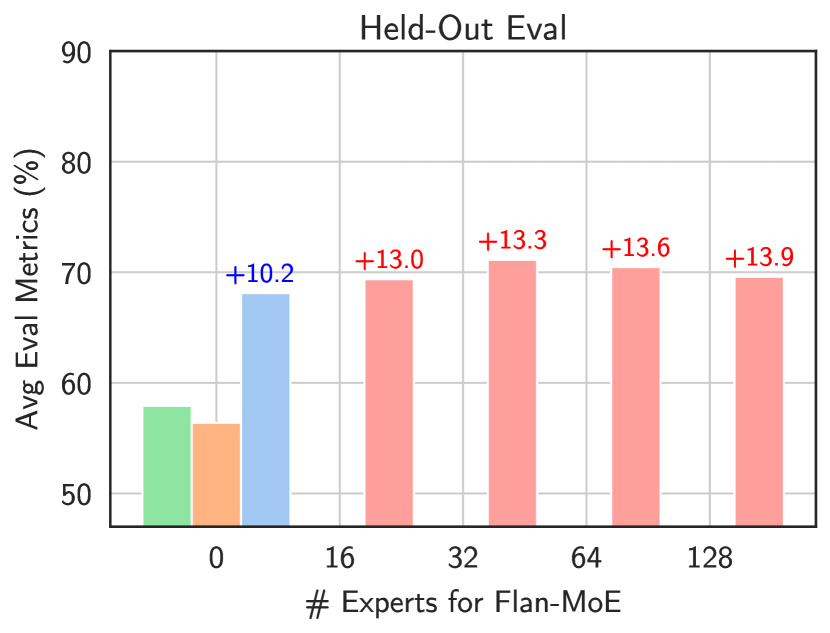
- MoE 的性能随专家数量提升而提升到某一点后趋于饱和,路由策略(专家选择 vs 令牌选择)影响结果。
- 指令微调在更大规模下对 MoE 模型的益处更大,且 Flan-EC(专家竞争)路由在多数任务上常常优于 Flan-GS(门控路由)。
- 尽管 Flan-MoE 显示显著收益,多语言基准(TyDiQA、MGSM)揭示仍存在薄弱之处,表明需要多样化的训练数据以覆盖多语言。
阅读本论文
在 Nubint 阅读器中打开原文,边读边就任意段落提问。
在 Nubint 中阅读本论文本解读由 AI 根据论文原文生成,引用前请核对原文。