
[论文解读] Π-ML: A dimensional analysis-based machine learning parameterization of optical turbulence in the atmospheric surface layer
本文提出Π-ML,一种融合物理规律的机器学习框架,利用量纲分析从大气变量中推导出无量纲特征,实现对近地面层光学湍流(Cₙ²)的高精度预测。通过在这些无量纲组上训练XGBoost模型集成,Π-ML在样本外数据上的决定系数R²达到0.958 ± 0.001,其中归一化位温方差(Π₂ = θ̄/σ_θ)被识别为最主要的预测因子。
Turbulent fluctuations of the atmospheric refraction index, so-called optical turbulence, can significantly distort propagating laser beams. Therefore, modeling the strength of these fluctuations ($C_n^2$) is highly relevant for the successful development and deployment of future free-space optical communication links. In this letter, we propose a physics-informed machine learning (ML) methodology, $Π$-ML, based on dimensional analysis and gradient boosting to estimate $C_n^2$. Through a systematic feature importance analysis, we identify the normalized variance of potential temperature as the dominating feature for predicting $C_n^2$. For statistical robustness, we train an ensemble of models which yields high performance on the out-of-sample data of $R^2=0.958\pm0.001$.
研究动机与目标
- 开发一种融合物理规律的机器学习模型,以改进传统Monin-Obukhov相似性理论(MOST)在大气近地面层对光学湍流(Cₙ²)的参数化方法。
- 利用量纲分析将物理变量转化为无量纲组(Π-集),提升机器学习模型的泛化能力并降低外推风险。
- 在真实世界MLO野外实验数据上评估模型的预测性能,重点关注样本外稳健性与特征重要性。
- 评估是否仅使用一组最小的无量纲特征即可保持高预测精度,从而在不显著损失性能的前提下降低模型复杂度。
- 对比基于无量纲特征与传统有量纲输入在机器学习方法中对Cₙ²估计的性能表现,证明物理量纲缩放的优势。
提出的方法
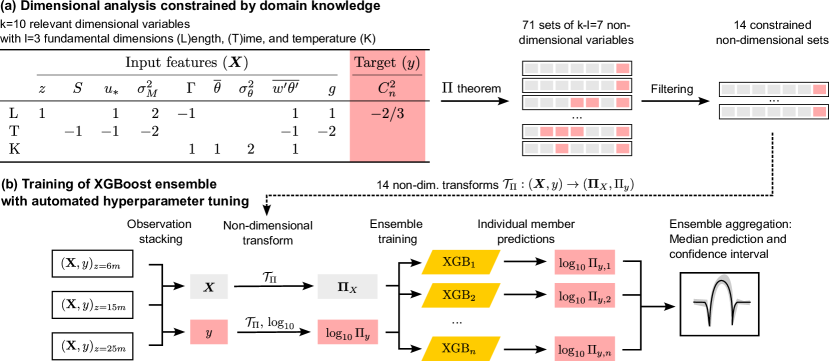
- 应用Buckingham Π定理,从基本大气变量(包括风切变、位温梯度、通量及长度尺度)中推导出无量纲组(Π-集)。
- 通过将观测到的有量纲变量转换为Π-集,构建无量纲数据集,实现跨不同野外实验项目与高度的插值。
- 在无量纲特征上训练XGBoost回归模型集成,以预测归一化为(Cₙ²)^{3/2} × z的Cₙ²,提升模型泛化能力与鲁棒性。
- 使用2006年7月中旬为期14天的测试集评估模型性能,确保训练数据涵盖季节性趋势并最小化外推风险。
- 利用XGBoost进行系统性特征重要性分析,识别最具影响力的Π-集,其中Π₂ = θ̄/σ_θ被确定为最主要预测因子。
- 将完整Π-ML模型与仅使用Π₂的简化版本及使用有量纲输入(如2m-T、2m-RH)的传统机器学习模型进行对比,验证无量纲化的优势。
实验结果
研究问题
- RQ1量纲分析能否提升机器学习模型在大气近地面层Cₙ²预测中的泛化能力与预测精度?
- RQ2哪组无量纲特征(Π-集)能为预测光学湍流强度提供最具信息量的输入?
- RQ3基于无量纲变量的物理融合型机器学习模型与使用有量纲输入的传统机器学习模型相比,性能如何?
- RQ4仅使用一组最小的无量纲特征(如仅Π₂)在多大程度上可维持Cₙ²的高预测精度?
- RQ5使用无量纲特征是否能使模型实现与测量高度(z)无关的Cₙ²预测,而传统方法则不具备此特性?
主要发现
- Π-ML在样本外数据上的决定系数R²达到0.958 ± 0.001,表明其在未见数据上具有高度统计稳健性与预测精度。
- 归一化位温方差(Π₂ = θ̄/σ_θ)被识别为预测Cₙ²最关键的特征,解释了大部分预测能力。
- 仅以Π₂作为输入的简化版Π-ML模型达到R² = 0.929 ± 0.000与RMSE = 0.220 ± 0.000,表明单一无量纲特征已捕捉到绝大部分物理信号。
- 当测试集取自数据集起始或末尾时,完整Π-ML模型性能显著下降(R²降至约0.93),证实模型依赖插值而非外推。
- 使用有量纲输入(如2m-T、2m-RH、15m-Γ、15m-S)的传统机器学习模型的RMSE接近Π-ML的两倍,且R²更低,凸显无量纲缩放的优势。
- 无量纲框架使Cₙ²预测实现高度无关性,而传统模型则需针对每个高度层级单独训练。
阅读本论文
在 Nubint 阅读器中打开原文,边读边就任意段落提问。
在 Nubint 中阅读本论文本解读由 AI 根据论文原文生成,引用前请核对原文。