
[论文解读] ML-Decoder: Scalable and Versatile Classification Head
ML-Decoder 是一种新颖、可扩展且高效的基于注意力的分类头,通过可学习或固定的查询以及分组解码机制,取代全局平均池化,实现了在单标签、多标签和零样本分类任务中的最先进性能。其在 ResNet50 上的 ImageNet 数据集上达到 80.7% 的 top-1 准确率,在 MS-COCO 数据集上达到 91.4% 的 mAP,优于更大的主干网络和先前方法,同时保持较低的推理成本。
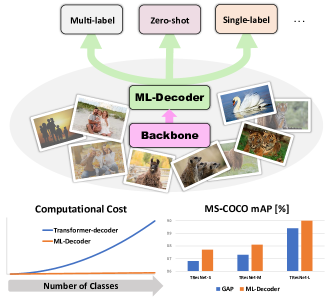
In this paper, we introduce ML-Decoder, a new attention-based classification head. ML-Decoder predicts the existence of class labels via queries, and enables better utilization of spatial data compared to global average pooling. By redesigning the decoder architecture, and using a novel group-decoding scheme, ML-Decoder is highly efficient, and can scale well to thousands of classes. Compared to using a larger backbone, ML-Decoder consistently provides a better speed-accuracy trade-off. ML-Decoder is also versatile - it can be used as a drop-in replacement for various classification heads, and generalize to unseen classes when operated with word queries. Novel query augmentations further improve its generalization ability. Using ML-Decoder, we achieve state-of-the-art results on several classification tasks: on MS-COCO multi-label, we reach 91.4% mAP; on NUS-WIDE zero-shot, we reach 31.1% ZSL mAP; and on ImageNet single-label, we reach with vanilla ResNet50 backbone a new top score of 80.7%, without extra data or distillation. Public code is available at: https://github.com/Alibaba-MIIL/ML_Decoder
研究动机与目标
- 为解决全局平均池化(GAP)在多标签和极端分类任务中的局限性,即未能充分利用空间信息且难以扩展至数千个类别。
- 设计一种既高效又可扩展的分类头,适用于大规模分类任务,支持在极端和零样本学习场景中的实际部署。
- 通过使用基于文本的查询和查询增强技术,提升零样本泛化能力,使模型能够预测未见类别。
- 提供一种统一的、可直接替换现有分类头的解决方案,在多种任务中均优于 GAP 和基于注意力的基线方法。
提出的方法
- ML-Decoder 用基于可学习查询的注意力机制替代全局平均池化,使模型能够关注空间特征,提升空间特征的利用效率。
- 移除了标准 Transformer 中冗余的自注意力层,将复杂度从查询数量的二次方降低为线性。
- 提出一种新颖的分组解码机制,使用固定数量的查询,并通过分组全连接层插值至最终类别数,实现固定的特征空间池化开销。
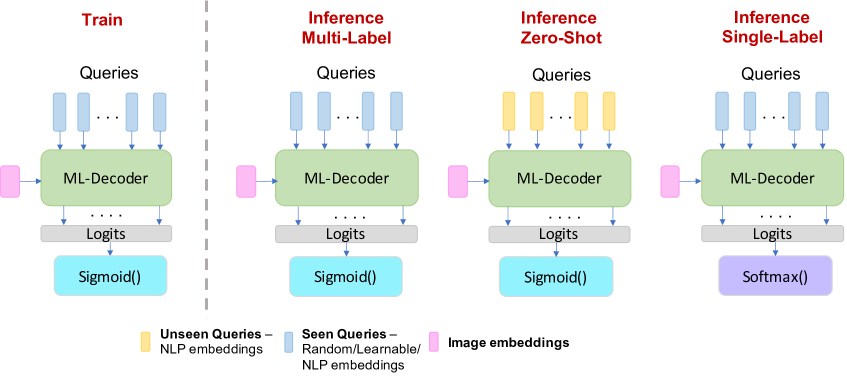
- 该方法支持可学习和固定查询,并允许在训练和推理阶段使用不同类型的查询,从而实现零样本泛化。
- 在训练阶段引入新型查询增强技术,以提升对未见类别的泛化能力。
- 该架构设计为标准分类头的即插即用替代品,兼容多种主干网络和损失函数。
实验结果
研究问题
- RQ1基于注意力的分类头是否能在多标签和极端分类任务中实现比全局平均池化更高的准确率和效率?
- RQ2为实现高可扩展性而设计的分类头是否能在保持低计算成本的前提下处理数千个类别?
- RQ3统一的分类头是否能仅通过文本查询在零样本学习中有效泛化到未见类别?
- RQ4与更大的主干网络或标准注意力头相比,分组解码机制是否能实现更优的速度-准确率权衡?
- RQ5查询增强技术是否能在不依赖额外数据或蒸馏的情况下显著提升零样本泛化性能?
主要发现
- ML-Decoder 在多标签 MS-COCO 数据集上达到 91.4% 的 mAP,创下新的最先进结果。
- 在 NUS-WIDE 零样本学习基准上,ML-Decoder 达到 31.1% 的 mAP,较之前最先进方法提升 4.8%。
- 使用原始 ResNet50 主干网络时,ML-Decoder 在 ImageNet 上达到 80.7% 的 top-1 准确率,是未使用额外数据或知识蒸馏的报告中最优结果。
- 即使仅替换分类头,该模型在速度-准确率权衡上也优于使用更大主干网络的方案。
- ML-Decoder 在未见类别上泛化能力出色,在 NUS-WIDE 的 GZSL 设置下达到 19.9% 的 mAP,显著优于先前方法。
- 该方法在多个数据集上表现稳健,在 CIFAR-100 和 Stanford-Cars 的单标签分类任务中均取得顶尖性能,证实其通用性。
阅读本论文
在 Nubint 阅读器中打开原文,边读边就任意段落提问。
在 Nubint 中阅读本论文本解读由 AI 根据论文原文生成,引用前请核对原文。