
[论文解读] MoE-LLaVA: Mixture of Experts for Large Vision-Language Models
MoE-LLaVA 引入了三阶段的 MoE-Tuning 策略和基于稀疏 MoE 的 LVLM,使在常数计算量下实现大规模参数量并仅用很小比例激活参数即可达到具有竞争力的视觉语言性能。
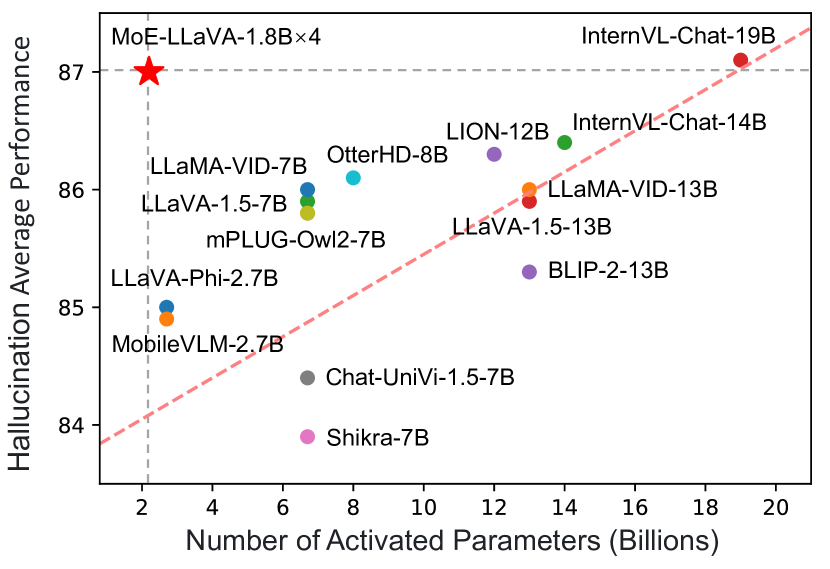
Recent advances demonstrate that scaling Large Vision-Language Models (LVLMs) effectively improves downstream task performances. However, existing scaling methods enable all model parameters to be active for each token in the calculation, which brings massive training and inferring costs. In this work, we propose a simple yet effective training strategy MoE-Tuning for LVLMs. This strategy innovatively addresses the common issue of performance degradation in multi-modal sparsity learning, consequently constructing a sparse model with an outrageous number of parameters but a constant computational cost. Furthermore, we present the MoE-LLaVA, a MoE-based sparse LVLM architecture, which uniquely activates only the top-k experts through routers during deployment, keeping the remaining experts inactive. Extensive experiments show the significant performance of MoE-LLaVA in a variety of visual understanding and object hallucination benchmarks. Remarkably, with only approximately 3B sparsely activated parameters, MoE-LLaVA demonstrates performance comparable to the LLaVA-1.5-7B on various visual understanding datasets and even surpasses the LLaVA-1.5-13B in object hallucination benchmark. Through MoE-LLaVA, we aim to establish a baseline for sparse LVLMs and provide valuable insights for future research in developing more efficient and effective multi-modal learning systems. Code is released at https://github.com/PKU-YuanGroup/MoE-LLaVA.
研究动机与目标
- 通过稀疏专家混合在扩展 LVLM 能力的同时降低计算量的动机。
- 提出 MoE-Tuning 以在不降低性能的前提下使 MoE 适应 LVLM。
- 介绍 MoE-LLaVA,一种基于 MoE 的稀疏 LVLM,在推理阶段仅激活前 k 个专家的 MoE-LLaVA。
提出的方法
- 三阶段 MoE-Tuning 训练:阶段 I 训练一个 MLP 将图像令牌适配到 LLM;阶段 II 训练 LLM 后端以实现多模态理解;阶段 III 将 MoE 专家从 FFN 权重初始化,并仅训练 MoE 层。
- MoE-LLaVA 架构将 MoE 编码层叠加在视觉编码器、视觉投影 MLP 和将文本嵌入层输入给 LLM 的模块之上。
- 硬路由/路由器设计细节:软路由将标记分配给前 k 个专家;路由权重 W 将 x 映射到专家概率,通过 softmax。
- 辅助负载均衡损失用于鼓励跨令牌的专家利用率保持平衡。
- 自回归损失在图像和文本输入上训练 LLM 的输出;辅助负载均衡损失通过平衡项来互补。
实验结果
研究问题
- RQ1一个稀疏 MoE LVLM 是否能够在激活参数远少于密集 LVLM 的情况下达到或超过它们的性能?
- RQ2三阶段的 MoE-Tuning 工作流程是否可以使训练稳定并实现对 LVLM 的有效稀疏化?
- RQ3与密集基线相比,MoE-LLaVA 在图像理解和对象幻觉基准上的表现如何?
- RQ4多模态 MoE-LLaVA 模型中的路由模式和专家工作负载是什么?
主要发现
- 约有 3B 激活参数的 MoE-LLaVA 在视觉理解基准上达到与 LLaVA-1.5-7B 相当的性能。
- 在 2.2B 激活参数时,MoE-LLaVA 可以超过 LLaVA-1.5-13B。
- 在 3.6B 激活参数时,MoE-LLaVA 在多个基准(ScienceQA、POPE、MMBench、LLaVA-W、MM-Vet)上均优于 LLaVA-1.5-7B。
- MoE-LLaVA 的路由在前几层大致将标记均匀分布到各个专家,并显示出模态无关的路由偏好;深层专家形成了特定的工作负载模式。
- 三阶段训练策略是必需的;若在没有合适的指令微调初始化的情况下,单纯将 FFN 替换为 MoE 的做法效果会不理想。

阅读本论文
在 Nubint 阅读器中打开原文,边读边就任意段落提问。
在 Nubint 中阅读本论文本解读由 AI 根据论文原文生成,引用前请核对原文。