
[论文解读] More Control for Free! Image Synthesis with Semantic Diffusion Guidance
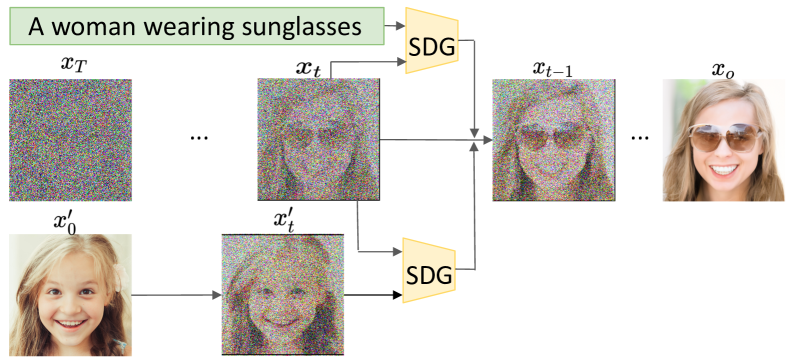
本文介绍 Semantic Diffusion Guidance (SDG),一个统一的、无需重新训练的框架,将语言和图像引导注入到无条件扩散模型中以实现可控的图像合成,并包含一个自监督的 CLIP 微调步骤。
Controllable image synthesis models allow creation of diverse images based on text instructions or guidance from a reference image. Recently, denoising diffusion probabilistic models have been shown to generate more realistic imagery than prior methods, and have been successfully demonstrated in unconditional and class-conditional settings. We investigate fine-grained, continuous control of this model class, and introduce a novel unified framework for semantic diffusion guidance, which allows either language or image guidance, or both. Guidance is injected into a pretrained unconditional diffusion model using the gradient of image-text or image matching scores, without re-training the diffusion model. We explore CLIP-based language guidance as well as both content and style-based image guidance in a unified framework. Our text-guided synthesis approach can be applied to datasets without associated text annotations. We conduct experiments on FFHQ and LSUN datasets, and show results on fine-grained text-guided image synthesis, synthesis of images related to a style or content reference image, and examples with both textual and image guidance.
研究动机与目标
- 在预训练的无条件扩散模型中实现对图像合成的细粒度、连续控制,支持文本、图像或两者引导。
- 在没有语言注释的数据集上支持文本引导的合成。
- 使用来自参考图像的内容或风格引导实现图像引导的合成。
- 提供一个将语言和图像信号结合的多模态引导的统一框架。
提出的方法
- 通过梯度基的引导函数,将引导注入现成的无条件扩散模型。
- 通过基于 CLIP 的语言引导,利用时序相关的图像编码器来处理嘈杂的扩散时间步。
- 定义两种图像引导模式:内容引导(嵌入的语义相似性)和风格引导(特征图的 Gram 矩阵对齐)。
- 通过线性组合语言与图像引导信号并可调权重,实现多模态引导。
- 在噪声图像上对 CLIP 图像编码器进行自监督对比学习目标的微调,以避免文本注释。
实验结果
研究问题
- RQ1SDG 能否在无需图像-文本配对数据的情况下提供细粒度且多样的文本到图像合成?
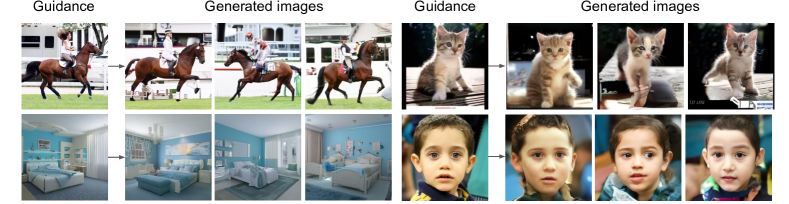
- RQ2SDG 是否能够提供有意义的图像引导,既保持内容或风格,又允许结构上的变化?
- RQ3多模态(文本 + 图像)引导在质量、多样性和与引导的一致性方面,与单模态引导相比有何差异?
主要发现
- SDG 在图像质量和多样性方面超过了先前的图像引导方法(FID 和 LPIPS),同时实现与引导的一致的语义对齐。
- 在图像引导的合成中,SDG 在质量(更低的 FID)和多样性(更高的 LPIPS)方面在 LSUN 和 FFHQ 子集上均优于 ILVR。
- 在文本引导的合成中,SDG 在与提示的一致性方面达到与 StyleGAN+CLIP 的竞争性结果,同时保持更好的多样性。
- 多模态引导使生成的图像既满足语言指令又符合参考图像线索,提供对内容和风格的灵活控制。
阅读本论文
在 Nubint 阅读器中打开原文,边读边就任意段落提问。
在 Nubint 中阅读本论文本解读由 AI 根据论文原文生成,引用前请核对原文。