
[论文解读] Morphological Prototyping for Unsupervised Slide Representation Learning in Computational Pathology
本文提出 Panther,一种用于计算病理学全切片图像(WSIs)的原型基无监督表示学习框架,通过高斯混合模型(GMM)从图像块嵌入中识别形态学原型。通过EM算法估计混合成分参数,Panther生成紧凑且可解释的切片表示,在13个数据集上的亚型分类与生存预测任务中均优于监督式MIL基线方法,同时通过后验概率图实现每个原型的可解释性。
Representation learning of pathology whole-slide images (WSIs) has been has primarily relied on weak supervision with Multiple Instance Learning (MIL). However, the slide representations resulting from this approach are highly tailored to specific clinical tasks, which limits their expressivity and generalization, particularly in scenarios with limited data. Instead, we hypothesize that morphological redundancy in tissue can be leveraged to build a task-agnostic slide representation in an unsupervised fashion. To this end, we introduce PANTHER, a prototype-based approach rooted in the Gaussian mixture model that summarizes the set of WSI patches into a much smaller set of morphological prototypes. Specifically, each patch is assumed to have been generated from a mixture distribution, where each mixture component represents a morphological exemplar. Utilizing the estimated mixture parameters, we then construct a compact slide representation that can be readily used for a wide range of downstream tasks. By performing an extensive evaluation of PANTHER on subtyping and survival tasks using 13 datasets, we show that 1) PANTHER outperforms or is on par with supervised MIL baselines and 2) the analysis of morphological prototypes brings new qualitative and quantitative insights into model interpretability.
研究动机与目标
- 解决现有任务特定、弱监督MIL方法在全切片图像表示学习中泛化能力与表达能力有限的问题。
- 开发一种无监督、任务无关的框架,以捕捉组织中的形态学冗余与混合模式。
- 通过识别并量化形态学原型,实现可解释的切片表示。
- 在13个数据集上对多种下游任务(包括亚型分类与生存预测)进行框架评估。
- 通过后验概率图与形态学术语注释,实现每个原型的可解释性。
提出的方法
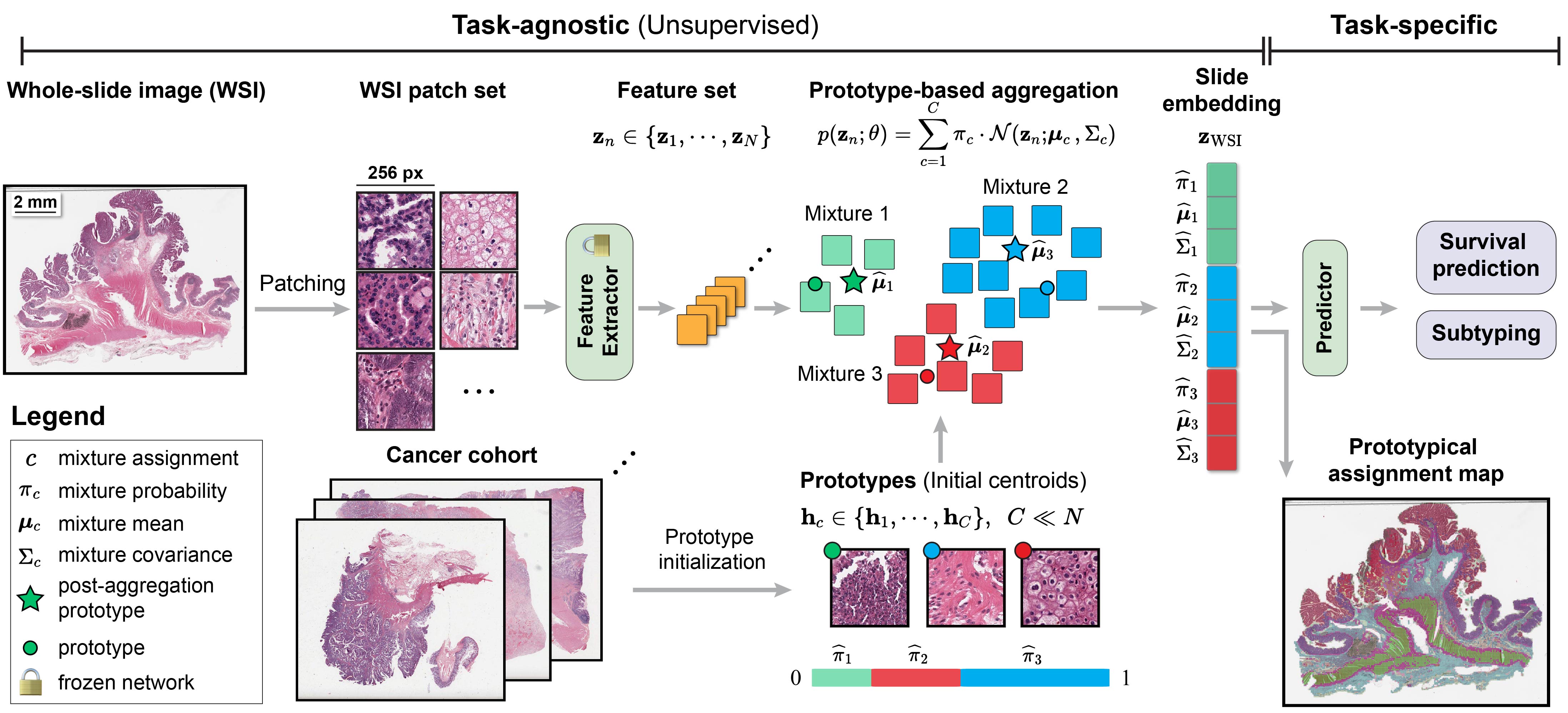
- 将全切片图像的图像块嵌入建模为来自高斯混合模型(GMM)的生成数据,其中每个混合成分对应一个形态学原型。
- 使用期望最大化(EM)算法估计GMM参数:混合权重(基数)、均值(原型表示)和协方差(可变性)。
- 将所有原型的估计GMM参数拼接,构建切片级别的表示。
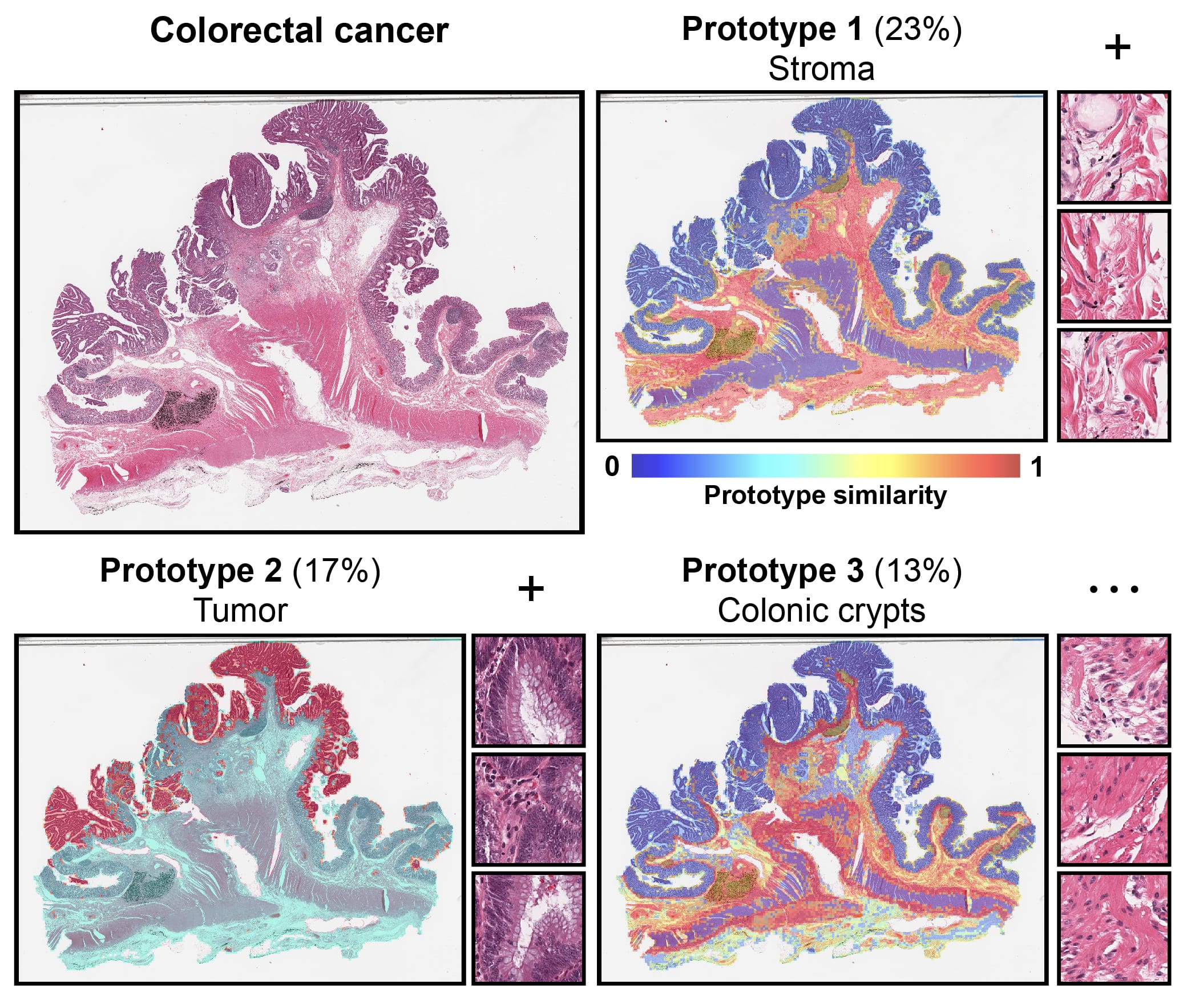
- 通过后验概率将每个图像块分配给一个原型,实现原型感知的解释与热力图可视化。
- 仅使用预训练视觉编码器生成的图像块嵌入,以无监督方式训练该框架。
- 将学习到的表示应用于下游任务,采用简单的线性头或MLP进行分类与生存预测。
实验结果
研究问题
- RQ1是否可以利用全切片图像中的形态学冗余,学习到任务无关的无监督切片表示?
- RQ2基于原型的GMM方法是否在下游诊断与预后任务中优于现有无监督与监督式MIL基线?
- RQ3所识别的形态学原型是否能为切片级表示提供定性与定量的可解释性?
- RQ4原型分布与分配方式是否与已知的组织病理学模式及临床结局相关?
- RQ5该框架在不同癌症类型与切片特征下的泛化能力如何?
主要发现
- Panther在13个数据集的亚型分类与生存预测任务中,表现优于或匹配监督式MIL基线,展现出强大的泛化能力。
- 在生存预测(Cox)任务中,AUC均值达0.671 ± 0.09;在亚型分类任务中,AUC均值达0.651 ± 0.04,优于无监督基线方法如OT与ProtoCounts。
- 基于原型的热力图解释与监督式图像块级分类器高度一致,验证了在BLCA、BRCA与KIRC中形态学的相关性。
- 每个切片的原型分布$π_c$能捕捉具有生物学意义的组织成分比例,经病理学家注释确认。
- 后验概率可视化揭示了与肿瘤区域、免疫细胞浸润及间质成分一致的空间模式。
- 该框架支持每个原型的非线性建模与解释,为组织微环境复杂性提供了新见解。
阅读本论文
在 Nubint 阅读器中打开原文,边读边就任意段落提问。
在 Nubint 中阅读本论文本解读由 AI 根据论文原文生成,引用前请核对原文。