
[论文解读] mPLUG-2: A Modularized Multi-modal Foundation Model Across Text, Image and Video
mPLUG-2 引入了一个模块化的变换器框架,用于文本、图像和视频的统一预训练,将模态特定组件从共享的通用模块中解耦,以实现灵活的任务特定模块组装并获得强大的跨模态性能。
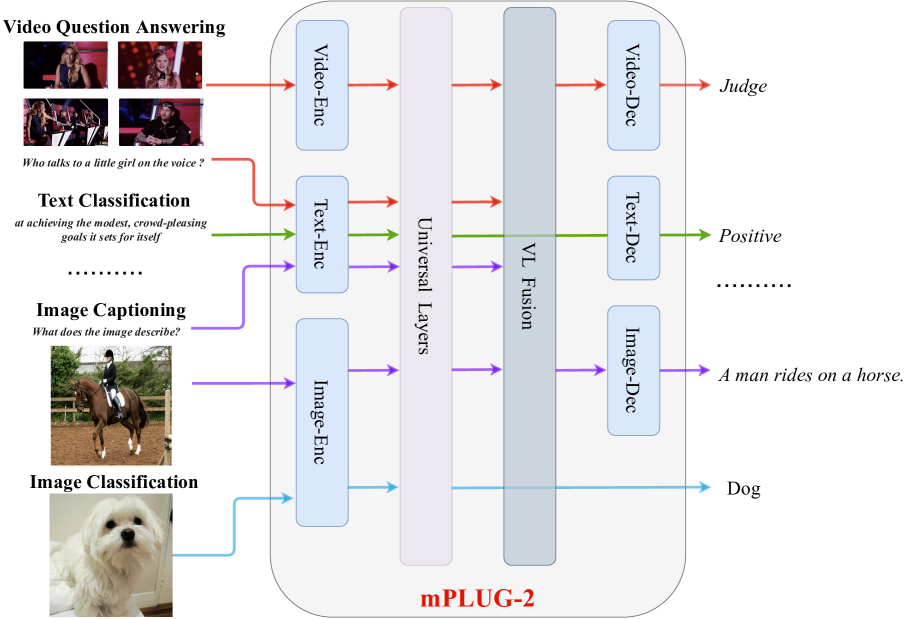
Recent years have witnessed a big convergence of language, vision, and multi-modal pretraining. In this work, we present mPLUG-2, a new unified paradigm with modularized design for multi-modal pretraining, which can benefit from modality collaboration while addressing the problem of modality entanglement. In contrast to predominant paradigms of solely relying on sequence-to-sequence generation or encoder-based instance discrimination, mPLUG-2 introduces a multi-module composition network by sharing common universal modules for modality collaboration and disentangling different modality modules to deal with modality entanglement. It is flexible to select different modules for different understanding and generation tasks across all modalities including text, image, and video. Empirical study shows that mPLUG-2 achieves state-of-the-art or competitive results on a broad range of over 30 downstream tasks, spanning multi-modal tasks of image-text and video-text understanding and generation, and uni-modal tasks of text-only, image-only, and video-only understanding. Notably, mPLUG-2 shows new state-of-the-art results of 48.0 top-1 accuracy and 80.3 CIDEr on the challenging MSRVTT video QA and video caption tasks with a far smaller model size and data scale. It also demonstrates strong zero-shot transferability on vision-language and video-language tasks. Code and models will be released in https://github.com/alibaba/AliceMind.
研究动机与目标
- 倡导一种统一而模块化的多模态预训练方法,以在模态协作与纠缠之间取得平衡。
- 开发一个共享的通用模块网络,加上模态特定组件,以支持多样的一元和跨模态任务。
- 实现文本、图像和视频理解与生成的灵活任务特定模块选择。
- 在包括图像文本和视频文本理解与生成在内的 30+ 个下游任务上展示出色表现。
- 展示在有限的预训练数据下的强零-shot 转移能力和高效性。
提出的方法
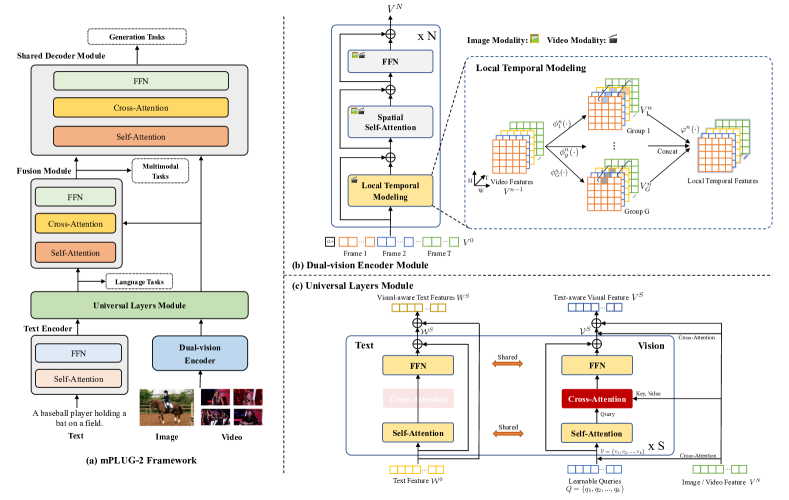
- 提出一个用于图像与视频的双视角编码器,具有空间和局部时序建模。
- 引入通过自注意力和跨注意力操作将视觉与语言映射到共享语义空间的通用层。
- 添加跨模态融合模块,以整合跨模态表示用于生成任务。
- 为单模态和跨模态生成任务采用共享的基于 Transformer 的解码器。
- 以语言 MLM、跨模态匹配损失以及受 Flamingo 与 OFA 启发的指令式语言建模目标进行预训练。
实验结果
研究问题
- RQ1模块化是否能够在实现文本、图像和视频任务的模态协作的同时减轻模态纠缠?
- RQ2共享通用模块与模态特定组件如何影响单模态和跨模态基准的表现?
- RQ3与单网络方法相比,使用模块化的多模态基础模型在效率与可迁移性方面有哪些提升?
- RQ4在视觉-语言和视频-语言设置下,模型在检索、问答、字幕生成与生成等 30+ 任务中达到最先进或具竞争力结果的程度如何?
主要发现
- 在跨越图像-文本和视频-文本理解与生成的 30+ 个下游任务中实现最先进或具竞争力的结果。
- 在 MSRVTT 视频问答和视频字幕任务上取得新的最先进结果,模型和数据 footprint 更小(top-1 48.0,CIDEr 80.3)。
- 在视觉-语言和视频-语言任务上展示出强大的零-shot 转移能力。
- mPLUG-2 Base 与 Full 版本在视频到文本检索和视频问答基准上超过若干前序方法,且预训练数据显著减少。
- 模块化设计使得灵活的任务特定模块组装成为可能,在不增加过大模型规模的情况下提升单模态和跨模态的性能。
阅读本论文
在 Nubint 阅读器中打开原文,边读边就任意段落提问。
在 Nubint 中阅读本论文本解读由 AI 根据论文原文生成,引用前请核对原文。