
[论文解读] Multi-Concept Customization of Text-to-Image Diffusion
Custom Diffusion 通过微调跨注意力权重的一小部分子集,在少量示例中学习新概念,实现组合生成,并在现有扩散模型中高效地合并多概念。
While generative models produce high-quality images of concepts learned from a large-scale database, a user often wishes to synthesize instantiations of their own concepts (for example, their family, pets, or items). Can we teach a model to quickly acquire a new concept, given a few examples? Furthermore, can we compose multiple new concepts together? We propose Custom Diffusion, an efficient method for augmenting existing text-to-image models. We find that only optimizing a few parameters in the text-to-image conditioning mechanism is sufficiently powerful to represent new concepts while enabling fast tuning (~6 minutes). Additionally, we can jointly train for multiple concepts or combine multiple fine-tuned models into one via closed-form constrained optimization. Our fine-tuned model generates variations of multiple new concepts and seamlessly composes them with existing concepts in novel settings. Our method outperforms or performs on par with several baselines and concurrent works in both qualitative and quantitative evaluations while being memory and computationally efficient.
研究动机与目标
- 让大型文本到图像模型个性化以适应用户特定的概念(例如宠物、物体),这些概念在预训练时未出现。
- 开发一种简洁的微调方法,在学习新概念的同时保留现有概念知识。
- 实现多个新概念在单张图像生成中的组合,而不发生灾难性遗忘。
- 将训练时间和内存占用降至实际可行水平。
提出的方法
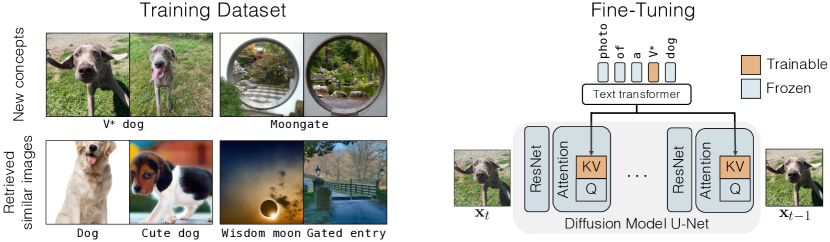
- 在微调期间识别跨注意力层中一个最小且影响最大的参数子集(键和值投影)进行更新。
- 使用新的修饰符标记 V* 来表示个性化概念,并在跨注意力矩阵的优化中同时优化其嵌入。
- 引入包含与描述相似的真实图像的正则化数据集,以防止语言漂移和过拟合。
- 在微调中应用增强(图像缩放及相关提示),以改善收敛。
- 对于多概念,联合训练或通过闭式约束优化(最小二乘)合并概念以实现组合。
- 以一个受约束的优化目标来支撑组合,使目标概念映射与预先计算的正则化映射保持一致。
实验结果
研究问题
- RQ1少量跨注意力权重子集是否足以在少量示例下学习新概念?
- RQ2仅更新跨注意力的键和值是否能够在实现新概念学习的同时保留现有知识?
- RQ3是否可以同时学习多个新概念并在新提示中实现连贯的组合?
- RQ4闭式约束优化在合并多个微调概念方面的有效性如何?
主要发现
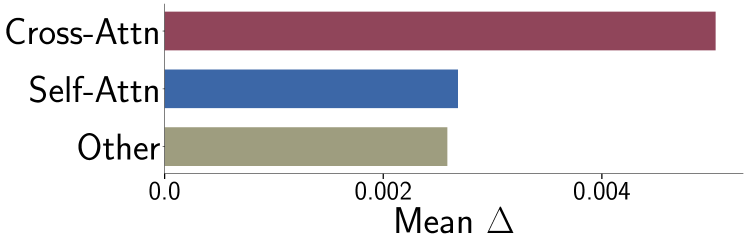
- 跨注意力权重更新具有不成比例的影响力,使仅更新约 3% 的模型参数即可实现概念学习。
- 带有正则化集的微调降低了过拟合和语言漂移,提升了图像与文本的对齐。
- 该方法在较短的微调时间(在 2 个 A100 GPU 上约 ~6 分钟)和较小的存储需求(每个概念 ~75 MB)方面优于基线。
- 多概念训练和闭式组合在共享场景中实现了连贯的生成,在大多数情况下优于或等同于基线。
- 与 DreamBooth 和 Textual Inversion 相比,在单概念场景下 Custom Diffusion 提供更高的文本与图像对齐以及更低的 KID。
阅读本论文
在 Nubint 阅读器中打开原文,边读边就任意段落提问。
在 Nubint 中阅读本论文本解读由 AI 根据论文原文生成,引用前请核对原文。