
[论文解读] Multi-Echo Denoising in Adverse Weather
本论文提出了一种用于恶劣天气下LiDAR的多回波去噪方法,采用自监督深度学习方法(SMEDNet),通过特征相似性正则化识别并恢复受噪声污染信号中的有用回波。该方法在半合成数据集上相较于最先进自监督方法实现了23%的性能提升,并在真实恶劣天气数据上展现出出色的定性表现。
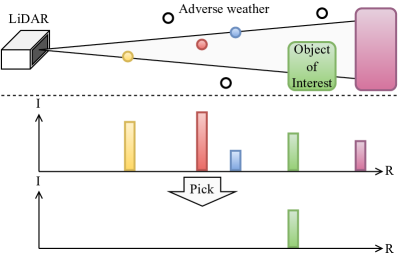
Adverse weather can cause noise to light detection and ranging (LiDAR) data. This is a problem since it is used in many outdoor applications, e.g. object detection and mapping. We propose the task of multi-echo denoising, where the goal is to pick the echo that represents the objects of interest and discard other echoes. Thus, the idea is to pick points from alternative echoes that are not available in standard strongest echo point clouds due to the noise. In an intuitive sense, we are trying to see through the adverse weather. To achieve this goal, we propose a novel self-supervised deep learning method and the characteristics similarity regularization method to boost its performance. Based on extensive experiments on a semi-synthetic dataset, our method achieves superior performance compared to the state-of-the-art in self-supervised adverse weather denoising (23% improvement). Moreover, the experiments with a real multi-echo adverse weather dataset prove the efficacy of multi-echo denoising. Our work enables more reliable point cloud acquisition in adverse weather and thus promises safer autonomous driving and driving assistance systems in such conditions. The code is available at https://github.com/alvariseppanen/SMEDNet
研究动机与目标
- 解决雾、雨、雪等恶劣天气条件下LiDAR点云退化这一关键挑战。
- 克服单回波LiDAR系统因噪声而丢弃较弱或较晚回波中潜在有用信息的局限性。
- 通过恢复标准最强回波点云中未捕获的其他回波中的有效点,实现在恶劣天气下可靠的目标检测与地图构建。
- 开发一种自监督方法,避免昂贵的逐点标注,尤其适用于多回波数据。
- 通过一种新颖的特征相似性正则化技术,提升模型泛化能力与性能。
提出的方法
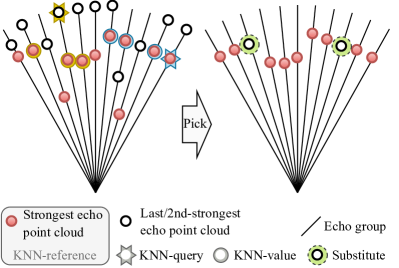
- 提出SMEDNet,一种自监督深度学习框架,利用邻域相关性和盲区机制,识别每个激光脉冲中最具有信息量的回波。
- 以多回波点云作为输入,其中每个脉冲产生多个回波,并学习选择最可能代表物理物体的回波。
- 引入特征相似性正则化,以促进同一物理点在不同回波间特征的一致性,从而提升收敛速度与推理阶段性能。
- 采用邻域编码器,结合KNN或基于网格的邻近点搜索,从点云中提取局部几何特征。
- 通过利用不同回波间有效点的几何一致性,采用类似对比学习的目标函数,在无真实标签的情况下进行模型训练。
- 为每个观测角度输出单回波点云,与标准下游感知流程兼容。
实验结果
研究问题
- RQ1能否利用多回波LiDAR数据恢复因恶劣天气导致最强回波中丢失的目标点?
- RQ2在无逐点标注的情况下,自监督深度学习方法在多个噪声回波中识别正确回波的有效性如何?
- RQ3特征相似性正则化在多回波去噪模型中对鲁棒性与性能的提升程度如何?
- RQ4与经典方法DROR相比,所提方法在处理高程度天气诱导噪声时表现如何?
- RQ5该方法能否泛化至超越合成数据的真实世界恶劣天气场景?
主要发现
- 在半合成恶劣天气数据集上,SMEDNet相较于最先进自监督方法在平均IoU上实现了23%的性能提升。
- 在STF真实世界数据集上,SMEDNet在所有噪声水平下(包括浓雾和降雪)均成功恢复了替代点,优于经典MEDROR基线方法。
- MEDROR基线方法在高噪声条件下无法恢复足够数量的替代点,产生大量假阴性结果,且对阈值调优敏感。
- 定性结果表明,SMEDNet能从替代回波(如第二回波或最后一回波)中识别出可用的替代点,即使最强回波已被污染。
- 特征相似性正则化显著提升了模型收敛速度与推理阶段性能,尤其在恶劣天气条件下表现突出。
- 该方法展现出强大的泛化能力,在合成与真实数据中,无论在轻度、中度还是重度恶劣天气条件下均保持高性能。
阅读本论文
在 Nubint 阅读器中打开原文,边读边就任意段落提问。
在 Nubint 中阅读本论文本解读由 AI 根据论文原文生成,引用前请核对原文。