
[论文解读] MuLTI: Efficient Video-and-Language Understanding with Text-Guided MultiWay-Sampler and Multiple Choice Modeling
MuLTI 提出了一种高效的视频与语言理解框架,采用 MultiWay-Sampler 实现内存高效的基于注意力的特征融合,并引入基于注意力的适配器以低 GPU 成本微调浅层特征。此外,该方法提出了一种多选建模(Multiple Choice Modeling)作为预训练任务,弥合了预训练与下游视频问答任务之间的差距,在七个基准测试中实现了最先进性能,同时显著降低了内存使用量。
Video-and-language understanding has a variety of applications in the industry, such as video question answering, text-video retrieval, and multi-label classification. Existing video-and-language understanding methods generally adopt heavy multi-modal encoders and feature fusion modules, which consume high computational costs. Specially, they have difficulty dealing with dense video frames or long text prevalent in industrial applications. This paper proposes MuLTI, a highly accurate and efficient video-and-language understanding model that achieves efficient and effective feature fusion and rapid adaptation to downstream tasks. Specifically, we design a Text-Guided MultiWay-Sampler based on adapt-pooling residual mapping and self-attention modules to sample long sequences and fuse multi-modal features, which reduces the computational costs and addresses performance degradation caused by previous samplers. Therefore, MuLTI can handle longer sequences with limited computational costs. Then, to further enhance the model's performance and fill in the lack of pretraining tasks in the video question answering, we propose a new pretraining task named Multiple Choice Modeling. This task bridges the gap between pretraining and downstream tasks and improves the model's ability to align video and text features. Benefiting from the efficient feature fusion module and the new pretraining task, MuLTI achieves state-of-the-art performance on multiple datasets. Implementation and pretrained models will be released.
研究动机与目标
- 解决因全参数微调和长序列处理导致的视频与语言模型高 GPU 显存消耗问题。
- 在不牺牲性能的前提下,提升视频与文本模态之间特征融合的效率与效果。
- 通过新型预训练目标,缩小预训练与下游视频问答任务之间的任务差距。
- 利用基于注意力的适配器,以极低的显存开销实现浅层特征的有效微调。
- 在有限的 GPU 显存下,高效处理长文本和稀疏视频帧。
提出的方法
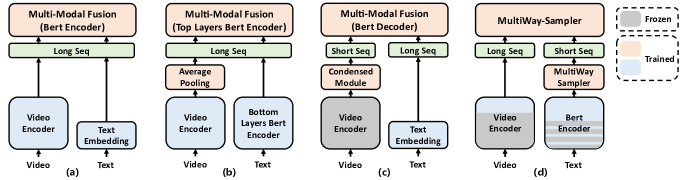
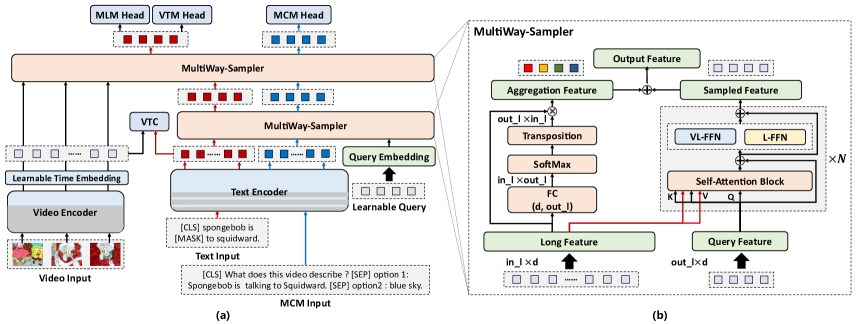
- MultiWay-Sampler 使用可学习的查询向量和自注意力机制,对文本特征进行采样与压缩,随后通过基于注意力的残差聚合保留关键信息。
- 该采样器使用共享的自注意力模块,但为视频和文本特征分别使用模态特定的前馈网络进行处理。
- 基于注意力的适配器被插入编码器中,用于微调浅层特征,相比全参数微调显著降低了显存成本。
- 部分冻结编码器(Partially Frozen Encoder, PFE)策略通过冻结部分编码器层,提升了训练效率并缓解了过拟合问题。
- 引入多选建模(Multiple Choice Modeling, MCM)作为预训练任务,模型需从多个候选文本描述中为给定视频选择最佳描述,从而增强跨模态对齐。
- 模型通过结合 MultiWay-Sampler、注意力适配器和 MCM 预训练,实现了高性能与低显存消耗的平衡。
实验结果
研究问题
- RQ1多模态特征融合模块是否能在保持或提升视频与语言任务性能的同时,降低 GPU 显存使用?
- RQ2与全参数微调相比,基于注意力的适配器在性能和显存效率方面表现如何?
- RQ3引入多选建模(MCM)预训练任务在多大程度上提升了下游视频问答与检索任务的性能?
- RQ4模型是否能在不造成显著性能下降的前提下,有效处理长文本和稀疏视频帧?
- RQ5结合特征采样、选择性微调与新型预训练任务,是否能在多样化的视频与语言基准上实现最先进结果?
主要发现
- MuLTI 在七个视频与语言任务上均达到最先进性能,包括 MSRVTT-QA(45.71% 准确率)和 MSVD-QA(50.63% 准确率),优于先前方法。
- 与基线模型相比,基于注意力的适配器在 MSVD-QA 上提升 0.82%,在 MSRVTT-QA 上提升 0.17%。
- 与无聚合的基线相比,使用 MultiWay-Sampler 配合基于注意力的残差聚合,使 MSRVTT-QA 的准确率提升 0.38%。
- 部分冻结编码器策略将 GPU 显存使用从 6109 MB 降低至 10283 MB,同时在 MSVD-QA 上相比全参数微调将准确率提升 3.03%。
- 多选建模(MCM)显著提升了视频问答与检索任务的性能,有效缩小了预训练与下游任务之间的任务差距。
- 结合 MultiWay-Sampler、注意力适配器与 MCM 预训练的策略,在所有评估数据集和任务上均实现了稳定提升。
阅读本论文
在 Nubint 阅读器中打开原文,边读边就任意段落提问。
在 Nubint 中阅读本论文本解读由 AI 根据论文原文生成,引用前请核对原文。