
[论文解读] Multi-objective generative AI for designing novel brain-targeting small molecules
本研究提出了一种基于蒙特卡洛树搜索(MCTS)的多目标生成式人工智能框架,用于设计新型、可合成的小分子,其具备高血脑屏障(BBB)通透性、对多巴胺D2受体(D2R)的强预测结合亲和力以及有利的安全性特征。该方法整合了基于图神经网络的BBB通透性、D2R生物活性及ADME-Tox性质预测器,生成了一个包含26,581种分子的多样化库,其中表现最佳的分子在对接模拟中展现出与临床使用的抗精神病药物利培酮相当的结合亲和力。
The strict selectivity of the blood-brain barrier (BBB) represents one of the most formidable challenges to successful central nervous system (CNS) drug delivery. Computational methods to generate BBB permeable drugs in silico may be valuable tools in the CNS drug design pipeline. However, in real-world applications, BBB penetration alone is insufficient; rather, after transiting the BBB, molecules must bind to a specific target or receptor in the brain and must also be safe and non-toxic. To discover small molecules that concurrently satisfy these constraints, we use multi-objective generative AI to synthesize drug-like BBB-permeable small molecules. Specifically, we computationally synthesize molecules with predicted binding affinity against dopamine receptor D2, the primary target for many clinically effective antipsychotic drugs. After training several graph neural network-based property predictors, we adapt SyntheMol (Swanson et al., 2024), a recently developed Monte Carlo Tree Search-based algorithm for antibiotic design, to perform a multi-objective guided traversal over an easily synthesizable molecular space. We design a library of 26,581 novel and diverse small molecules containing hits with high predicted BBB permeability and favorable predicted safety and toxicity profiles, and that could readily be synthesized for experimental validation in the wet lab. We also validate top scoring molecules with molecular docking simulation against the D2 receptor and demonstrate predicted binding affinity on par with risperidone, a clinically prescribed D2-targeting antipsychotic. In the future, the SyntheMol-based computational approach described here may enable the discovery of novel neurotherapeutics for currently intractable disorders of the CNS.
研究动机与目标
- 为解决中枢神经系统(CNS)药物研发中血脑屏障(BBB)通透性不足这一主要挑战,该挑战限制了神经退行性疾病和精神疾病的有效治疗。
- 设计不仅具备BBB通透性,还对多巴胺D2受体(D2R)具有高预测结合亲和力的小分子,D2R是抗精神病药物的关键靶点。
- 通过在分子设计过程中整合预测的安全性和毒性特征(ADME-Tox),确保治疗可行性。
- 生成一个多样化且可合成的新型化合物库,适用于湿实验环境中的实验验证。
- 证明利用多目标引导的分子生成方法发现目前难以治疗的CNS疾病神经治疗药物的可行性。
提出的方法
- 采用改进的SyntheMol算法,一种基于蒙特卡洛树搜索(MCTS)的生成式框架,以探索化学上可行的分子空间。
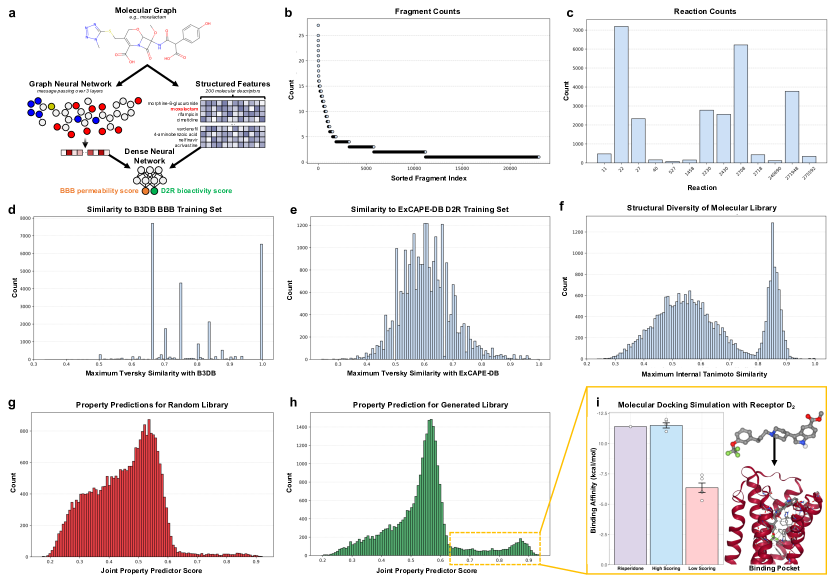
- 整合了三个基于图神经网络(GNN)的性质预测器:一个用于BBB通透性,一个用于D2R生物活性,一个用于ADME-Tox特征。
- 使用多目标评分函数P(N),通过平均BBB通透性、D2R结合亲和力和毒性预测的归一化值,平衡MCTS模拟过程中的探索与利用。
- 使用132,479种分子构建模块和13种化学反应,迭代构建分子,搜索树中的每个节点代表一种潜在的分子构型。
- 应用Tanimoto和Tversky相似性度量评估生成分子相对于训练数据的分子多样性,确保结构新颖性。
- 通过针对D2受体的分子对接模拟验证了最佳候选分子的结合亲和力,以计算方式评估其在体外的结合能力。
实验结果
研究问题
- RQ1多目标生成式人工智能能否有效设计出同时具备高BBB通透性、强D2R结合亲和力及有利安全性特征的小分子?
- RQ2在受限的分子空间中,整合BBB、D2R和ADME-Tox等多种性质预测器如何影响生成分子的质量与多样性?
- RQ3与训练数据相比,生成分子在结构上新颖性和多样性方面达到何种程度?
- RQ4最佳候选分子的预测结合亲和力与临床使用的抗精神病药物(如利培酮)相比如何?
- RQ5基于MCTS的多目标评分引导的生成方法能否产生具有高合成可及性、适合湿实验验证的分子?
主要发现
- 该方法成功生成了26,581种新颖且结构多样的小分子,其预测BBB通透性高,且ADME-Tox特征理想。
- 表现最佳的分子在D2受体上的预测结合亲和力与利培酮(一种临床处方的抗精神病药物)相当,经分子对接模拟验证。
- 多目标评分函数有效平衡了探索与利用,在综合性质评分上优于随机采样基线。
- 通过最大内部Tanimoto和Tversky相似性度量确认了分子多样性,显示与训练化合物的相似性较低,具有高度结构新颖性。
- 性质预测器表现出强大的泛化能力,在10折交叉验证中,BBB通透性和D2R生物活性的AUROC值均高于0.85。
- 该方法成功识别出同时满足多种治疗约束条件的分子——包括BBB穿透能力、靶点结合亲和力和安全性,使其成为实验测试的强有力候选分子。
阅读本论文
在 Nubint 阅读器中打开原文,边读边就任意段落提问。
在 Nubint 中阅读本论文本解读由 AI 根据论文原文生成,引用前请核对原文。