
[论文解读] Multimodal Image-Text Matching Improves Retrieval-based Chest X-Ray Report Generation
X-REM 使用多模态图像-文本匹配分数来检索胸部X光片的放射学报告,在临床和自然语言指标上优于先前的基于检索的方法和图像字幕生成方法,并获得较佳的人类评估。
Automated generation of clinically accurate radiology reports can improve patient care. Previous report generation methods that rely on image captioning models often generate incoherent and incorrect text due to their lack of relevant domain knowledge, while retrieval-based attempts frequently retrieve reports that are irrelevant to the input image. In this work, we propose Contrastive X-Ray REport Match (X-REM), a novel retrieval-based radiology report generation module that uses an image-text matching score to measure the similarity of a chest X-ray image and radiology report for report retrieval. We observe that computing the image-text matching score with a language-image model can effectively capture the fine-grained interaction between image and text that is often lost when using cosine similarity. X-REM outperforms multiple prior radiology report generation modules in terms of both natural language and clinical metrics. Human evaluation of the generated reports suggests that X-REM increased the number of zero-error reports and decreased the average error severity compared to the baseline retrieval approach. Our code is available at: https://github.com/rajpurkarlab/X-REM
研究动机与目标
- 推动自动化、临床上准确的放射科报告生成,以支持放射科医生和患者护理。
- 解决图像字幕生成模型易出现幻觉或不连贯的问题。
- 提出一种基于检索的框架,使用学习得到的图像-文本匹配分数来选择临床相关的报告。
- 利用领域特定的预训练和监督对比学习来将X-ray图像与放射科报告对齐。
提出的方法
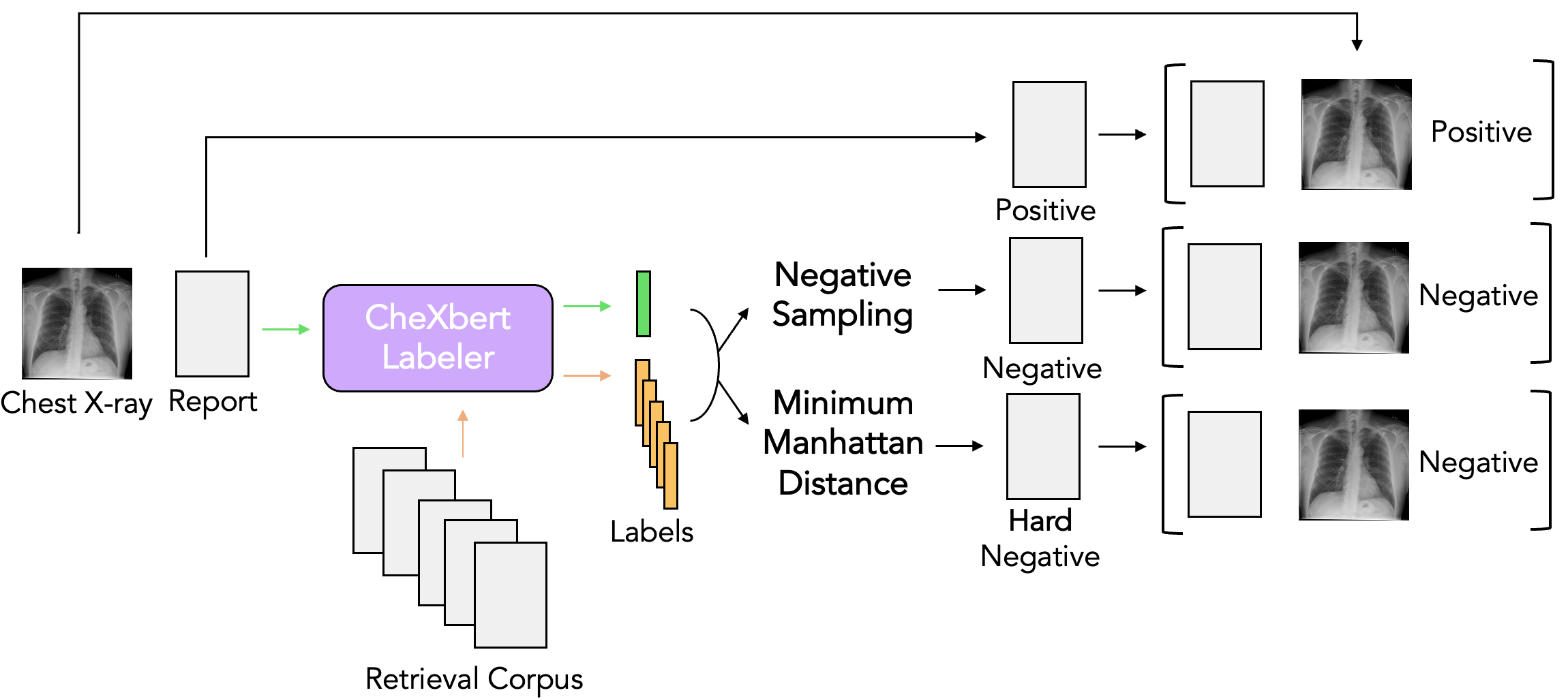
- 采用包含单模态图像/文本编码器和多模态编码器的三层 X-REM 流程。
- 以 ALBEF 作为骨干语言-图像模型,生成图像-文本嵌入和多模态的图像-文本匹配分数。
- 检索工作流:先通过单模态嵌入的余弦相似度进行筛选,再按图像-文本匹配分数选择前列候选。
- 应用基于自然语言推理(NLI)的筛选,去除冗余或冲突的报告。
- 在图像-文本匹配和 NLI 任务上对模型进行微调,使用带有负样本的监督临床标签。
- 在基于 MIMIC-CXR 的数据集(包含 impression、findings 或两者)上进行训练和评估,并报告 RadCliQ、RadGraph F1、CheXbert、BERTScore 以及 BLEU2。

实验结果
研究问题
- RQ1使用学习得到的图像-文本匹配分数是否相较于余弦相似度和基线检索方法提升放射科报告的基于检索的生成?
- RQ2在放射领域中,使用带监督对比学习的多模态编码器是否能更好地捕捉图像-文本交互?
- RQ3领域特定的预训练对模型性能和生成报告的临床准确性有何影响?
- RQ4与先前方法相比,X-REM 在不同报告部分(impression、findings,或两者)上的表现如何?
- RQ5检索后的过滤(NLI、内容冗余)对报告质量和错误率有何影响?
主要发现
- X-REM 在临床和自然语言指标上优于先前的放射科报告生成模块。
- 人工评估显示,与基线检索模型相比,X-REM 将零错误报告率提升了 70%。
- 在评估的报告中,X-REM 生成的零错误报告占比为 18%,基线为 9%,人类基准为 34%。
- 图像-文本匹配分数提供的相似性信号比余弦相似度更强,适用于检索。
- 一个领域预训练并微调的基于 ALBEF 的模型在 RadCliQ、RadGraph F1、CheXbert 相似度和 BERTScore 上优于若干基线。
阅读本论文
在 Nubint 阅读器中打开原文,边读边就任意段落提问。
在 Nubint 中阅读本论文本解读由 AI 根据论文原文生成,引用前请核对原文。