
[论文解读] MusicRL: Aligning Music Generation to Human Preferences
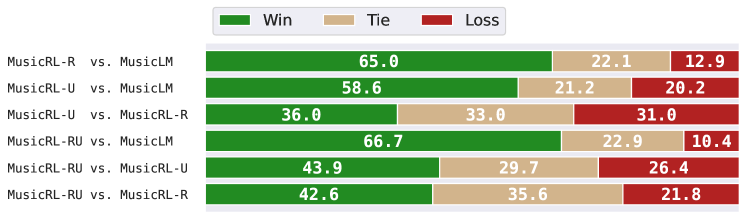
MusicRL 是首个通过人类反馈强化学习(RLHF)微调的文本到音乐生成模型,提升了与人类偏好的对齐程度。它结合了文本一致性、音频质量及用户偏好的奖励信号——这些信号来自300,000次成对比较——从而训练出一个模型(MusicRL-RU),在人类评估中优于基线模型及先前的RL微调变体。
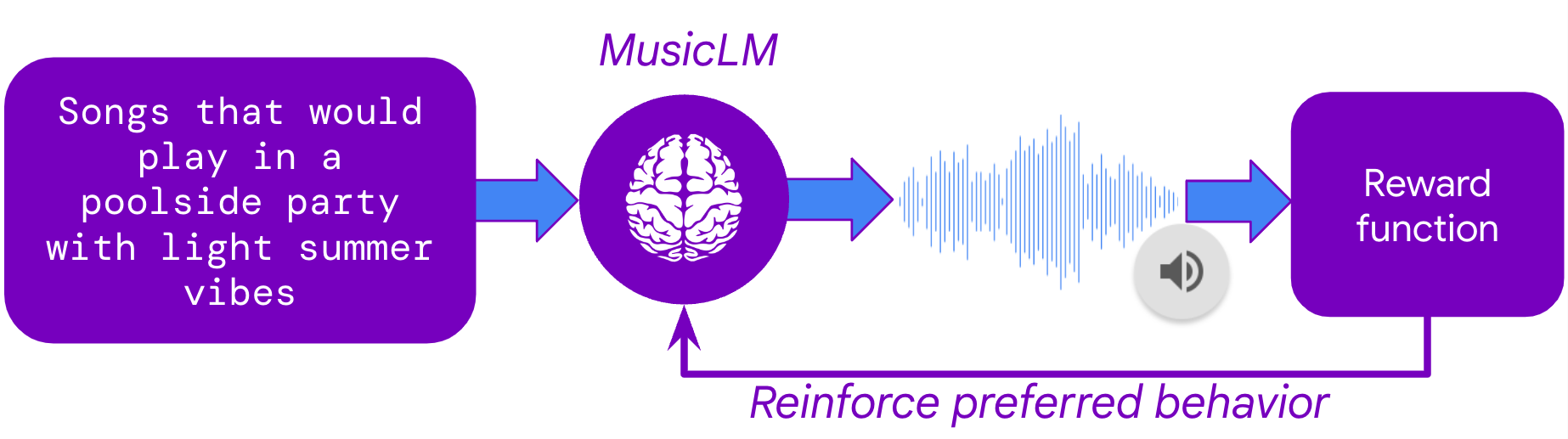
We propose MusicRL, the first music generation system finetuned from human feedback. Appreciation of text-to-music models is particularly subjective since the concept of musicality as well as the specific intention behind a caption are user-dependent (e.g. a caption such as "upbeat work-out music" can map to a retro guitar solo or a techno pop beat). Not only this makes supervised training of such models challenging, but it also calls for integrating continuous human feedback in their post-deployment finetuning. MusicRL is a pretrained autoregressive MusicLM (Agostinelli et al., 2023) model of discrete audio tokens finetuned with reinforcement learning to maximise sequence-level rewards. We design reward functions related specifically to text-adherence and audio quality with the help from selected raters, and use those to finetune MusicLM into MusicRL-R. We deploy MusicLM to users and collect a substantial dataset comprising 300,000 pairwise preferences. Using Reinforcement Learning from Human Feedback (RLHF), we train MusicRL-U, the first text-to-music model that incorporates human feedback at scale. Human evaluations show that both MusicRL-R and MusicRL-U are preferred to the baseline. Ultimately, MusicRL-RU combines the two approaches and results in the best model according to human raters. Ablation studies shed light on the musical attributes influencing human preferences, indicating that text adherence and quality only account for a part of it. This underscores the prevalence of subjectivity in musical appreciation and calls for further involvement of human listeners in the finetuning of music generation models.
研究动机与目标
- 解决音乐欣赏的主观性问题,该问题限制了文本到音乐模型的监督训练。
- 通过引入人类反馈,克服自回归音频生成中缺乏音乐性偏置的问题。
- 开发一种可扩展的方法,利用强化学习将音乐生成与人类偏好对齐。
- 探究用户反馈是否包含超越文本一致性与音频质量的信号。
- 构建一个可通过部署后持续的人类反馈实现音乐生成改进的系统。
提出的方法
- 使用强化学习微调预训练的自回归 MusicLM 模型,以最大化序列级奖励。
- 基于选定评分者的反馈,设计基于文本一致性(例如,MuLan循环一致性)和音频质量(例如,Fréchet Audio Distance)的奖励函数。
- 将 MusicLM 部署给用户,通过网页界面收集300,000对用户生成的字幕-音频配对及其成对偏好标注。
- 在收集到的用户偏好数据上训练奖励模型,以指导后续的强化学习微调。
- 应用RLHF训练 MusicRL-U,使用用户偏好奖励模型,并在 MusicRL-RU 中将其与先前的奖励信号相结合。
- 在未来迭代中采用在线策略数据收集,以缩小反馈与实际部署之间的分布差距。
实验结果
研究问题
- RQ1人类反馈强化学习(RLHF)是否能有效提升文本到音乐生成性能,超越自动指标?
- RQ2用户在音乐生成中的偏好在多大程度上与文本一致性与音频质量等客观指标对齐?
- RQ3结合多种奖励信号——文本一致性、音频质量与用户偏好——如何影响模型性能?
- RQ4除了文本一致性和音频质量外,哪些音乐属性会影响人类偏好?
- RQ5大规模野外收集的用户反馈能否有效用于训练稳健的音乐生成奖励模型?
主要发现
- MusicRL-RU(结合质量、文本一致性与用户偏好奖励)在人类评估中优于 MusicRL-R 与 MusicRL-U。
- MusicRL-U(基于300,000条用户成对偏好训练)显著优于预训练的 MusicLM 基线模型。
- 质量预测器在预测哪段音频更受青睐方面达到了53.3%的准确率,表明音频质量是人类偏爱中的中等但非主导信号。
- 用户偏好包含超越文本一致性和音频质量的信息,表明音乐性涉及主观且复杂的属性。
- 消融研究显示,尽管文本一致性和质量能提升性能,但无法完全解释人类偏好,凸显了主观音乐性的作用。
- 基于用户反馈训练的模型(MusicRL-U)在质量评分上略有提升,表明用户反馈捕捉到了偏好中额外的、非平凡的方面。
阅读本论文
在 Nubint 阅读器中打开原文,边读边就任意段落提问。
在 Nubint 中阅读本论文本解读由 AI 根据论文原文生成,引用前请核对原文。