
[论文解读] MVDream: Multi-view Diffusion for 3D Generation
MVDream 提出了一种在 3D 渲染数据和 2D 数据上训练的多视图扩散模型,用于从文本生成一致的多视图图像;它可作为基于 SDS 的 3D 生成的 3D 先验,并支持 DreamBooth 风格的 3D 个性化。
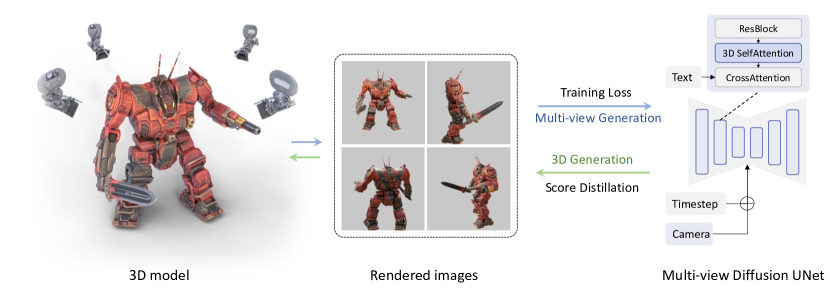
We introduce MVDream, a diffusion model that is able to generate consistent multi-view images from a given text prompt. Learning from both 2D and 3D data, a multi-view diffusion model can achieve the generalizability of 2D diffusion models and the consistency of 3D renderings. We demonstrate that such a multi-view diffusion model is implicitly a generalizable 3D prior agnostic to 3D representations. It can be applied to 3D generation via Score Distillation Sampling, significantly enhancing the consistency and stability of existing 2D-lifting methods. It can also learn new concepts from a few 2D examples, akin to DreamBooth, but for 3D generation.
研究动机与目标
- Motivate and address the lack of cross-view consistency in 2D diffusion–based 3D generation.
- Propose a multi-view diffusion model that preserves 2D diffusion generalizability while ensuring multi-view consistency.
- Demonstrate improved stability and quality for 3D generation using the multi-view prior in SDS-based pipelines.
- Enable few-shot 3D personalization by extending the model with a DreamBooth-style adaptation.
提出的方法
- Convert a standard 2D text-to-image diffusion backbone into a multi-view diffusion model by introducing 3D cross-view attention and camera embeddings.
- Train on a mixture of 3D-rendered multi-view data and large-scale 2D text–image data to inherit generalizability while enforcing cross-view consistency.
- Use multi-view diffusion as a 3D prior in Score Distillation Sampling (SDS) to drive 3D NeRF-style representations, with camera parameters fed as inputs.
- Adopt an x0 reconstruction loss and techniques like time-step annealing, negative prompts, and CFG rescale to stabilize multi-view SDS and improve texture/lighting realism.
- Extend the MV diffusion model to a DreamBooth-like setup (MV DreamBooth) for few-shot personalization with a preservation loss to maintain multi-view consistency.

实验结果
研究问题
- RQ1How can diffusion models be extended to generate consistent multi-view images from a single text prompt?
- RQ2Can a multi-view diffusion model serve as a robust, generalizable 3D prior for SDS-based 3D generation across diverse prompts and views?
- RQ3Does incorporating camera conditioning and shared 3D attention improve cross-view consistency and reduce content drift in generated multi-view sets?
- RQ4Can multi-view diffusion enable effective 3D DreamBooth-style personalization without compromising multi-view coherence?
主要发现
- The proposed MV diffusion model achieves multi-view consistency and comparable or better texture/structure quality across views compared to single-view diffusion baselines.
- Quantitative results show FID, IS, and CLIP scores that are competitive with training data and improve CLIP/IS when a text-to-image dataset is added (LAION).
- In SDS-based 3D generation, MV-SDS yields more stable and higher-quality 3D assets than several 2D-lifting baselines (DreamFusion, Magic3D, Text2Mesh, ProlificDreamer).
- A DreamBooth-style fine-tuning (MV DreamBooth) preserves multi-view consistency while enabling identity-specific 3D customization.
- A user study indicates about 78% of participants preferred MV DreamBooth outputs over baselines, supporting robustness and quality.
阅读本论文
在 Nubint 阅读器中打开原文,边读边就任意段落提问。
在 Nubint 中阅读本论文本解读由 AI 根据论文原文生成,引用前请核对原文。