
[论文解读] "My Answer is C": First-Token Probabilities Do Not Match Text Answers in Instruction-Tuned Language Models
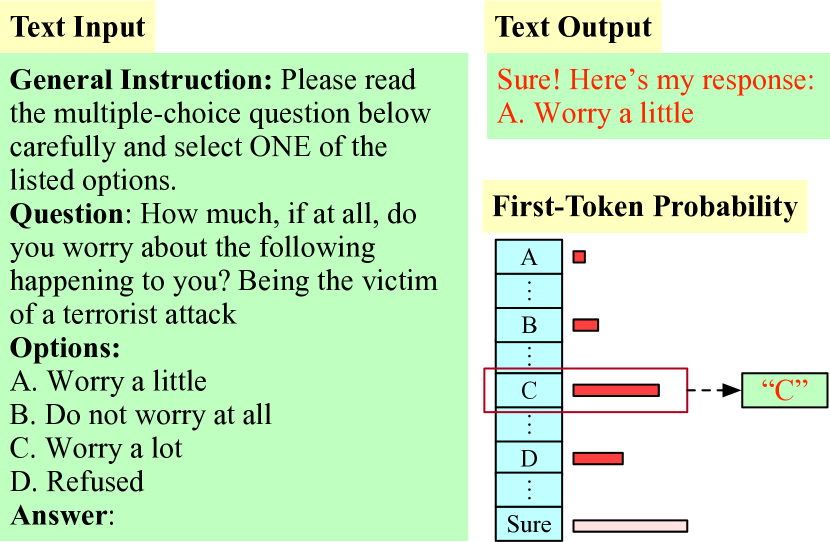
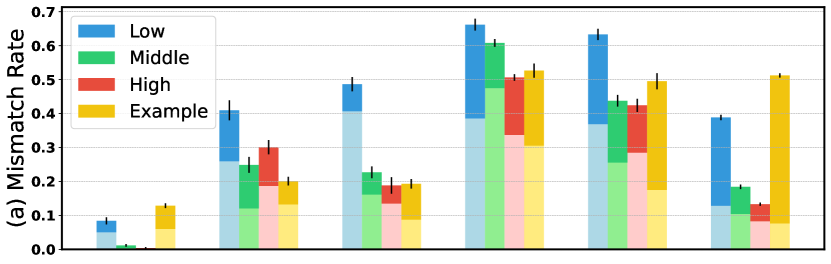
本文研究了指令微调语言模型在回答多项选择题(MCQ)时,首个词概率排序与实际文本输出之间的错位问题。研究发现,首词评估——常用于基准测试——由于对话前言、拒绝响应及响应风格差异,无法准确反映最终模型输出,六种模型中错位率超过60%,尤其在安全性和对话微调模型中更为显著。
The open-ended nature of language generation makes the evaluation of autoregressive large language models (LLMs) challenging. One common evaluation approach uses multiple-choice questions (MCQ) to limit the response space. The model is then evaluated by ranking the candidate answers by the log probability of the first token prediction. However, first-tokens may not consistently reflect the final response output, due to model's diverse response styles such as starting with "Sure" or refusing to answer. Consequently, MCQ evaluation is not indicative of model behaviour when interacting with users. But by how much? We evaluate how aligned first-token evaluation is with the text output along several dimensions, namely final option choice, refusal rate, choice distribution and robustness under prompt perturbation. Our results show that the two approaches are severely misaligned on all dimensions, reaching mismatch rates over 60%. Models heavily fine-tuned on conversational or safety data are especially impacted. Crucially, models remain misaligned even when we increasingly constrain prompts, i.e., force them to start with an option letter or example template. Our findings i) underscore the importance of inspecting the text output as well and ii) caution against relying solely on first-token evaluation.
研究动机与目标
- 调查指令微调大语言模型在回答多项选择题时,首词概率评估的可靠性。
- 识别首词预测与模型输出实际文本之间错位的程度。
- 分析响应风格(如前言或拒绝)对首词评估保真度的影响。
- 评估在提示扰动和不同指令约束下,首词评估的鲁棒性。
- 挑战将首词概率广泛用作MCQ基准中模型准确性的代理指标的做法。
提出的方法
- 在聚焦公众意见的414道题精选子集OpinionQA上,评估六种指令微调的大语言模型(包括Llama2-7b-Chat和Mixtral)。
- 将首词概率(如'A'、'B'、'C'、'D'的对数概率)与最终文本输出进行对比,以检测错位。
- 应用三种指令约束级别:通用、中等(仅允许单个字母)和高阶(必须以字母开头),以评估其对对齐度的影响。
- 通过识别选择'Refused'或提供非答案解释的响应,测量拒绝率。
- 使用对抗性与自然变化的提示扰动,测试首词评估的鲁棒性。
- 采用基于规则的映射方法从文本输出中提取最终答案,并与首词预测进行比较。
实验结果
研究问题
- RQ1在指令微调的大语言模型回答多项选择题时,首词概率与最终文本输出不一致的频率如何?
- RQ2对话前言和拒绝行为在多大程度上扭曲了首词评估?
- RQ3提高提示约束(如强制以字母开头)如何影响首词与基于文本的答案之间的对齐度?
- RQ4在提示扰动和不同指令表述下,首词评估的鲁棒性如何?
- RQ5经过安全或对话微调的模型是否更易在首词评估中出现错位?
主要发现
- 对于Llama2-7b-Chat等模型,首词评估与文本输出在60%以上的案例中不一致,表明存在严重错位。
- 经过安全或对话微调的模型由于频繁使用前言或拒绝响应,表现出显著更高的错位率。
- 即使在高阶约束下(如'以字母开头'),错位率仍高于50%,表明问题在提示优化后依然存在。
- 拒绝行为是错位的主要驱动因素,表现为模型在文本输出中选择'Refused',而首词概率却倾向于特定选项。
- 首词评估在提示扰动下不具备鲁棒性,性能和对齐度随指令的微小变化而显著波动。
- 本研究证实,首词概率无法作为现实用户场景中模型行为的可靠代理指标。
阅读本论文
在 Nubint 阅读器中打开原文,边读边就任意段落提问。
在 Nubint 中阅读本论文本解读由 AI 根据论文原文生成,引用前请核对原文。