
[论文解读] NANOGrav Signal and PBH from the Modified Higgs Inflation
本文研究了在希格斯势中引入高斯型缺口的修正希格斯涨落模型,展示了弯曲扰动增强并能形成原初黑洞(PBHs),并产生可与NANOGrav信号解释相匹配的随机引力波背景,同时在膨胀约束下保持一致。
This study investigates the classical Higgs inflation model with a modified Higgs potential featuring a dip. We examine the implications of this modification on the generation of curvature perturbations, stochastic gravitational wave production, and the potential formation of primordial black holes (PBHs). Unlike the classical model, the modified potential allows for enhanced power spectra and the existence of PBHs within a wide mass range $1.5 imes10^{20}$ g -- $9.72 imes10^{32}$ g. We identify parameter space regions that align with inflationary constraints and have the potential to contribute significantly to the observed dark matter content. Additionally, the study explores the consistency of the obtained parameter space with cosmological constraints and discusses the implications for explaining the observed excess in gravitational wave signals, particularly in the NANOGrav experiment. Overall, this investigation highlights the relevance of the modified Higgs potential in the classical Higgs inflation model, shedding light on the formation of PBHs, the nature of dark matter, and the connection to gravitational wave observations.
研究动机与目标
- Motivate exploring Higgs inflation with a modified potential to simultaneously address inflation, PBH formation, and gravitational waves.
- Show that a Gaussian dip in the potential can enhance the power spectrum at PBH-relevant scales.
- Map the parameter space (A, h0, σ, λ, ξ) yielding both CMB-scale inflation observables and PBH production.
- Compute PBH abundances and their DM implications under cosmological constraints.
- Assess whether the resulting SGWB can account for NANOGrav observations.
提出的方法
- Introduce a Gaussian dip (or bump) term in the Higgs potential and transform to the Einstein frame.
- Derive the modified effective potential U_eff(φ) and corresponding slow-roll parameters (ε, η, N_e) via numerical methods.
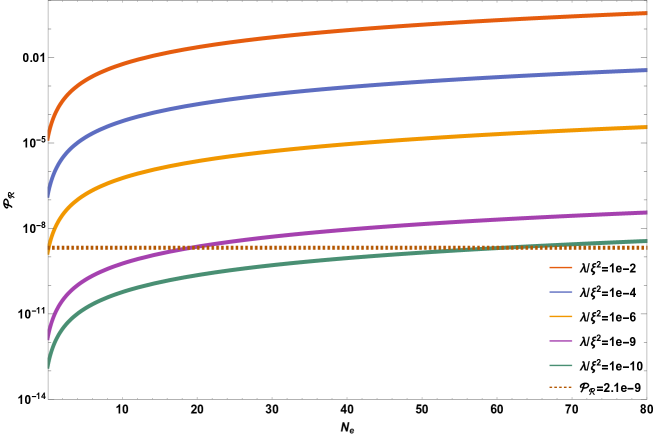
- Calculate the curvature power spectrum P_R(k) for the modified potential and identify regions yielding P_R ≈ 10^-2–10^-3 for PBH formation and P_R ≈ 2.1×10^-9 at CMB scales.
- Use the Press-Schechter-like formalism with a Gaussian perturbation PDF to estimate PBH mass fraction β(M_PBH) and f_PBH, incorporating window functions and formation thresholds.
- Relate PBH masses to the horizon mass and current SGWB via second-order gravitational wave production, computing Ω_GW h^2 across frequencies.
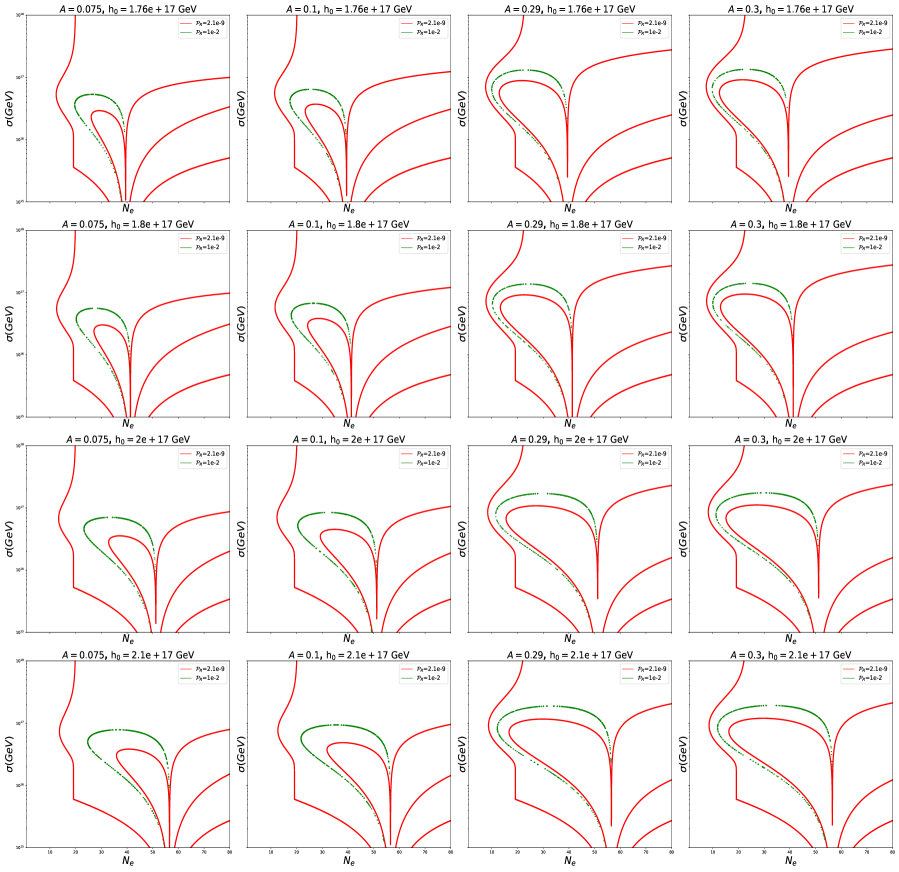
- Perform parameter scans over (A, σ, h0) with fixed λ and ξ to identify viable regions and compare with observational constraints.
实验结果
研究问题
- RQ1Can a Gaussian dip in the Higgs potential produce the required small-scale power boost for PBH formation without spoiling CMB-scale inflationary observables?
- RQ2What regions of the dip parameter space (depth A, position h0, width σ) yield PBHs that can constitute all or part of dark matter while remaining consistent with CMB constraints?
- RQ3Does the resultant stochastic gravitational wave background from second-order effects align with NANOGrav 15-year observations?
- RQ4What is the predicted PBH mass range and corresponding SGWB peak frequencies in this modified Higgs inflation scenario?
主要发现
- A dip in the Higgs potential can generate a power-spectrum peak strong enough for PBH formation during inflation, while preserving CMB-scale inflationary parameters in certain regions.
- PBHs formed span masses from about 1.5×10^20 g to 9.72×10^32 g, with some parameter choices allowing PBHs to make up a substantial fraction or all of dark matter within observational constraints.
- Certain dip configurations (e.g., A ≈ 0.29–0.3, h0 ≈ (1.76–1.8)×10^17 GeV, σ ≈ (1.31–1.40)×10^17 GeV) yield PBH abundances f_PBH consistent with or approaching 100% of dark matter in Regions a–f, while maintaining n_s around 0.95–0.99 and r ~ 0.02–0.03.
- The model predicts a second-order SGWB whose spectrum can reach the sensitivity range of NANOGrav, with region f (dip at h0 ≈ 2.1×10^17 GeV, A ≈ 0.075, σ ≈ 7.83×10^16 GeV) particularly aligned with NANOGrav observations.
- Bump features in the potential generally require more delicate tuning and typically align with PBH formation at later epochs rather than the early PBH window discussed for dips.
- The framework remains broadly consistent with cosmological constraints, offering a cohesive link between PBH dark matter, NANOGrav signals, and inflationary observables.
阅读本论文
在 Nubint 阅读器中打开原文,边读边就任意段落提问。
在 Nubint 中阅读本论文本解读由 AI 根据论文原文生成,引用前请核对原文。